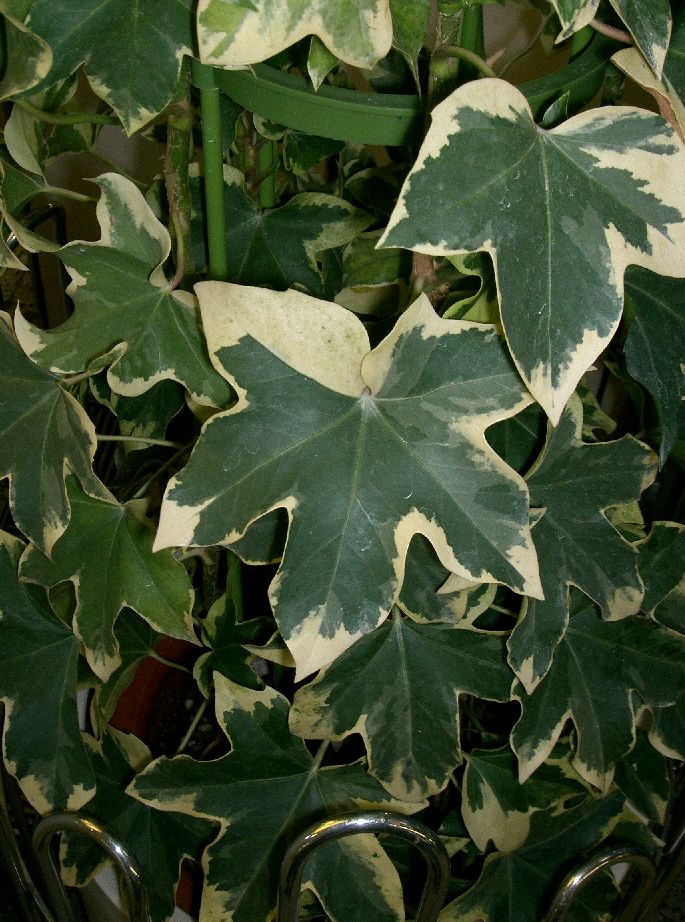
× Fatshedera is a monotypic hybrid genus in the family Araliaceae, containing a single species, × Fatshedera lizei, commonly known as tree ivy or aralia ivy. The × symbol before the name signals its origin as an inter-generic hybrid — a deliberate cross between plants belonging to two separate genera: Fatsia japonica (Japanese fatsia) and Hedera helix (common ivy).
The plant was raised in 1912 at the Lizé Frères nursery in Nantes, France, by crossing Fatsia japonica ‘Moserii’ as the seed parent with Hedera helix as the pollen parent. It was first formally described by Pierre Charles Marie Cochet in 1912 as Aralia × lizei, then transferred to its own hybrid genus by André Guillaumin in 1923 under the name × Fatshedera lizei (Cochet) Guillaumin.
Morphologically, × Fatshedera lizei blends traits from both parents: it has the open, shrubby habit of Fatsia combined with the deeply five-lobed, glossy leaves characteristic of Hedera. As a free-standing shrub it typically reaches about 1.2 m before the relatively weak branches begin to bend under their own weight. When tied to a support it can be trained as a vine reaching 3–4 m, though — unlike true ivy — it does not self-cling. Leaves are 7–25 cm long and wide, on petioles of 5–20 cm. Small yellowish-white flowers, 4–6 mm across, appear in late autumn or early winter, clustered in dense umbels; they are generally sterile and set no fruit. Several cultivars have been selected offering dark green or variously white- and yellow-variegated foliage. × Fatshedera lizei and the cultivars ‘Annemieke’ and ‘Variegata’ have received the Royal Horticultural Society’s Award of Garden Merit.
Etymology
The name × Fatshedera is a portmanteau formed from the names of its two parent genera: Fatsia and Hedera. The species epithet lizei commemorates the Lizé Frères nursery in Nantes, France, where the hybrid was created in 1912.
History
× Fatshedera lizei was deliberately bred in 1912 at the Lizé Frères tree nursery in Nantes, France, by crossing Fatsia japonica ‘Moserii’ (seed parent) with Hedera helix (pollen parent). Pierre Charles Marie Cochet formally described it that same year as Aralia × lizei. In 1923 André Guillaumin erected the hybrid genus × Fatshedera and transferred the species to its current name, × Fatshedera lizei (Cochet) Guillaumin.
Taxonomy Notes
× Fatshedera is an artificial inter-generic hybrid, indicated by the × prefix. Its parentage — Fatsia japonica and Hedera hibernica — places it within the family Araliaceae. The genus is monotypic, containing only the single nothospecies × Fatshedera lizei.
Cultivation
× Fatshedera lizei is grown both as an outdoor garden shrub and as a houseplant. It is valued for its tolerance of shady conditions; indoors it performs best in bright indirect light. Outdoor specimens are hardy to approximately −15 °C. Numerous cultivars exist with dark green, white-variegated, or yellow-variegated leaves. × Fatshedera lizei and the cultivars ‘Annemieke’ and ‘Variegata’ hold the Royal Horticultural Society’s Award of Garden Merit.










