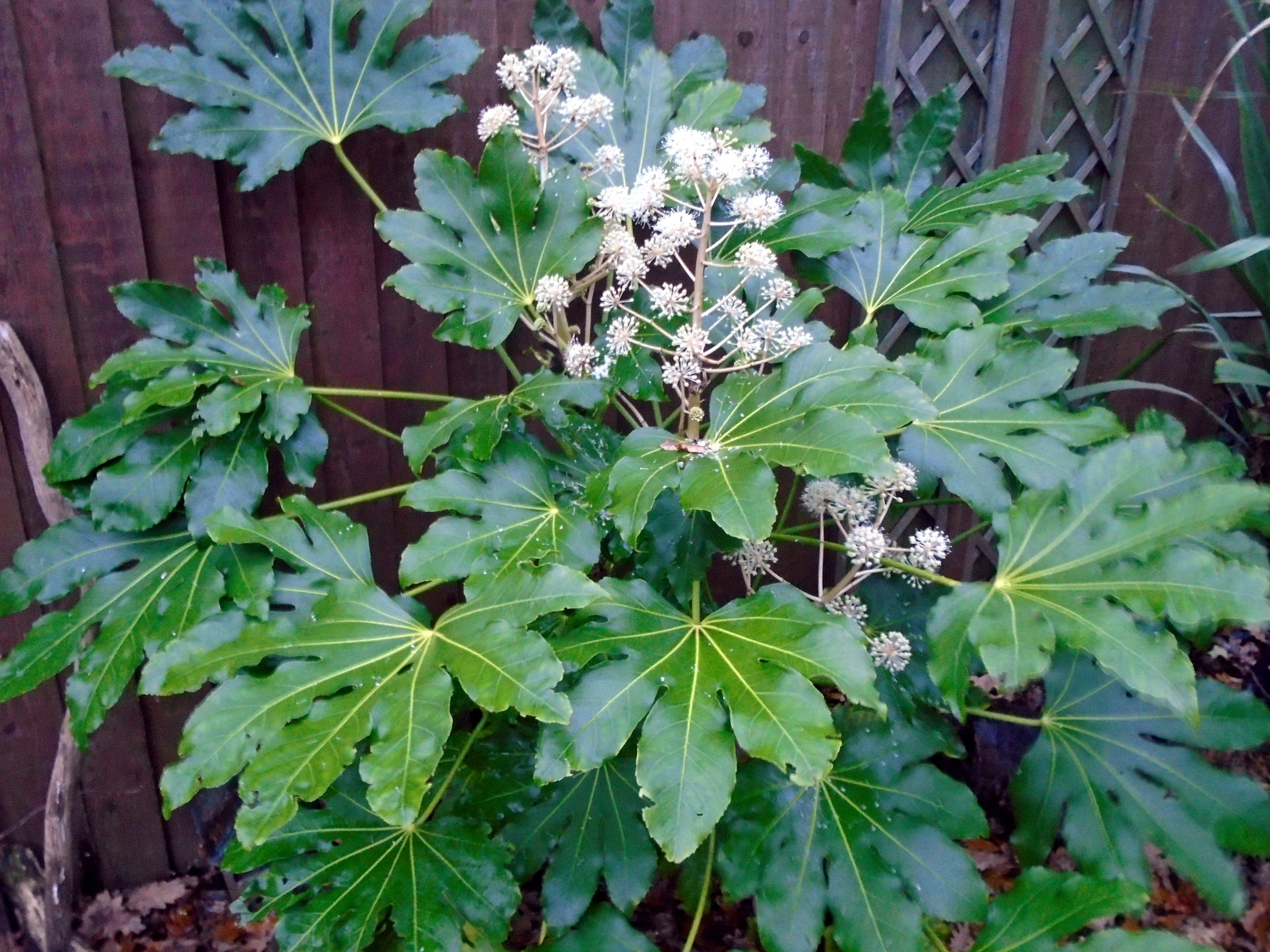
Fatsia is a small genus of three species of evergreen shrubs in the family Araliaceae (order Apiales), native to Korea, southern Japan, and Taiwan. Plants in this genus are recognised by their stout, sparsely branched stems and large, leathery, palmately lobed leaves that typically reach 20–50 cm across, held on long petioles of up to 50 cm. In late autumn to early winter the plants produce small creamy-white flowers arranged in dense terminal compound umbels, followed by small black fruit.
The genus was formerly treated as part of the related genus Aralia, but is now maintained as a distinct group within Araliaceae. Plants of the World Online (as of February 2026) accepts three species: Fatsia japonica, Fatsia polycarpa, and Fatsia oligocarpella. A well-known sterile hybrid, × Fatshedera lizei, arose from a cross between Fatsia japonica and Hedera hibernica and is grown in cultivation across western Europe in both plain green and variegated forms. Some species once placed in Fatsia have since been transferred to other genera: Fatsia papyrifera is now Tetrapanax papyrifer, and Fatsia horrida is now Oplopanax horridus.
Fatsia japonica (Japanese aralia) is by far the most widely cultivated species, valued as a bold architectural foliage plant in temperate gardens and as an indoor specimen in cooler climates.
Distribution
Fatsia is native to East Asia, with its natural range spanning Korea, southern Japan, and Taiwan. The genus is found in forest understory and coastal habitats within these regions.
Taxonomy Notes
Fatsia belongs to the family Araliaceae (order Apiales) and was formerly treated as part of the broader genus Aralia. Two species once placed here have been moved to other genera: Fatsia papyrifera is now recognised as Tetrapanax papyrifer, and Fatsia horrida as Oplopanax horridus. The genus is also closely related to Hedera (ivy), as demonstrated by the artificial hybrid × Fatshedera lizei.
Cultivation
Fatsia japonica is the most commonly cultivated species and is widely grown as an ornamental in temperate gardens for its large, glossy, palmately lobed leaves. It tolerates shade and is also popular as an indoor foliage plant. A sterile hybrid, × Fatshedera lizei (Fatsia japonica × Hedera hibernica), is grown in western Europe in both plain green and variegated forms.










