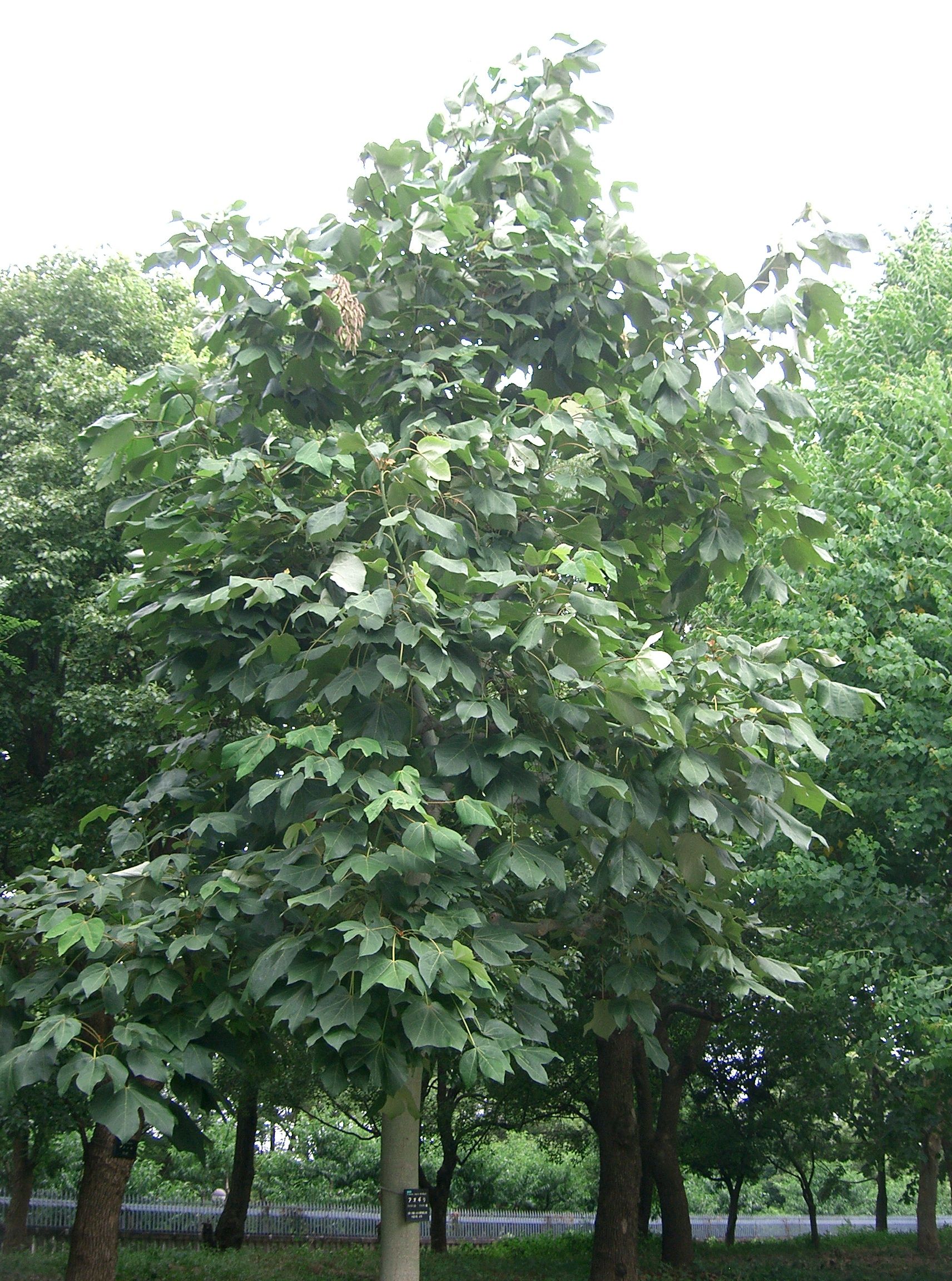
Firmiana is a genus of about 18 species of flowering trees and shrubs in the family Malvaceae (order Malvales), native to tropical and temperate regions of south, southeast, and eastern Asia, extending to New Guinea and the southwest Pacific. The genus was formerly placed in the now-defunct family Sterculiaceae before molecular studies consolidated it into Malvaceae. Members of Firmiana are sometimes collectively called "parasol trees," a name most closely associated with the best-known species, Firmiana simplex (Chinese parasol tree or wutong).
The most distinctive feature of the genus is the unusual development of its fruit. Shortly after pollination, the five carpels separate and unfold into flat, leaf-like structures that turn green, each carrying up to four seeds attached along its margins and fully exposed to the air — an arrangement unlike most other members of Malvaceae.
The approximately 18 accepted species range from the Indian subcontinent and mainland Southeast Asia through southern China to the Pacific island groups. Notable members include Firmiana simplex, long cultivated in East Asia as an ornamental and holding deep cultural significance in Chinese literature and art; Firmiana colorata, native to tropical Asia; and Firmiana kerrii, found in Thailand and neighbouring countries.
The genus name honours Karl Joseph von Firmian (1716–1782), Austrian diplomat and patron of the arts, governor-general of Lombardy under Habsburg rule.
Etymology
The genus name Firmiana honours Karl Joseph von Firmian (1716–1782), an Austrian statesman and patron of the arts who served as governor-general of Austrian Lombardy. The common name "parasol tree" refers to the broad, palmate leaves characteristic of several species in the genus.
Distribution
Firmiana is native to tropical and temperate south, southeast, and eastern Asia, with its range extending from the Indian subcontinent and mainland Southeast Asia through southern China to New Guinea and the southwest Pacific islands. Individual species occupy a range of habitats from lowland tropical forests to temperate woodlands in subtropical China.
Taxonomy Notes
Firmiana was formerly placed in the family Sterculiaceae, which is now treated as a synonym of Malvaceae under modern molecular phylogenetic classifications. Within Malvaceae the genus belongs to subfamily Sterculioideae. Plants of the World Online currently accepts 18 species. The genus is placed in order Malvales, class Magnoliopsida.
Cultural Uses
Firmiana simplex (wutong) has been cultivated in China for thousands of years and holds a prominent place in Chinese poetry, painting, and folklore. The tree is traditionally associated with the Chinese phoenix (fenghuang), which was said to alight only on wutong. Its lightweight, straight-grained timber has historically been used in the construction of musical instruments, including the guqin (Chinese zither).

