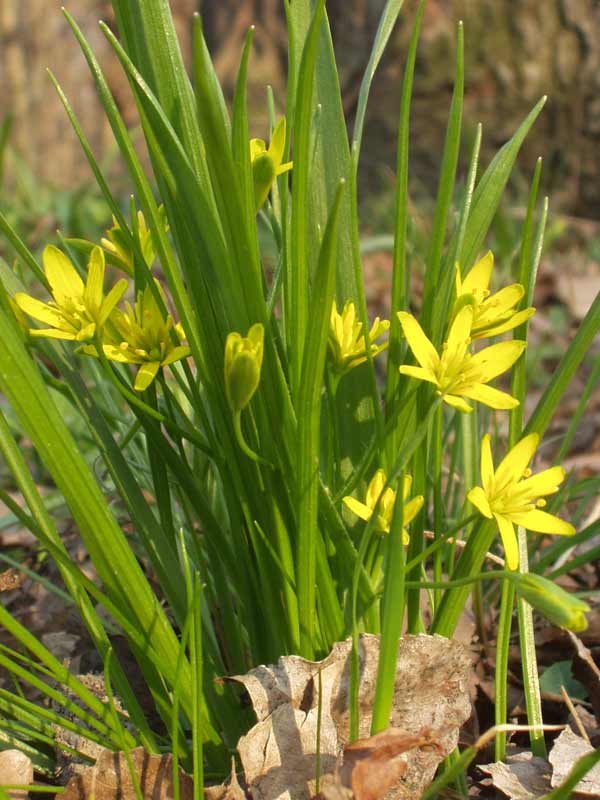
Gagea Salisb. is a genus of around 229 accepted species of bulbous geophytes in the family Liliaceae, described by Richard Anthony Salisbury in 1806. Collectively called yellow star-of-Bethlehem, the plants are named in honour of the English naturalist Sir Thomas Gage (1781–1820). The genus is distributed across subarctic and temperate Eurasia from the Atlantic coast to Japan, extending south into North Africa and the Mediterranean, with a separate foothold in subarctic and subalpine North America represented by a single native species, Gagea serotina.
Plants produce modest bulbs from which narrow, mostly basal leaves emerge in late winter or early spring. The six-tepalled flowers are yellow, star-shaped, and persistent on the tepals after anthesis. Most species behave as spring ephemerals, completing their entire above-ground life cycle in a few weeks before the forest canopy closes or dry-season heat arrives. Plant height is low — typically around 0.2 m — and the bulbs allow the plant to overwinter even in soils reaching -10 °C.
Reproduction varies across the genus. Many species rely on insect pollination, but asexual bulbil production is widespread, and certain species such as G. spathacea — a nonaploid of Central Europe — have abandoned seed-based reproduction almost entirely, spreading clonally across large geographic areas with little genetic variation. Polyploidy and hybridization are recurring forces in Gagea speciation, making species boundaries in some complexes difficult to resolve and contributing to ongoing taxonomic revision. Former segregate genera including Lloydia, Hornungia, Bulbillaria, and Upoxis are now treated as synonyms of Gagea.
In Switzerland, six species are documented: G. fragifera, G. lutea, G. minima, G. pratensis, G. saxatilis, and G. villosa. The bulbs of G. lutea are recorded as a historical famine food, edible raw or cooked, though of low culinary value.
Etymology
The genus name Gagea was coined by Richard Anthony Salisbury in 1806, honouring the English botanist and naturalist Sir Thomas Gage (1781–1820). The popular common name "yellow star-of-Bethlehem" reflects both the characteristically yellow, star-shaped flowers and the genus's historical classification within Ornithogalum, whose white-flowered members share the common name "star-of-Bethlehem."
Distribution
Gagea has its centre of diversity in temperate and subarctic Eurasia, ranging from western Europe and Scandinavia eastward through Central Asia, the Himalayas, and China to Japan, with a southern arm reaching North Africa and the Mediterranean basin, including mountain ranges across the Middle East and Afghanistan. The genus is predominantly Old World: POWO lists 229 accepted species with a native range described as "subarctic and temperate Eurasia to N. Africa, subarctic and subalpine North America." The single North American representative, G. serotina, occurs in high-altitude alpine habitats. In Europe, the genus is particularly species-rich in the Caucasus region and Central Asian steppes. Six species are documented in Switzerland alone (G. fragifera, G. lutea, G. minima, G. pratensis, G. saxatilis, G. villosa), while G. lutea ranges from Britain and Scandinavia south to Spain and east to Japan.
Ecology
Gagea species are geophytes — they store energy in underground bulbs that allow survival through cold winters and dry summers. The majority are spring ephemerals that emerge, flower, and set seed (or produce bulbils) within a brief window in early spring, often completing their above-ground growth before the tree canopy leafs out or before summer drought begins. Habitats include damp deciduous woodlands, meadows and pastures on basic soils, rocky slopes, steppes, and alpine turf. Gagea lutea, for example, favours moist woodland and pasture on alkaline to neutral soils and tolerates full sun to semi-shade.
Pollination is primarily by insects, but the genus also employs asexual reproduction via bulbils. Some species such as G. bulbifera are notable bulbil producers, while G. spathacea appears to rely on clonal bulbil spread almost exclusively, resulting in genetically uniform populations across Central Europe despite wide geographic separation. Amphistomatic stomata (occurring on both leaf surfaces) and trichomes (dendroid or glandular in some species) are additional morphological features of note.
Cultivation
Gagea plants are not widely cultivated ornamentals, though individual species (especially G. lutea) appear occasionally in naturalistic or woodland garden settings. They prefer moist, well-drained soils with alkaline to neutral pH and perform well in both sunny and semi-shaded positions. Dormant bulbs are cold-hardy, tolerating soil temperatures of at least -10 °C, and are suited to USDA hardiness zones 5–9. No specific toxicity is recorded for the genus.
Cultural uses
The bulbs and young leaves of Gagea lutea are recorded as edible — bulbs may be eaten raw or cooked, and the young leaves are edible when cooked. However, the plant rates low in culinary value and is classified in ethnobotanical literature as a famine food, resorted to only in times of food scarcity.
Taxonomy notes
Gagea was formally described by Richard Anthony Salisbury in Annals of Botany (König & Sims) 2: 555 (1806), where it was placed in Liliaceae. The genus is accepted in GBIF (usageKey 2751406) and POWO (IPNI LSID urn:lsid:ipni.org:names:24276-1) with the authorship Gagea Salisb. POWO recognises 229 accepted species; GBIF records approximately 358 descendant taxa (including infraspecific ranks). The discrepancy reflects differing treatments of subspecies and varieties.
The genus absorbs several historical segregates: Lloydia, Hornungia, Bulbillaria, and Upoxis are now treated as heterotypic synonyms (16 synonyms total in POWO). The transfer of Gagea delavayi from Lloydia in 2022 exemplifies ongoing revision. Polyploidy and hybridization are major drivers of diversification, complicating species delimitation in many complexes — G. spathacea (nonaploid, 2n=54) is a textbook example of allopolyploid origin followed by clonal fixation.
Propagation
Propagation is by seed or bulb division. Seed should be sown in spring under glass; seedlings are best left in their pots for two to three years before planting out, as they resent disturbance. Many species also produce bulbils naturally; these can be separated and grown on to flowering size. Bulb division is carried out after the foliage has died down in summer.










