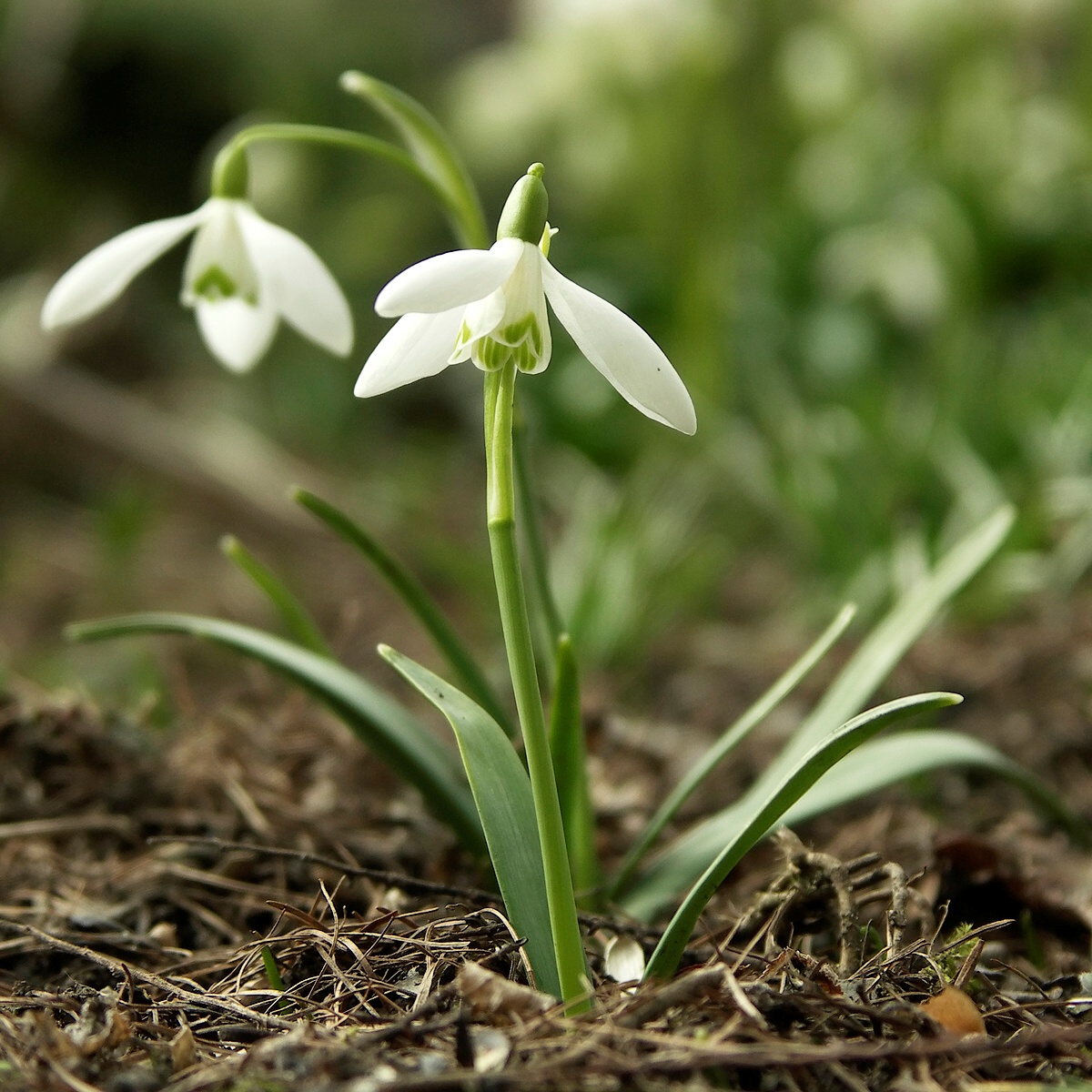
Galanthus, commonly known as snowdrops, is a small genus of approximately 20 species of bulbous perennial herbaceous plants in the family Amaryllidaceae, order Asparagales. Each plant produces two narrow linear leaves and a single nodding, bell-shaped white flower composed of six petaloid tepals arranged in two whorls: three larger outer tepals and three smaller inner ones, the latter marked with distinctive green patches.
Most species bloom in late winter, before the vernal equinox, making snowdrops among the earliest flowering bulbs of the year. A handful of forms flower in early spring or late autumn. In colder climates the shoots can push up through snow, aided by an enzyme that inhibits ice-crystal formation on the plant tissues.
The genus is native to Europe and the Middle East, from the Pyrenees in the west through to the Caucasus and Iran in the east, and south to Sicily, the Aegean, Turkey, Lebanon, and Syria. Galanthus nivalis, the common snowdrop, is the most widespread species and has been widely naturalised across Europe, North America, and beyond. The majority of species originate from the eastern Mediterranean and Caucasus region; Galanthus fosteri, for example, is native to Jordan, Lebanon, Syria, and Turkey.
The genus was formally named in 1753. Early attempts to divide the species into subgroups relied on patterns of leaf vernation, but molecular phylogenetics has shown this character to be unreliable. Seven molecularly defined clades are now recognised, broadly reflecting the biogeographical distribution of the species, and new species continue to be described.
Snowdrops are popular ornamental bulbs and are subject to significant international trade. All Galanthus species are listed under CITES, and international trade requires a permit. Several species appear on the IUCN Red List; G. trojanus is critically endangered and G. panjutinii is endangered, while G. nivalis is near threatened with declining populations across much of its range.
Etymology
The genus name Galanthus derives from the Ancient Greek γάλα (gala, “milk”) and ἄνθος (anthos, “flower”), alluding to the milk-white colour of the blooms. The common name “snowdrop” is thought to come from the German Schneetropfen, the teardrop-shaped pearl earrings fashionable in the sixteenth and seventeenth centuries. Older English names include Candlemas bells, Fair maids of February, and White ladies.
Distribution
Galanthus is native to a broad arc from the Pyrenees in the west to the Caucasus and Iran in the east, and south through the Mediterranean to Sicily, Turkey, Lebanon, and Syria. Most species inhabit woodland, growing in acid or alkaline soils, though some occur in grassland or at altitude. Galanthus nivalis has been widely introduced and naturalised across Europe and North America, and several other ornamental species have similarly spread beyond their native ranges.
Ecology
Snowdrops are hardy geophytes that perennate via underground bulbs and are among the first bulbs to emerge each year, often flowering through snow. An enzyme coating inhibits ice-crystal formation on plant tissues. After flowering, the foliage dies back within a few weeks. Populations spread by bulb offsets, seed dispersal, animal disturbance, and, occasionally, flooding. Naturalised drifts, often found near former monastic sites or human habitation, are frequently sterile clonal colonies.
Cultivation
Galanthus species and cultivars are among the most widely traded ornamental bulb genera in the world. Millions of bulbs are exported annually from Turkey and Georgia under CITES-regulated quotas. Snowdrops are valued as early-season garden plants and are grown in woodland and shade gardens across temperate regions. The hobby of collecting and breeding named cultivars (known as galanthophilia) has driven substantial horticultural interest and premium pricing for rare forms.
Conservation
All Galanthus species are listed under CITES Appendix II; international trade in any quantity — bulbs, live plants, or dead material — requires a CITES permit. A limited regulated trade in wild-collected bulbs of G. nivalis, G. elwesii, and G. woronowii from Turkey and Georgia is permitted. Several species are on the IUCN Red List: G. trojanus is critically endangered, G. panjutinii is endangered, four species are vulnerable, and G. nivalis is near threatened. Habitat destruction, illegal wild collection, and climate change are the primary threats. One of five known sites of G. panjutinii at Sochi was destroyed by construction for the 2014 Winter Olympics.
History
Snowdrops have been known and used since antiquity under various names. The genus was formally described and named Galanthus by Linnaeus in 1753. In 1983, researchers suggested that the mysterious herb moly described in Homer's Odyssey may have been a snowdrop, noting that the alkaloid galantamine — present in snowdrops — is an acetylcholinesterase inhibitor and could have acted as an antidote to the poisons described in the text. This hypothesis is supported by a fourth-century BC reference in Theophrastus's Historia Plantarum. Galantamine derived from snowdrops has since been investigated for treatment of Alzheimer's disease.










