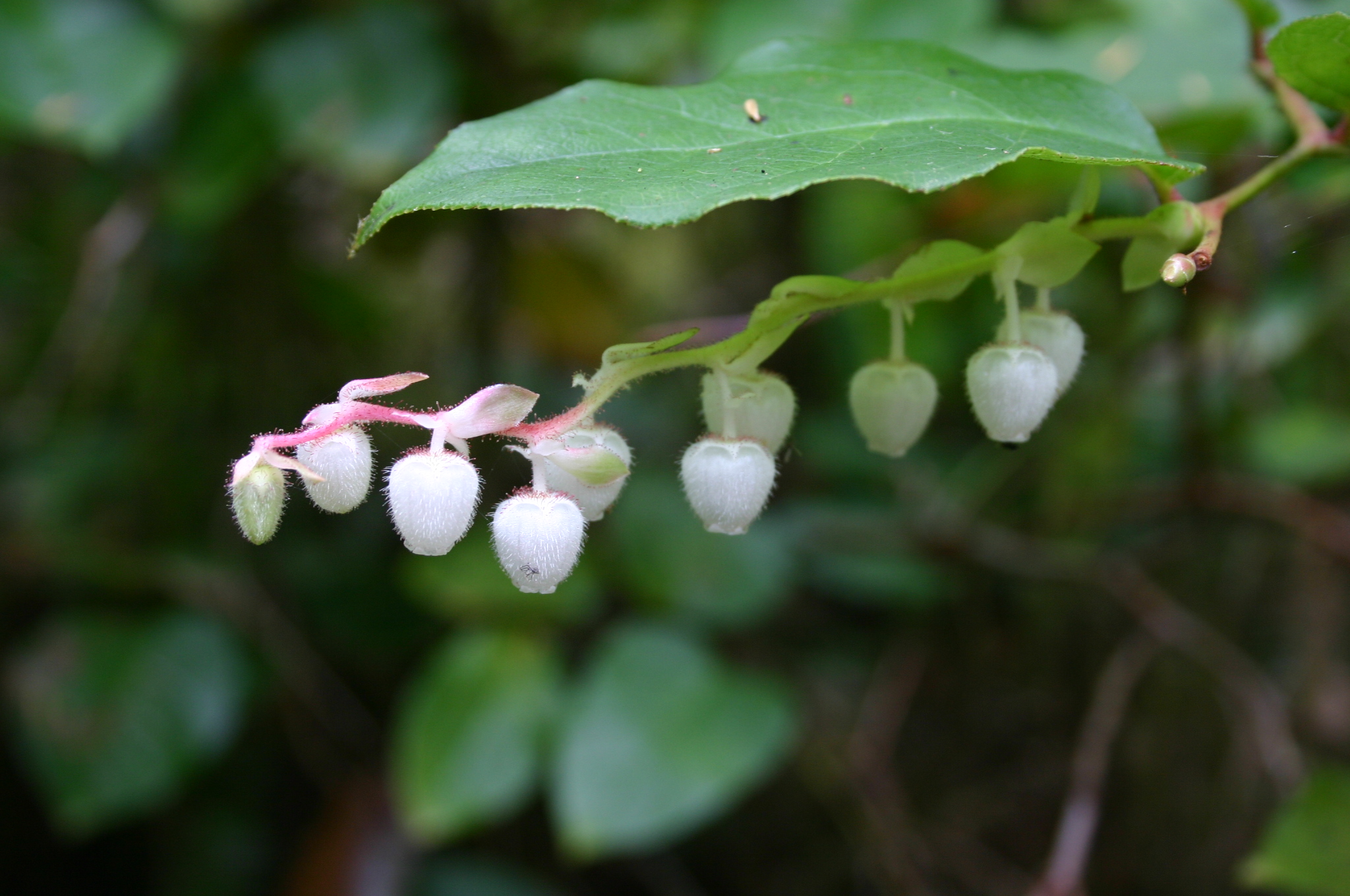
Gaultheria is a genus of approximately 135–283 evergreen shrubs in the heath family (Ericaceae), placed in subfamily Vaccinioideae, tribe Gaultherieae. The wide species count reflects ongoing taxonomic revision following the absorption of the formerly separate genus Pernettya — genetic studies found insufficient differences to maintain the two genera apart. GBIF currently recognises 433 descendant taxa under the accepted name Gaultheria Kalm ex L., first published in Amoenitates Academicae (1756).
Plants range dramatically in size, from prostrate ground-hugging shrubs barely 8–10 cm tall to erect shrubs or small trees reaching 5–6 m. The leaves are simple, alternate, and leathery, typically elliptical to lanceolate and 1–4 inches long, remaining evergreen year-round. Flowers are characteristically urn- or bell-shaped, borne in racemes or solitary, appearing in summer in white, pink, or red. Fruits are fleshy false berries or dry capsules in white, pink, red, or near-black, persisting into fall and winter and providing ornamental interest as well as food for birds.
The genus name commemorates Jean François Gaultier (1708–1756), a physician and botanist in Quebec; Pehr Kalm proposed the name during his North American travels and Carl Linnaeus formally adopted it.
Etymology
The genus name Gaultheria honours Jean François Gaultier, an eighteenth-century French-Canadian physician and botanist based in Quebec. The botanist Pehr Kalm proposed the name during his 1748 North American expedition, and Carl Linnaeus formally adopted it in his Species Plantarum (1753), with the genus authorship cited as Kalm ex L. (published in Amoenitates Academicae 3: 14, 1756). Common names in English include wintergreen and, in North America, snowberry.
Distribution
Gaultheria has a remarkably wide and disjunct natural distribution spanning four continents. Species are native to North America (from the Atlantic coast to the Pacific Northwest, and extending into northern Canada), Central and South America (including Chile, Argentina, and Andean regions), Asia (the Himalayas, Japan, Borneo, Sumatra, and mainland Southeast Asia), and Australasia (New Zealand and Australia). This wide, disjunct pattern is shared with other Ericaceae genera and reflects ancient long-distance dispersal events. Within North America, ITIS recognises seven native species, while the global tally of accepted taxa reaches several hundred.
Taxonomy
Gaultheria belongs to family Ericaceae, subfamily Vaccinioideae, tribe Gaultherieae, within order Ericales. The most significant modern change to genus circumscription was the merger of Pernettya Gaudich. — a genus of Southern Hemisphere species — into Gaultheria. Molecular phylogenetic studies showed Pernettya was nested within Gaultheria and that no clear morphological boundary distinguished the two, leading to synonymisation. GBIF records several additional synonymised genera, including Amphicalyx Blume, Brossaea L., Chiogenes Salisb. ex Torr., Diplycosia Blume, and Tepuia Camp. Two nothogenera (hybrid genera) are also registered: ×Gaulnettya Marchant and ×Gaulthettya Camp. The type species is Gaultheria procumbens L.
Ecology
Gaultheria species are primarily shade-tolerant understory shrubs, thriving in moist, peaty, humus-rich soils in woodland, heath, and subalpine settings. They require acid soil (pH typically below 6.0) and tolerate occasionally boggy conditions, making them well suited to the damp, acidic forest floors of temperate rainforests and heath communities. The fleshy berries are eaten by birds, supporting songbird populations, while the dense, low-growing habit of many species provides useful ground cover. Plants are pollinated by insects attracted to the pendant, bell-shaped flowers. Gaultheria is notably resistant to honey fungus, an advantage in woodland gardens. The fruits, leaves, and sap of some species contain andromedotoxin (grayanotoxin), which has low-severity toxicity in some mammals.
Cultivation
Most Gaultheria species perform best in partial to deep shade, though some tolerate partial sun. A moist, humus-rich, peaty, and lime-free (acid) soil is essential; clay or compacted soils are unsuitable, but boggy conditions are tolerated by certain species. USDA hardiness zones span roughly 4a–10b across the genus, reflecting the wide altitudinal and latitudinal range of species. Smaller species make excellent rock garden or ground-cover plants, while taller forms suit woodland edges, naturalised areas, shade gardens, and pond borders. G. mucronata and G. shallon are among the most widely grown ornamental species in temperate gardens. Plants are notably resistant to honey fungus.
Propagation
Gaultheria can be propagated by seed, stem cuttings, division, or layering. Seeds require cold stratification — typically 4–10 weeks of pre-chilling — before they will germinate. Semi-ripe stem cuttings, 3–6 cm long, are taken in July or August and rooted under cover. Division is carried out in spring, before new growth begins, and is particularly effective for mat-forming, suckering species. Layering of low-growing stems is also viable where plants are accessible.
Cultural Uses
Several Gaultheria species have important ethnobotanical and economic uses. Gaultheria procumbens (eastern teaberry or American wintergreen) is the traditional source of natural wintergreen flavouring; oil of wintergreen (methyl salicylate) was historically distilled from its leaves and is used in food, confectionery, and topical analgesics. Gaultheria shallon (salal) produces edible berries that Indigenous peoples of the Pacific Northwest ate fresh and dried, and the fruit is still used for jelly-making. Most Gaultheria species produce berries that can be eaten raw or cooked. Gaultheria leucocarpa is used in Chinese herbal medicine for its anti-inflammatory properties, and the genus has a broader history of use in traditional medicine across its range for conditions such as arthritis and rheumatic complaints.










