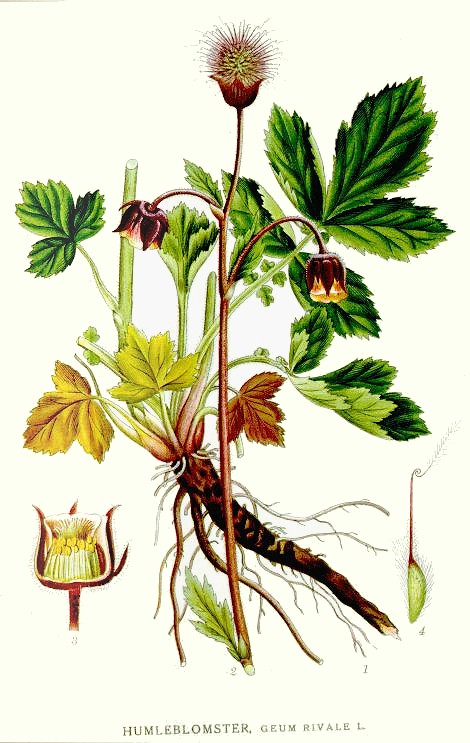
Geum, commonly known as avens, is a genus of approximately 50 species of rhizomatous perennial herbaceous plants in the rose family (Rosaceae), published by Carl Linnaeus in Species Plantarum in 1753. Plants typically grow 10–120 cm tall in a mounding habit, with basal leaves that are pinnate or pseudopinnate and often persist through winter. Stem leaves are smaller, sometimes trifoliolate or simple. Stems are glabrous or hairy, usually numbering 1–5 per plant.
Flowers are borne in terminal open cymes and measure 4–46 mm in diameter, with orbicular to obovate petals in yellow, white, or red — colors that call to mind small roses. Stamens are numerous (10–120) and carpels range from 20–250. The fruit is a cluster of achenes, each 2–4.5 mm long, with a long, hooked beak that facilitates dispersal by catching on animal fur and clothing.
The genus has an exceptionally wide distribution, spanning temperate and arctic-alpine regions across Europe, Asia, Africa, both Americas, Pacific Islands, Australia, and New Zealand. It is most species-rich in the Northern Hemisphere. Plants favor cooler climates and moist, well-drained soils, and are reasonably tolerant of dry conditions, though they are vulnerable to wet winter soils. In gardens, Geum thrives in USDA zones 3–7, performing best in full sun to partial shade.
Ecologically, Geum species support diverse invertebrate communities: G. urbanum serves as a larval host for the grizzled skipper butterfly (Pyrgus malvae), and the early-flowering species are valuable nectar sources for overwintering bumblebee queens. Various rust fungi and ascomycetes are known to colonize different species within the genus.
Geum has a long history of human use. Roots of several species, particularly G. urbanum, are astringent and clove-scented due to high tannin content, and were traditionally used as anti-inflammatory, antiseptic, diuretic, and astringent remedies. Contemporary phytochemical research confirms antimicrobial, antioxidant, cardioprotective, and antiviral properties. Young leaves of some species are edible when cooked. Ornamentally, Geum cultivars are valued as reliable garden perennials, with named selections such as 'Mrs J. Bradshaw' having received the Royal Horticultural Society's Award of Garden Merit.
Etymology
The genus name Geum is believed to derive from the Greek words geyo or geno, meaning "to give off a pleasant scent." This is a reference to the characteristic fragrance of the roots of several species — most notably Geum urbanum — which smell like cloves when freshly crushed. The genus was first described under the name Caryophyllata by Swiss botanist Gaspard Bauhin in 1623. Carl Linnaeus established the current name Geum in his landmark Species Plantarum of 1753, where it appeared at page 500 of the first volume.
Distribution
Geum has an exceptionally broad global distribution, occurring in temperate and arctic-alpine regions across all major land masses. In Europe, it is recorded across the continent from Iceland and the Faroe Islands south through Scandinavia, the British Isles, Central Europe, the Mediterranean basin (France, Italy, Greece, Cyprus), and into the Balkans. Asian occurrences span the Caucasus, the Middle East (Afghanistan, Iran, Iraq, Lebanon-Syria), Central Asia (Kazakhstan, Kyrgyzstan), Siberia (Altai, Amur, Kamchatka), East Asia (China, Japan, Korea, Mongolia, Kuril Islands), and the Himalayas. In North America the genus is represented from Alaska and Greenland south through Canada and the contiguous United States. South American records include Argentina, Bolivia, Brazil, Chile, Colombia, and Ecuador. In Africa, Geum is known from North Africa (Algeria, Morocco) and from the high-altitude regions of southern Africa (South Africa's Cape Provinces, Free State, KwaZulu-Natal, and Lesotho). The genus also reaches Australasia and Pacific islands.
In Switzerland specifically, four species are documented: G. montanum (alpine meadows), G. reptans (high alpine), G. rivale (wetlands), and G. urbanum (woodlands), along with their natural hybrid G. rivale × urbanum.
Ecology
Geum species occupy a wide range of habitats within their temperate and alpine range. They prefer cooler climates and moist, well-drained soils, though many species tolerate periodic drought; wet winter conditions can be lethal. Habitats range from lowland thickets and woodland margins (G. urbanum) to streamside and wetland settings (G. rivale), montane meadows (G. montanum), and exposed high-alpine rocky terrain (G. reptans).
Geum supports diverse invertebrate communities: G. urbanum is a confirmed larval host plant for the grizzled skipper butterfly (Pyrgus malvae), and early-blooming species provide critical nectar for overwintered bumblebee queens before other plants come into flower. Plants are generally deer-resistant and serve as hosts for various Lepidoptera. Several rust fungi and ascomycetes are known to colonize the foliage of various species.
Cultivation
Geum cultivars are valued as low-maintenance garden perennials, typically growing 9–45 cm tall, with colorful 5-petaled flowers that resemble small roses. They perform best in full sun to partial shade; in warmer climates — particularly the humid southeastern United States — summer heat and humidity can cause dieback. A moist, well-drained soil enriched with organic matter is ideal (neutral to slightly alkaline pH suits most species), but plants tolerate dry conditions once established. Wet winter soils are a common cause of loss.
USDA hardiness zones vary by species: many tolerate zones 3–7 broadly, while common horticultural selections cluster around 5a–7b. Yearly division maintains plant vigor and flowering performance. Deadheading extends the bloom period; leaving spent flowers in place showcases the ornamental, fluffy seed plumes of species such as G. triflorum. Suitable applications include borders, mass plantings, cottage and English gardens, rock gardens, and post-bloom groundcover. The cultivar 'Mrs J. Bradshaw' has received the Royal Horticultural Society's Award of Garden Merit.
Propagation
Geum is propagated by seed or by division. Seeds can be sown in spring or autumn; germination is generally straightforward under cool conditions. Division is the preferred method for maintaining named cultivars true to type and for rejuvenating older clumps. Annual division sustains vigor and flowering performance for cultivars; for unselected plants, division every three to four years is sufficient.
Cultural Uses
Several Geum species have a long history of medicinal and limited culinary use. The roots — particularly those of G. urbanum — are astringent, diaphoretic, and febrifuge, and have been used in traditional decoctions to treat diarrhea, fevers, childhood coughs, dental pain, and sore throats. Externally, preparations were applied to sores, wounds, and skin diseases. Contemporary phytochemical studies confirm that the high tannin content of Geum roots is associated with anti-inflammatory, antioxidant, antimicrobial, cardioprotective, and antiviral activities. Culinary use is minor: young leaves of some species are edible when cooked in spring.
History
The genus Geum was formally established by Carl Linnaeus in Species Plantarum (1753), building on earlier work by Swiss botanist Gaspard Bauhin, who had described the plants as Caryophyllata in 1623. The synonym Sieversia reflects a historical alternative classification for several species later consolidated into Geum. Molecular phylogenetic research by Smedmark et al. (2003) proposed a broader circumscription of Geum sensu lato, encompassing all herbaceous perennials with a basal-leaf rosette in the tribe Colurieae of the Rosaceae.
Taxonomy Notes
Geum belongs to the family Rosaceae, order Rosales, and is placed in the tribe Colurieae. Linnaeus published the genus in 1753 (Sp. Pl. 1: 500). GBIF recognizes 256 descendant taxa under the accepted name Geum L., with approximately 50 species commonly recognized in modern floras. The historical synonym Sieversia is sometimes encountered in older literature for species now assigned to Geum. Modern molecular work (Smedmark et al. 2003) supports a broad circumscription treating the entire rosette-forming, herbaceous branch of tribe Colurieae as a single genus.










