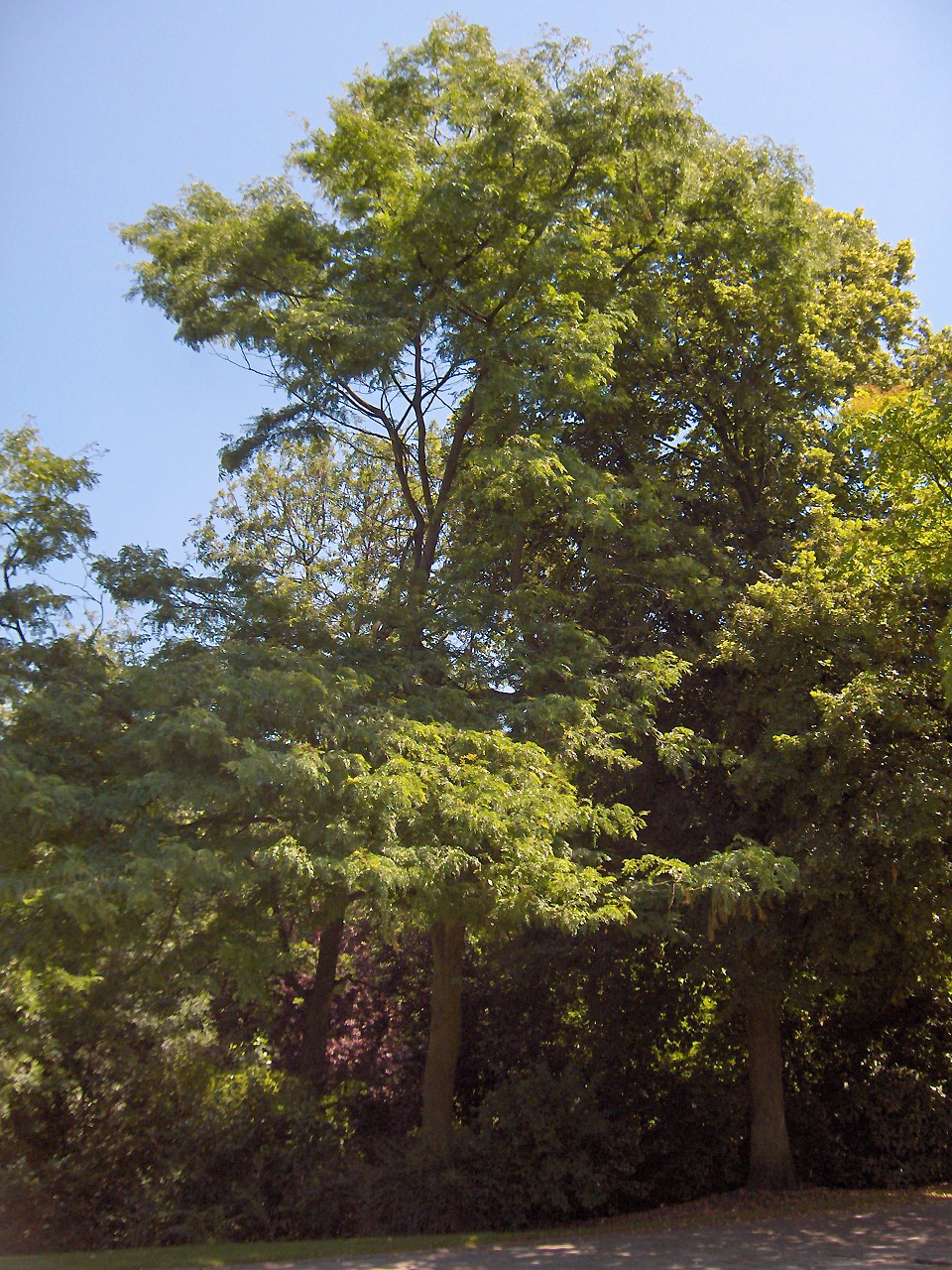
Gleditsia, commonly known as honey locusts, is a genus of about 12 species of deciduous trees in the family Fabaceae (subfamily Caesalpinioideae). The genus has a disjunct natural range spanning East Asia, the eastern coast of North America, and South America, with isolated populations around the Caspian Sea and in northeastern India. Most species are armed with stout, often branched thorns on the trunk and branches, a distinctive feature of the group; the sole exception is Gleditsia microphylla, which is also the only herbaceous member.
Honey locusts are members of the legume family, but their ability to fix atmospheric nitrogen — a trait common to many legumes — is disputed in the scientific literature. The species vary widely in habitat, from the floodplain forests favored by the North American G. aquatica (swamp locust) and G. triacanthos (thorny honey locust) to the dry subtropical forests of G. caspica in the Caucasus region.
Phylogenetic analyses place G. amorphoides from South America as the most basal species, most closely related to the Chinese G. sinensis, rather than to the North American species. The genus's closest relative is Gymnocladus (Kentucky coffeetree and allies), which shares a similar trans-Pacific biogeographic history. Fossil evidence from Europe indicates Gleditsia once had a far broader range.
Gleditsia triacanthos (thorny honey locust) is the best-known member, widely planted as a shade and street tree across temperate regions, particularly in thornless cultivated forms. Gleditsia sinensis (Chinese honey locust) holds a prominent place in traditional medicine as one of the 50 fundamental herbs of Chinese herbology.
Etymology
The genus name Gleditsia was coined to honor Johann Gottlieb Gleditsch (1714–1786), a German botanist and director of the Berlin Botanical Garden. The common name "honey locust" refers to the sweet pulp found inside the seed pods of several species, notably G. triacanthos.
Distribution
Gleditsia has a naturally disjunct distribution across East Asia, the eastern United States, and South America, with small outlying populations of G. caspica near the Caspian Sea and G. assamica in northeastern India. The genus is thought to have originated in East Asia during the Eocene, crossing into North America via a North Pacific land bridge and subsequently spreading into South America. Fossil records from Europe suggest the genus once extended across a wider Holarctic range.
Taxonomy Notes
Gleditsia belongs to the subfamily Caesalpinioideae of Fabaceae and comprises 12 accepted species plus one named hybrid (G. × texana, a natural cross between G. aquatica and G. triacanthos). Its sister genus is Gymnocladus. Within the genus, G. amorphoides is the most basal lineage; G. caspica and G. japonica form an intercontinental clade despite their geographic separation. The ability of Gleditsia species to fix atmospheric nitrogen, shared by many Fabaceae, has not been definitively established and remains a subject of debate.
Cultural Uses
Gleditsia sinensis (Chinese honey locust) is one of the 50 fundamental herbs of traditional Chinese medicine, where it is known as zào jiá (皂荚). The seed pods of G. triacanthos have been used as livestock fodder; the sweet pulp is palatable to large mammals and is thought to have evolved for dispersal by megafauna. Thornless cultivars of G. triacanthos are widely used in urban forestry and as street trees throughout temperate regions.

