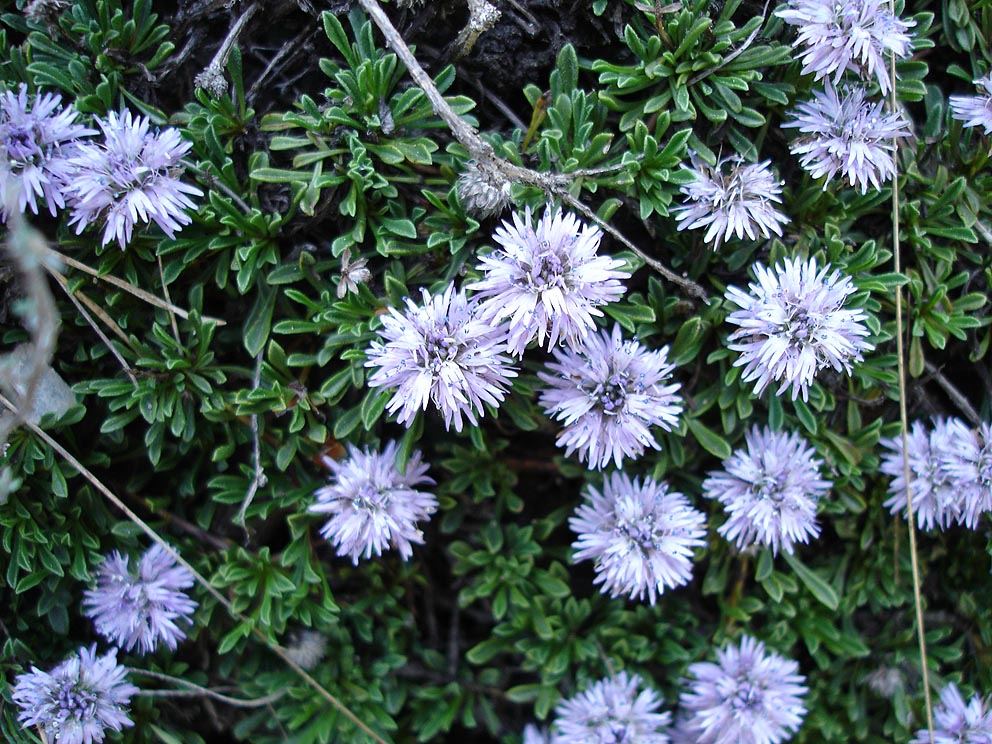
Globularia is a genus of roughly two dozen flowering plants commonly known as globe daisies or globularias. Most species are low, evergreen, mat-forming perennials or small subshrubs that hug the ground and spread to form dense cushions of leathery, oval foliage. The individual leaves are typically 1–10 cm long, often glossy, and arranged in basal rosettes or along short, woody stems. Above this evergreen carpet rise slender flowering stalks ranging from just a few centimetres to about 30 cm tall.
The inflorescence is the feature that gives the genus its name and its character: each stem ends in a dense, rounded head — a true capitulum — packed with many small tubular flowers. These heads are about 1–3 cm across and most often appear in shades of soft blue, violet, mauve, or pink, with white forms occurring in some species. The overall impression is of a pincushion or miniature scabious, which is why globe daisies have long been popular subjects for rock gardens, trough plantings, and dry stone walls.
Taxonomically the genus has had an unsettled history. Linnaeus described Globularia in Species Plantarum (1753), and for much of the twentieth century it sat in its own small family, Globulariaceae, in the Cronquist system. Molecular phylogenetic work has since folded the group into a much-enlarged Plantaginaceae within the order Lamiales, where it is recognised as tribe Globularieae. GBIF and other major checklists accept Globularia L. as a valid genus in Plantaginaceae, with around 28 accepted species plus several recognised hybrids.
The natural range of Globularia stretches across central and southern Europe — including the Alps, Pyrenees, Apennines, and Balkans — into the Mediterranean basin, Macaronesia, northwest Africa, and southwest Asia. The genus is especially diverse on islands and in dry, calcareous mountains, with notable endemics on the Canary Islands (G. ascanii, G. amygdalifolia, G. salicina, G. sarcophylla) and the Balearic Islands (G. majoricensis). In Switzerland alone, Info Flora records three species: G. bisnagarica, G. cordifolia, and G. nudicaulis. Beyond their botanical interest, Globularia species play a modest ecological role as larval host plants for several Lepidoptera, including the coleophorid moth Coleophora virgatella.
Distribution
The genus Globularia is centred on the mountains and Mediterranean fringes of Europe, with extensions into Macaronesia, northwest Africa, and southwest Asia. Wikipedia summarises the native range as central and southern Europe together with Macaronesia, northwest Africa, and southwest Asia. GBIF's accepted-species list bears this out: alpine and pre-alpine species such as G. cordifolia, G. nudicaulis, and G. repens occur in the central European mountain systems, while G. alypum, G. vulgaris, and G. trichosantha extend through the Mediterranean basin into the Near East. Several taxa are notable island endemics — G. ascanii, G. amygdalifolia, G. salicina, and G. sarcophylla on the Canary Islands, and G. majoricensis on Mallorca. Info Flora records three species in Switzerland (G. bisnagarica, G. cordifolia, G. nudicaulis), reflecting the genus's typical concentration in dry, calcareous European uplands.
Ecology
Globularia species are most characteristic of dry, sunny, often calcareous habitats — alpine turf, rocky slopes, and Mediterranean garrigue — and their dense cushion habit reflects an adaptation to exposed, drought-prone sites. The genus has a documented role in invertebrate ecology as a larval food plant for several Lepidoptera, with Wikipedia specifically citing the case-bearing moth Coleophora virgatella as feeding on Globularia.
Cultivation
Globe daisies are classic rock-garden plants. Cultivated species are evergreen perennials reaching about 0.2 m in height and flowering in July and August. They require a gritty, well-drained, circumneutral to slightly alkaline soil in full sun, and they perform poorly in shade or in heavy, wet ground. The plants are reliably hardy in cool-temperate climates, rated to UK zone 6 / USDA zones 5–9. These conditions — sharp drainage, lime-tolerant or lime-loving soil, and open exposure — are typical of the alpine and Mediterranean habitats where the genus is naturally at home. Globularia cordifolia and Globularia punctata are among the species most commonly grown ornamentally.
Propagation
There are three established methods for propagating Globularia: sowing seed in a cold frame as soon as it is ripe, dividing established clumps, and taking semi-ripe cuttings in June or July, also rooted in a cold frame. The cold-frame requirement reflects the genus's preference for cool, well-ventilated conditions during establishment.
Taxonomy
Globularia L. is an accepted genus in family Plantaginaceae, order Lamiales. It was described by Linnaeus in Species Plantarum (1753) and was long treated as the sole large genus of a segregate family, Globulariaceae, under the Cronquist system. Molecular phylogenetic evidence has since supported its merger into an expanded Plantaginaceae as tribe Globularieae. Wikipedia reports about 22 species; GBIF currently lists roughly 28 accepted species plus several recognised nothospecies (G. ×indubia, G. ×montiberica, and others). The genus shows notable insular diversification, particularly in the Canary Islands and Balearics.
History
The genus was formally established by Carl Linnaeus in Species Plantarum (1753). For much of the twentieth century it anchored its own family, Globulariaceae, under traditional morphology-based systems such as Cronquist's. Late-twentieth- and early-twenty-first-century molecular work led to the recognition that Globularia is nested within an expanded Plantaginaceae, and it is now treated as tribe Globularieae within that family.
Cultural & Traditional Uses
Several Globularia species have a record of use in European folk medicine. The leaves have been employed as a mild laxative and are also described as antirheumatic and stimulant. These uses are traditional rather than clinical, and the genus is not commercially important as a medicinal crop.










