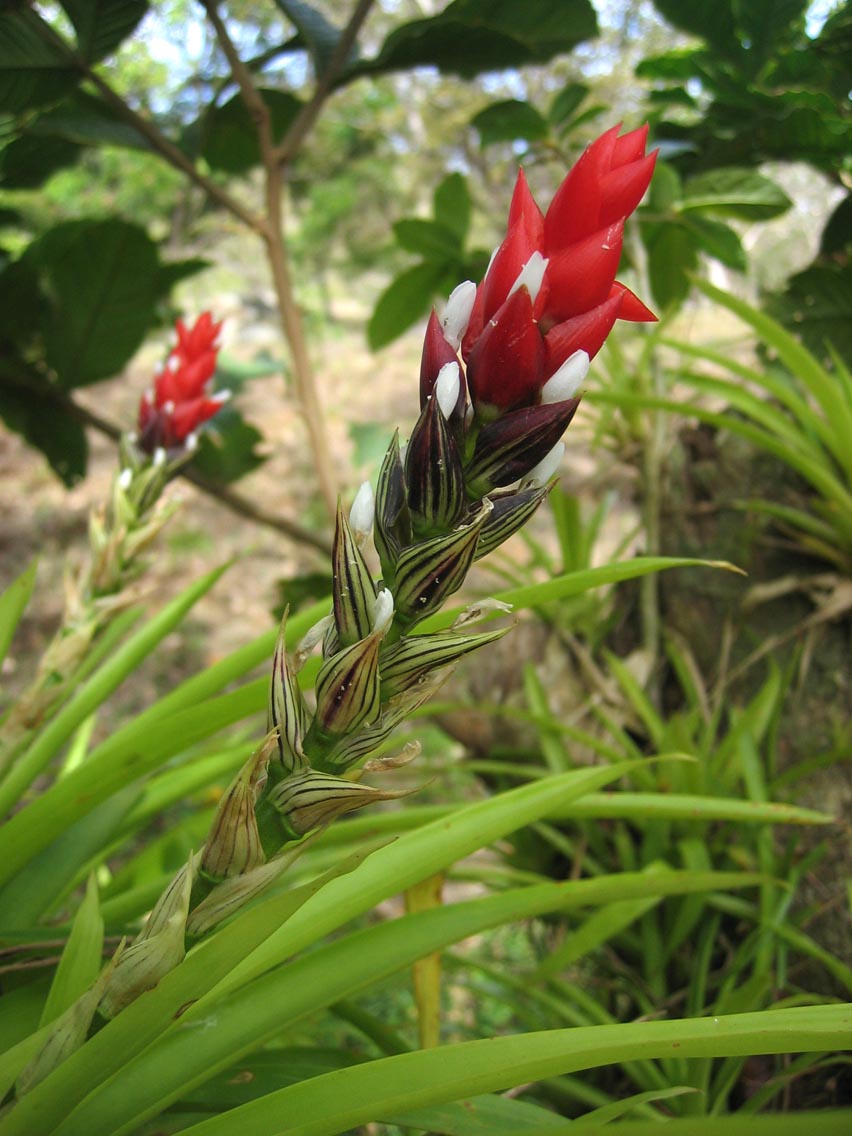
Guzmania (Ruiz & Pav.) is a genus of more than 120–200 species of evergreen, epiphytic perennial herbs in the family Bromeliaceae (subfamily Tillandsioideae), formally described in Flora Peruviana in 1802. Plants are mainly stemless, forming basal rosettes of strap-like, leathery leaves that range from solid green to variegated and can reach up to 50 cm (20 in) long. The rosette acts as a central tank, funneling rainwater and leaf litter directly to the root zone — a characteristic feature of tank bromeliads.
Inflorescences are showy and torch-like, held on an erect scape above the foliage, with bracts in brilliant shades of red, orange, pink, or yellow that far outlast the small, white to yellow, funnel-shaped flowers. After flowering, the parent rosette dies back and produces offsets (pups) at its base.
Guzmanias are native to tropical and subtropical regions of the Americas, ranging from southern Mexico and Central America through the Andes and lowland rainforests of South America to Brazil. They grow at elevations up to 3,500 m (11,500 ft), most abundantly in humid montane and cloud forests. In cultivation they are widely grown as houseplants and conservatory subjects, prized for their long-lasting, vividly coloured inflorescences and tolerance of lower light levels. Numerous hybrids and cultivars have been selected for the ornamental trade.
Etymology
The genus name Guzmania honours Anastasio Guzmán, an 18th-century Spanish-Ecuadorian pharmacist and naturalist. The name was bestowed by Hipólito Ruiz López and José Antonio Pavón Jiménez, the Spanish botanists who described the genus in their Flora Peruviana (1802).
Distribution
Guzmanias are native to the Neotropics: from southern Mexico south through Central America, and across the northern and western parts of South America, extending into Brazil. The genus is centred on the Andean region and adjacent lowland rainforests, with species recorded up to 3,500 m (11,500 ft) elevation in montane and cloud forests. The majority of species are epiphytic, growing on tree branches and trunks in humid forest environments.
Ecology
Guzmanias are principally epiphytic, anchoring to tree bark or mossy branches rather than rooting in soil. The tank formed by the tightly overlapping leaf bases collects rainwater, organic debris, and associated invertebrates, creating a microhabitat for specialised aquatic fauna. Plants are adapted to high humidity and diffuse light beneath the forest canopy, tolerating a wide range of elevations from lowland tropical forest up to Andean cloud forest at roughly 3,500 m. After the single flowering event the monocarpic rosette dies, but basal offsets ensure vegetative continuity.
Cultivation
In cultivation, guzmanias perform best in warm conditions (USDA zones 10a–12b outdoors) with high ambient humidity. They accept a wide light range from full sun to shade depending on species, though most houseplant varieties favour bright, indirect light. A bark-based orchid mix or standard houseplant compost enriched with bark and perlite suits containerised plants; alternatively they can be mounted on wood or cork bark with roots wrapped in sphagnum moss. The central leaf tank should be kept filled with water and flushed periodically to prevent stagnation; a dilute half-strength liquid fertiliser applied to the tank during the growing season supports development. Outdoor plants in warm climates should have standing tank water treated with Bti-based larvicides to prevent mosquito breeding. Root rot is the main cultural risk and results from cold, waterlogged roots.
Propagation
Guzmanias are propagated by division of offsets (pups). After the parent rosette flowers and begins to senesce, one or more pups emerge from the base. These are best removed once they have reached approximately one-third of the size of the flowering plant, at which point they have sufficient root development to establish independently. Severed offsets can be potted into a bark-based medium and kept warm and humid until established.
Taxonomy
Guzmania Ruiz & Pav. was formally published in Flora Peruviana in 1802 and is accepted in GBIF (usageKey 2698853). It belongs to family Bromeliaceae, subfamily Tillandsioideae, order Poales. The genus has accumulated several synonyms over its taxonomic history, including Caraguata Lindl., Chirripoa Suess., Devillea Bertero ex Schult. & Schult.f., Massangea É.Morren, and Sodiroa André. GBIF records 252 descendant taxa under the genus.










