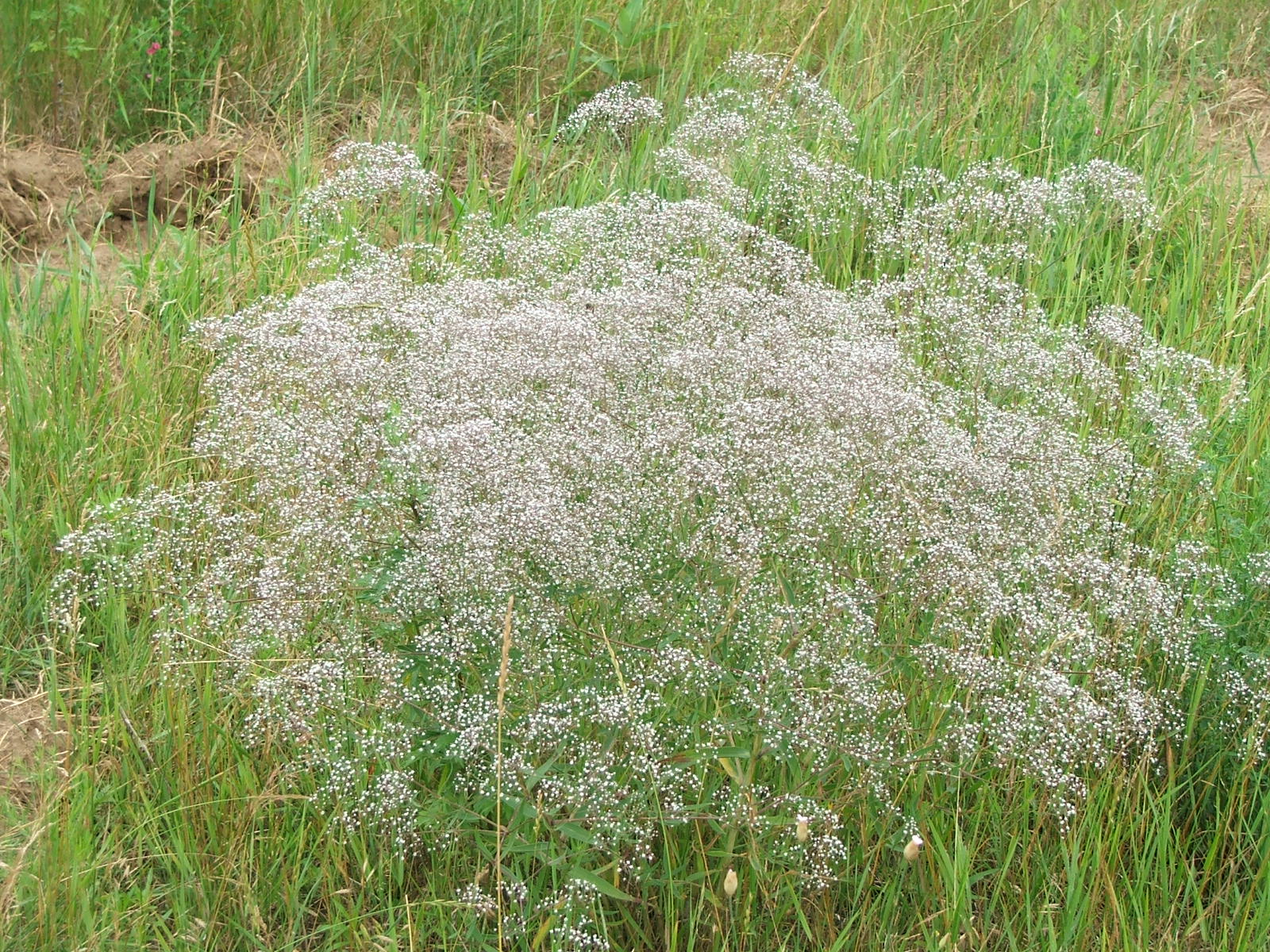
Gypsophila, commonly known as baby's-breath, is a genus of roughly 150 species of annual and perennial herbaceous plants belonging to the carnation family, Caryophyllaceae. The genus was formally described by Carl Linnaeus in his 1753 Species Plantarum. Plants range from compact cushion-forming alpines to tall, airy perennials with cloud-like masses of tiny flowers that have made the genus a florist's staple worldwide.
Stems are typically erect or sprawling, usually branched, and terete. Leaves are linear to oblong or ovate with rounded to acuminate tips. The inflorescence is a diffuse dichasial cyme or thyrse — in some species forming a loose, many-flowered panicle; in others, a compact head-like cluster. Each flower has a cup-like calyx of white-edged green sepals holding five petals in white, pink, or rose-purple, with ten stamens and usually two styles. The fruit is a globose or ellipsoid-ovoid capsule that opens by four valves, releasing brown to black, reniform to snail-shell-shaped seeds that are laterally compressed.
Gypsophila is primarily a genus of temperate Eurasia, with approximately 125 accepted species concentrated in the Irano-Turanian floristic region. Turkey alone harbours around 35 endemic species, making it the single greatest centre of diversification. The genus also extends to Africa, Australia, and the Pacific Islands. No species are native to the Americas, though several — most notably G. paniculata — have naturalised broadly following introduction as ornamentals.
Etymology
The genus name Gypsophila combines the Greek words gypsos (gypsum) and philios (loving), reflecting the tendency of many species to thrive in calcium-rich, gypsum-containing soils. The name was coined by Linnaeus when he formally described the genus in 1753.
Distribution
Gypsophila is predominantly a genus of temperate Eurasia, with its highest species richness in the Irano-Turanian region. Turkey is a major diversification centre, home to approximately 35 endemic species. The genus extends west through the Mediterranean and Central Europe, eastward through Central Asia to China, and further to Africa, Australia, and the Pacific Islands. Around 125 species are accepted, primarily in temperate Eurasia.
In Switzerland, four species are documented: the native alpine G. repens, plus G. muralis, G. paniculata, and G. scorzonerifolia — the latter two present as naturalized garden escapes. No species are native to northeastern North America, but introduced populations of G. paniculata are established in parts of North America.
Ecology
Most species grow in open, sunny, often calcareous habitats — rocky slopes, steppes, dry grasslands, and disturbed ground — consistent with the genus's affinity for well-drained, mineral-rich soils implied by its name. Flowers are rich in nectar and pollen, attracting bees and other pollinators; the plants also provide invertebrate shelter.
Gypsophila paniculata, the familiar garden baby's-breath, has escaped cultivation in North America and elsewhere, behaving as an aggressive invasive weed that competes with native vegetation in disturbed habitats. Chromosome numbers vary across the genus: x = 17 and x = 12 in Eurasian populations, x = 18 in some lineages.
Cultivation
Gypsophila species are popular garden and cut-flower plants valued for their airy masses of tiny blooms. They require full sun and cannot tolerate shade. Most prefer well-drained to dry soils and are remarkably tolerant of alkaline and chalky conditions, which accords with their natural calcareous habitats. They grow in light, medium, and heavy soil types.
G. paniculata and G. elegans are the dominant cut-flower crops in commercial horticulture. Alpine species such as G. repens serve as rock-garden or groundcover plants. G. arrostii is hardy in USDA zones 7–10.
Propagation
Gypsophila species can be propagated by seed sown in spring, by division in spring or autumn, by basal cuttings, or by root cuttings. Perennial species often develop stout branched caudices that facilitate division.
Cultural uses
The most widespread use of Gypsophila is as a cut flower: G. paniculata and G. elegans are globally traded florist crops, prized as filler foliage in bouquets and floral arrangements.
Beyond floristry, the genus has notable industrial and culinary applications tied to its saponin content. Saponins extracted from Gypsophila roots have historically been used in the production of photographic film emulsions and as laboratory reagents. Their detergent properties have also been exploited in soap and shampoo formulation. Culinarily, G. rokejeka is used in the preparation of halva in parts of the Middle East, and various species contribute flavour and texture to liqueurs, cheese, and ice cream.
Some Gypsophila species are hyperaccumulators of boron and have been investigated for phytoremediation of boron-contaminated soils — a field application linking the genus's soil chemistry affinity to environmental management.
Taxonomy notes
Gypsophila L. was published by Linnaeus in Species Plantarum (1753, p. 406). It is placed in the family Caryophyllaceae, order Caryophyllales, class Magnoliopsida. GBIF records 248 total descendants (accepted species plus synonyms) under usageKey 3085251. The genus exhibits base chromosome numbers of x = 17, x = 12, and x = 18 across different lineages.
The genus is closely allied with other Caryophyllaceous genera and has historically been subject to circumscription debates; modern treatments recognise approximately 125–150 accepted species concentrated in temperate Eurasia.

