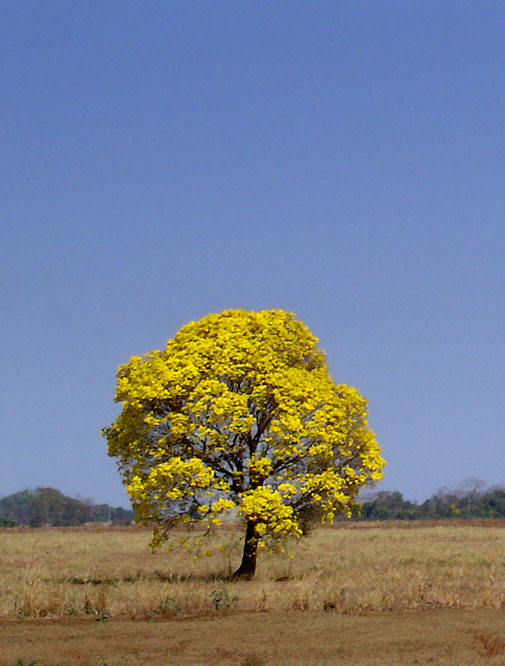
Handroanthus is a genus of approximately 30 species of trees in the family Bignoniaceae (order Lamiales), native to tropical and subtropical regions of the Americas — from Central America south through Brazil to northern Argentina, Paraguay, and Chile, with one species, H. billbergii, also native to the Antilles and northern South America. The genus is widely known by the common names ipê, pau d'arco, poui, lapacho, and guayacan.
The trees are renowned for their spectacular floral displays: large, tubular corollas in yellow or magenta (with a yellow throat) appear on still-leafless branches at the end of the dry season, making the blooms especially conspicuous. Leaves are palmately compound, typically with 3–9 leaflets bearing both lepidote scales and various types of hair. The wood is among the hardest and heaviest produced anywhere in the American tropics — dense, with heartwood distinct from sapwood and coloured olive-brown to black. The heartwood contains substantial quantities of lapachol. Fruit are elongate dehiscent capsules releasing thin, winged seeds that are widely dispersed by wind.
Handroanthus is distinguished from its close relative Tabebuia by its 5-dentate campanulate calyx, the combination of lepidote scales with hair trichomes, and fruit that is typically pubescent to tomentose rather than glabrous.
The genus was first erected by Brazilian botanist João Rodrigues de Mattos in 1970 in honour of botanist Oswaldo Handro, with "anthus" derived from the Greek word for flower. It was not widely accepted at the time — Alwyn H. Gentry folded the species back into Tabebuia in his comprehensive 1992 revision. Handroanthus was resurrected in 2007 following a molecular phylogenetic study that demonstrated Tabebuia as then circumscribed was polyphyletic; the type species is Handroanthus albus. Within the broader Bignoniaceae phylogeny, Handroanthus is sister to a clade including Spirotecoma, Parmentiera, Crescentia, and Amphitecna, and is one of 12–14 genera comprising the informal "Tabebuia alliance."
Several species are economically important timber trees; ipê wood commands high prices for furniture and outdoor decking owing to its exceptional hardness, insect resistance, and durability. Indigenous Amazonian peoples historically used the wood to make hunting bows — the origin of the name pau d'arco ("bow stick"). The bark is traditionally brewed as a tea (also called pau d'arco, lapacho, or taheebo) in South America, though its claimed medicinal properties have not been substantiated by clinical evidence.
Etymology
The name Handroanthus was established in 1970 by Brazilian botanist João Rodrigues de Mattos to honour his compatriot, botanist Oswaldo Handro. The suffix -anthus derives from the Greek word for "flower," alluding to the genus's spectacular floral displays.
Distribution
Handroanthus trees are native from Central America south through Brazil to northern Argentina, Paraguay, and Chile; H. billbergii extends the range into the Antilles and northern South America. The genus is widely cultivated as an ornamental tree far beyond its natural range in tropical and subtropical regions worldwide, and it naturalizes readily because its winged seeds are prolific and wind-dispersed.
Ecology
Handroanthus flowers provide an important nectar resource for bees and hummingbirds. The striking floral display — large flowers erupting on bare, leafless branches at the end of the dry season — is an adaptation that maximises pollinator attraction before new foliage obscures the blooms. Seeds are thin-winged and abundantly produced, enabling wide wind dispersal and rapid naturalization in introduced areas.
Cultural Uses
Indigenous peoples of the Amazon crafted hunting bows from the dense Handroanthus wood, a practice that gave rise to the Portuguese common name pau d'arco ("bow stick"). The inner bark of H. impetiginosus and related species is dried, shredded, and boiled to produce a bitter tea known as pau d'arco, lapacho, or taheebo, which has been used in South American traditional medicine; no clinical evidence supports claims that it prevents or slows cancer progression. Ipê lumber is highly prized for furniture and outdoor decking — New York City's Coney Island boardwalk, spanning over 16 km, has been surfaced with ipê wood since the late 1960s. FSC-certified ipê became available by 2007, though certification fraud has been reported.
History
Handroanthus was first described in 1970 by João Rodrigues de Mattos, but remained unaccepted by most of the botanical community. In 1992, Alwyn H. Gentry published a sweeping revision of Tabebuia covering 99 species, subsuming what are now the 30 Handroanthus species into three of his ten species groups. In 2007, a molecular phylogenetic study demonstrated that Tabebuia as circumscribed by Gentry was polyphyletic — resolving into three well-supported clades — and the name Handroanthus was resurrected for the clade containing its type species, H. albus.
Taxonomy Notes
Handroanthus belongs to the family Bignoniaceae (order Lamiales) and is part of the informal "Tabebuia alliance" of 12–14 genera. It is sister to a clade comprising Spirotecoma, Parmentiera, Crescentia, and Amphitecna. The genus was formerly placed in tribe Tecomeae, which has since been greatly reduced and no longer includes Handroanthus. Internal relationships within the genus remain poorly resolved due to limited taxon and DNA sampling.

