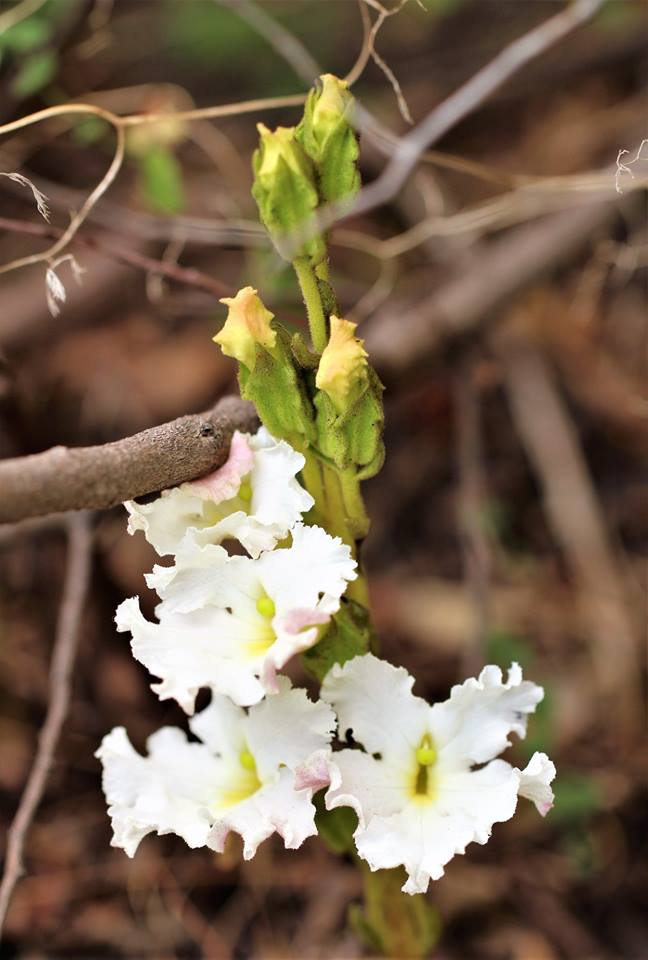
Harveya is a genus of roughly 29 species of parasitic flowering plants in the family Orobanchaceae, order Lamiales. Unlike most flowering plants, members of Harveya lack chlorophyll and obtain all their nutrients by parasitising the roots of host plants — a strategy shared with their close relatives in Orobanchaceae such as broomrapes (Orobanche) and witchweeds (Striga).
The genus ranges widely across Africa, from Eritrea and the Arabian Peninsula south to South Africa, with outlying populations in Madagascar, the Mascarene Islands, and as far east as Turkmenistan in Central Asia. In South Africa, where several species are concentrated, the plants are known in Afrikaans as inkblom (ink flower), because early European settlers extracted a dark dye from the flowers for use as ink — a use reflected in the English common names "ink flower" and "ink plant".
Well-known species include Harveya capensis, a South African endemic, and Harveya kiangombensis, described from East Africa. The genus is named in honour of William Henry Harvey (1811–1866), the Irish botanist and phycologist who spent time at the Cape of Good Hope and made substantial contributions to African plant taxonomy. Harvey himself expressed as a youth the ambition that a genus might one day carry his name, a wish that was eventually fulfilled.
Etymology
The genus name Harveya honours William Henry Harvey (1811–1866), the Irish botanist known for his work on African and Cape flora. Harvey wrote in his youth that his greatest ambition was for "a genus called Harveya" to bear his name — an ambition eventually fulfilled by Hook. (William Jackson Hooker), who established the genus.
Distribution
Harveya is native to sub-Saharan Africa and northeastern Africa from Eritrea to South Africa, with additional species in Madagascar, the Mascarene Islands, the Arabian Peninsula, and Turkmenistan. In South Africa several species are concentrated in fynbos and grassland biomes.
Taxonomy Notes
Harveya belongs to the family Orobanchaceae (order Lamiales), a family that has undergone major circumscription changes as molecular phylogenetics revealed many hemiparasitic and holoparasitic lineages previously placed in separate families (e.g. Scrophulariaceae, Orobanchaceae s.s.). GBIF records 17 descendant taxa under the backbone entry for the genus.

