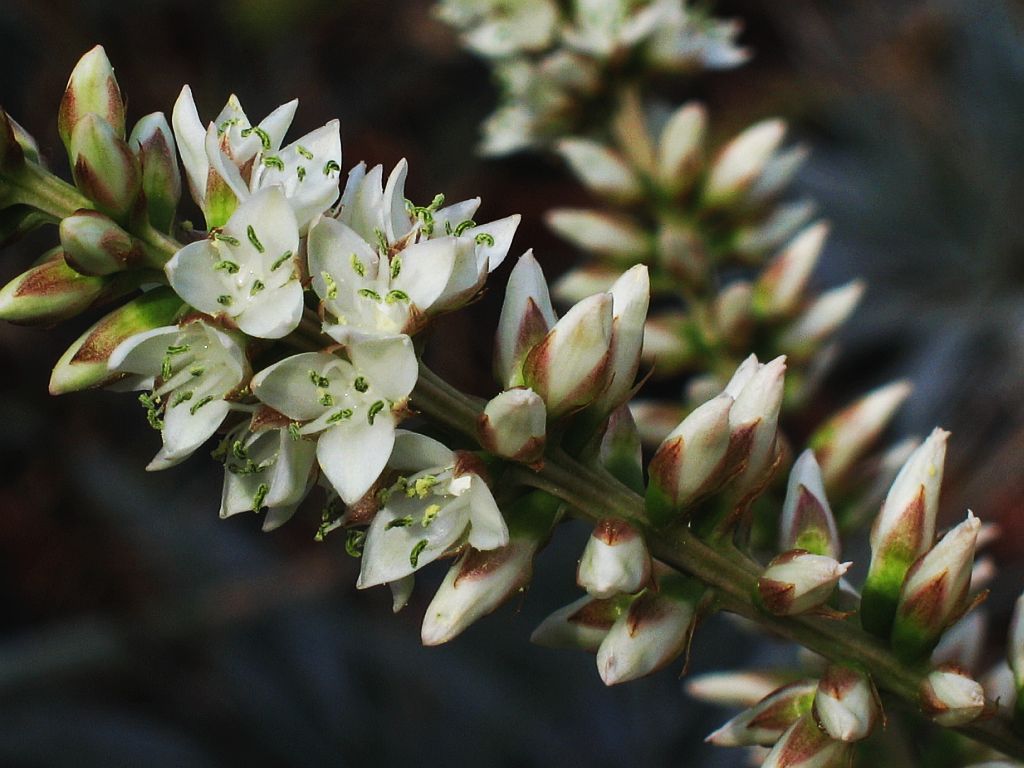
Hechtia is a genus of flowering plants in the family Bromeliaceae, and the sole genus of subfamily Hechtioideae. The genus was established by Johann Friedrich Klotzsch, first published in Allgemeine Gartenzeitung in 1835, and currently encompasses approximately 99 accepted species according to Kew's Plants of the World Online.
Plants in the genus are terrestrial herbs, growing on the ground or among rocks, and may be caulescent (with a visible stem) or stemless, occasionally producing stolons. The leaves are rosulate — arranged in a basal rosette — narrowly triangular in shape with spiny, spinose margins characteristic of many bromeliads adapted to arid and semi-arid environments. Inflorescences are simple to compound panicles bearing numerous small flowers.
A defining ecological feature of the genus is dioecy: male (staminate) and pistillate flowers occur on separate individual plants. This makes Hechtia unusual among bromeliads; almost uniquely, H. gayorum is hermaphroditic. The fruit is an ovoid, dehiscent capsule with narrowly winged or nearly wingless seeds without the feathery appendages seen in some other bromeliad genera.
Hechtia is concentrated in Mexico and Central America, with its native range spanning from Texas in the southern United States south through Mexico — across central, gulf, northeastern, northwestern, southwestern, and southeastern regions — into Guatemala, Honduras, El Salvador, and Nicaragua. The genus reaches its northern limit in the Chihuahuan Desert and Trans-Pecos Texas, where species are distinctive in bearing scaly capsules and flowers with scaly sepals, petals, and ovaries.
Etymology
The genus name Hechtia honors Julius Gottfried Conrad Hecht (1771–1837), a German privy counselor to the King of Prussia. The name was bestowed by the German botanist Johann Friedrich Klotzsch when he formally described the genus in 1835.
Distribution
Hechtia is endemic to the North American and Central American dry tropics. Its native range extends from Trans-Pecos Texas (USA) southward through Mexico — where the greatest species diversity occurs, spanning central, gulf-coast, northeastern, northwestern, southwestern, and southeastern regions — and continues into Guatemala, Honduras, El Salvador, and Nicaragua. Distribution data is sourced from the World Checklist of Vascular Plants and Catalogue of Life via GBIF. The genus reaches its northernmost limit in the Chihuahuan Desert of Texas, where a small number of species occur.
Ecology
Hechtia species are terrestrial or epilithic (rock-dwelling) herbs that thrive in dry, rocky, and semi-arid habitats — particularly on limestone outcrops, canyon walls, and scrubland. The genus is almost entirely dioecious, meaning staminate (male) and pistillate (female) flowers are borne on separate individuals; the single known exception is H. gayorum, which is hermaphroditic.
Leaves are arranged in a dense basal rosette and are armed with stiff, spiny margins, an adaptation that deters herbivory and helps channel moisture toward the plant's center. Inflorescences are simple to compound panicles. Fruits are ovoid, dehiscent capsules; seeds are narrowly winged or nearly wingless and lack the plumose appendages seen in wind-dispersed bromeliads. Species in Texas are further distinguished by scaly capsules and scaled floral parts (sepals, petals, ovary).
Taxonomy
Hechtia Klotzsch (1835) is the sole genus of subfamily Hechtioideae within the family Bromeliaceae (order Poales). The genus was originally described in Allgemeine Gartenzeitung 3: 401 (1835). Kew's Plants of the World Online currently accepts 99 species; the GBIF backbone records 103 descendants including infraspecific taxa, while Wikipedia lists approximately 75 — the disparity reflects ongoing taxonomic revision and differing treatment of synonyms.
Several genus-level synonyms have been placed in Hechtia over time: Bakerantha L.B.Sm., Bakeria André, Niveophyllum Matuda, and more recently Mesoamerantha I.Ramírez & K.Romero (Harvard Papers on Botany, 2018). The Flora of North America treatment was authored by Kathleen Burt-Utley and John F. Utley.










