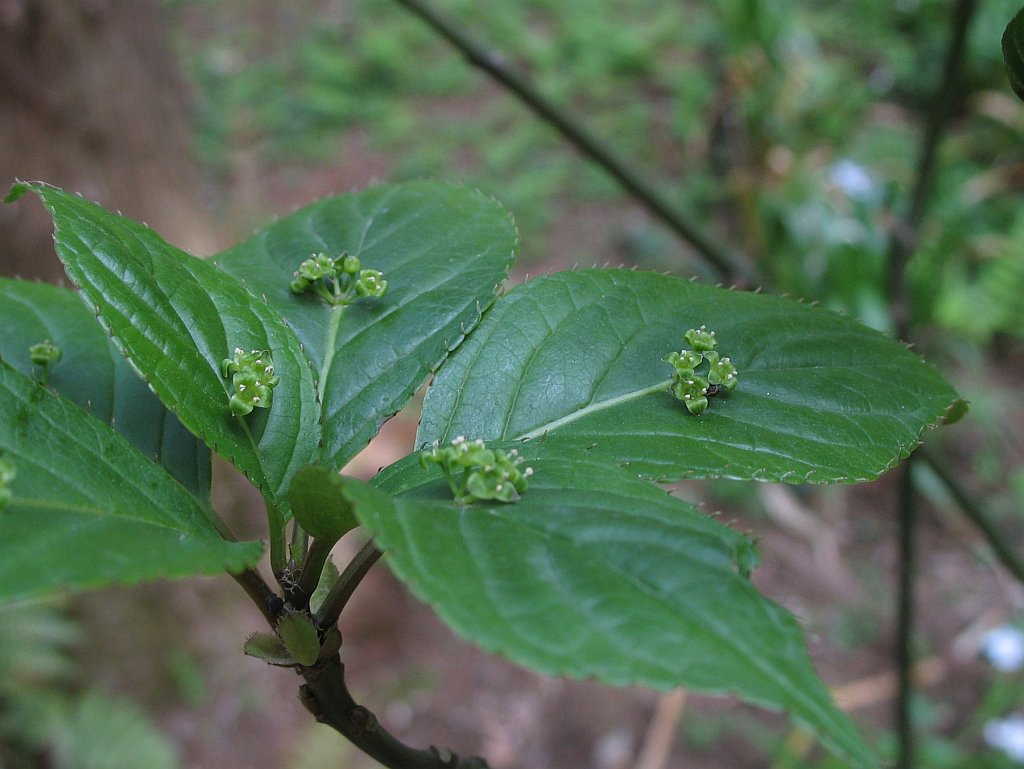
Helwingia is a small genus of deciduous or evergreen shrubs, occasionally small trees, belonging to the family Helwingiaceae and placed in the order Aquifoliales under the APG II system. The genus is the sole member of its family and is native to eastern Asia — spanning Japan, Korea, Taiwan, and much of China — as well as the Himalayan foothills of Nepal, Bhutan, and northeastern India, and extending into northern Indochina including Myanmar, Thailand, and Vietnam.
The genus is most remarkable for its epiphyllous inflorescences: the flowers develop directly on the upper surface of the leaf blade and ultimately fuse with the midrib, a trait shared by very few flowering plant lineages and considered a key diagnostic character. Leaves are alternate and may be evergreen or deciduous depending on species. Plants are dioecious, bearing male and female flowers on separate individuals. The flowers are small and inconspicuous, typically yellow-green or purple, and are followed by fleshy red or black berries.
Helwingia comprises three to four accepted species, of which Helwingia japonica is the most widespread, ranging from Japan and Korea through much of eastern and southwestern China into mainland Southeast Asia. Helwingia chinensis is confined to China, Myanmar, and Thailand, while Helwingia himalaica occupies the Himalayan arc. The genus was historically placed in Cornaceae (dogwood family) under the Cronquist system and has also been associated with Araliaceae; more recent molecular phylogenetics allies it with Aquifoliaceae (hollies) and the epiphyllous-flowered Phyllonomaceae in Aquifoliales. The genus name commemorates Georg Andreas Helwing, an eighteenth-century German botanist.
Etymology
The genus and family name Helwingia honors Georg Andreas Helwing (1666–1748), a German Lutheran pastor and botanist who worked in Prussia and was known for his studies of local flora. The epiphyllous flowering habit that distinguishes the genus has no connection to the etymology — the name is purely commemorative.
Distribution
Helwingia is native to eastern and southeastern Asia. Its range spans Japan (including the Ryukyu Islands), Korea, Taiwan, and a broad swath of China from Gansu and Henan in the north to Yunnan and Guangdong in the south. The genus also extends westward along the Himalayas through Nepal, Bhutan, Sikkim, and Assam, and southward into Myanmar, Thailand, and Vietnam.
Taxonomy Notes
Helwingia's family placement has shifted across classification systems. Cronquist (1981) included it in Cornaceae; it was later associated with Araliaceae. APG II (2003) recognized the monogeneric family Helwingiaceae and placed it in Aquifoliales alongside the holly family (Aquifoliaceae) and Phyllonomaceae — both of which also show epiphyllous or near-epiphyllous inflorescences. GBIF's backbone currently indexes Helwingia under Araliaceae / Apiales, reflecting an older or alternative placement that conflicts with APG II.










