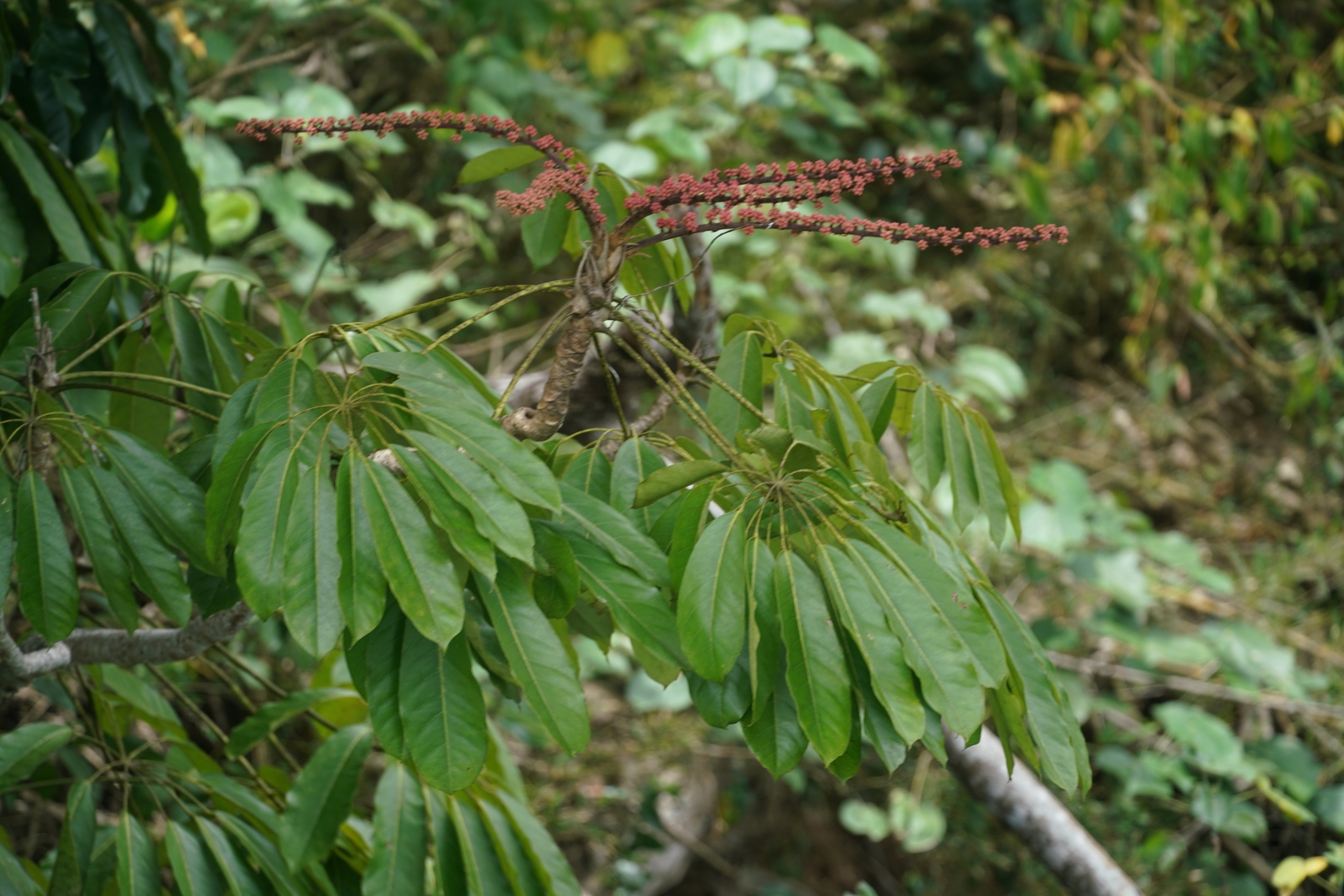
Heptapleurum is a large genus of flowering plants in the family Araliaceae, the ivy and ginseng family, placed in the order Apiales. The genus encompasses over 300 accepted species and, as of 2025, is considered the largest genus within Araliaceae. It was phylogenetically resurrected in 2020 from the broadly circumscribed genus Schefflera, following molecular phylogenetic studies that showed Schefflera as traditionally defined was not monophyletic.
Members of Heptapleurum are predominantly found across tropical and subtropical Asia, ranging from the Indian Subcontinent and Tibet through southern China, Vietnam, Hainan, Taiwan, Japan, and into Malesia, Papuasia, and Australia. Growth forms within the genus are diverse: most are scrambling subshrubs or small trees, but the genus also includes many epiphytic and climbing members adapted to forest canopy environments.
Several species are widely cultivated as houseplants or garden ornamentals, most notably Heptapleurum arboricola (formerly Schefflera arboricola), valued for its attractive palmate foliage. The genus also contains species of conservation concern — some are threatened or critically endangered due to deforestation and extreme endemism, with certain species known from a single locality covering only a few square kilometres.
Distribution
The genus is native to a broad arc of tropical and subtropical Asia and Australasia, including Malesia, Papuasia, southern China, Vietnam, the Indian Subcontinent, Tibet, Hainan, Taiwan, Japan, and Australia. The centre of diversity lies in Southeast Asia and the Pacific island region.
Taxonomy Notes
Heptapleurum was resurrected as a distinct genus in 2020, separated from the paraphyletic Schefflera following molecular phylogenetic analyses. It is now the largest genus in Araliaceae, with over 321 accepted species as of November 2025. iNaturalist retains a redirect linking Heptapleurum to the Schefflera Wikipedia article, reflecting the recent and ongoing nature of this reclassification.
Conservation
Some species in Heptapleurum are threatened, endangered, or critically endangered, primarily due to deforestation and extreme endemism. Heptapleurum acuminatissimum, for example, is known from a single location with an estimated extent of occurrence of only 4 km².

