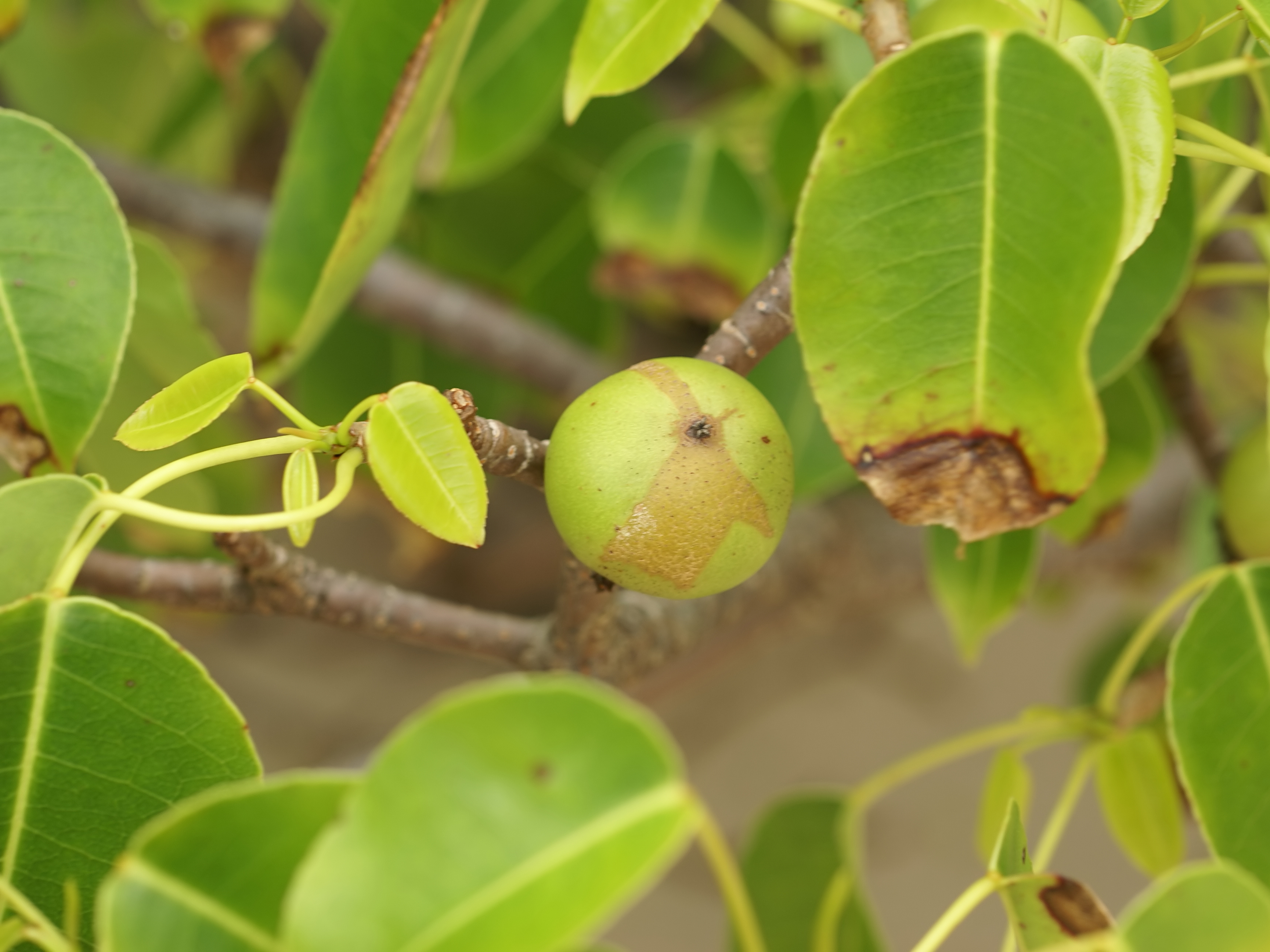
Hippomane is a small genus of flowering trees and shrubs in the family Euphorbiaceae, order Malpighiales, first formally described by Carl Linnaeus in 1753. The genus is native to the tropical and subtropical Americas, with its range spanning the West Indies, Mexico, Central America, the Florida Keys, Venezuela, Colombia, and the Galápagos Islands.
The genus is best known for its type species, Hippomane mancinella, commonly called the manchineel tree — widely regarded as one of the most toxic trees in the world. Manchineel produces caustic milky sap throughout all parts of the plant, including its bark, leaves, and small apple-like fruits. Contact with the sap causes severe skin irritation and blistering, and ingestion of any part of the plant can be fatal. The fruits have historically caused poisonings when eaten by people unfamiliar with the plant.
As members of Euphorbiaceae, species of Hippomane share the characteristic latex-producing tissues common to the family. The genus currently comprises three accepted species: H. mancinella, widespread across the Caribbean and adjacent mainland coasts; H. spinosa, restricted to Hispaniola; and H. horrida, known from the Barahona region of the Dominican Republic.
Etymology
The genus name Hippomane derives from the Greek word hippomanes, itself a compound of ἵππος (hippos, "horse") and μανία (mania, "insanity" or "frenzy"). The name was applied by the ancient botanist Theophrastus to an unidentified plant reputed to poison horses and drive them mad. Linnaeus applied the name to this genus in reference to the extreme toxicity of its sap.
Distribution
Hippomane is native to the tropical Americas. Hippomane mancinella occurs across the West Indies, Mexico, Central America, the Florida Keys, Venezuela, Colombia, and the Galápagos Islands. Hippomane spinosa is endemic to Hispaniola, and H. horrida is known only from the Barahona region of the Dominican Republic.
Ecology
Hippomane mancinella typically grows in coastal habitats, including beaches, mangrove margins, and low-lying tropical shorelines. All parts of the plant — sap, bark, leaves, and fruit — are highly toxic due to the presence of caustic diterpenoid compounds. The sap can cause severe dermatitis and eye damage on contact, and smoke from burning the wood is hazardous to the eyes and respiratory tract.
Cultural Uses
Hippomane mancinella has a long history of recognition as an exceptionally dangerous plant. Indigenous peoples of the Caribbean are reported to have used the poisonous sap to tip arrows. The tree's small greenish-yellow fruits, deceptively similar in appearance to small apples, have caused accidental poisonings throughout recorded history. Spanish explorers reportedly encountered the tree's toxicity during early exploration of the Caribbean.










