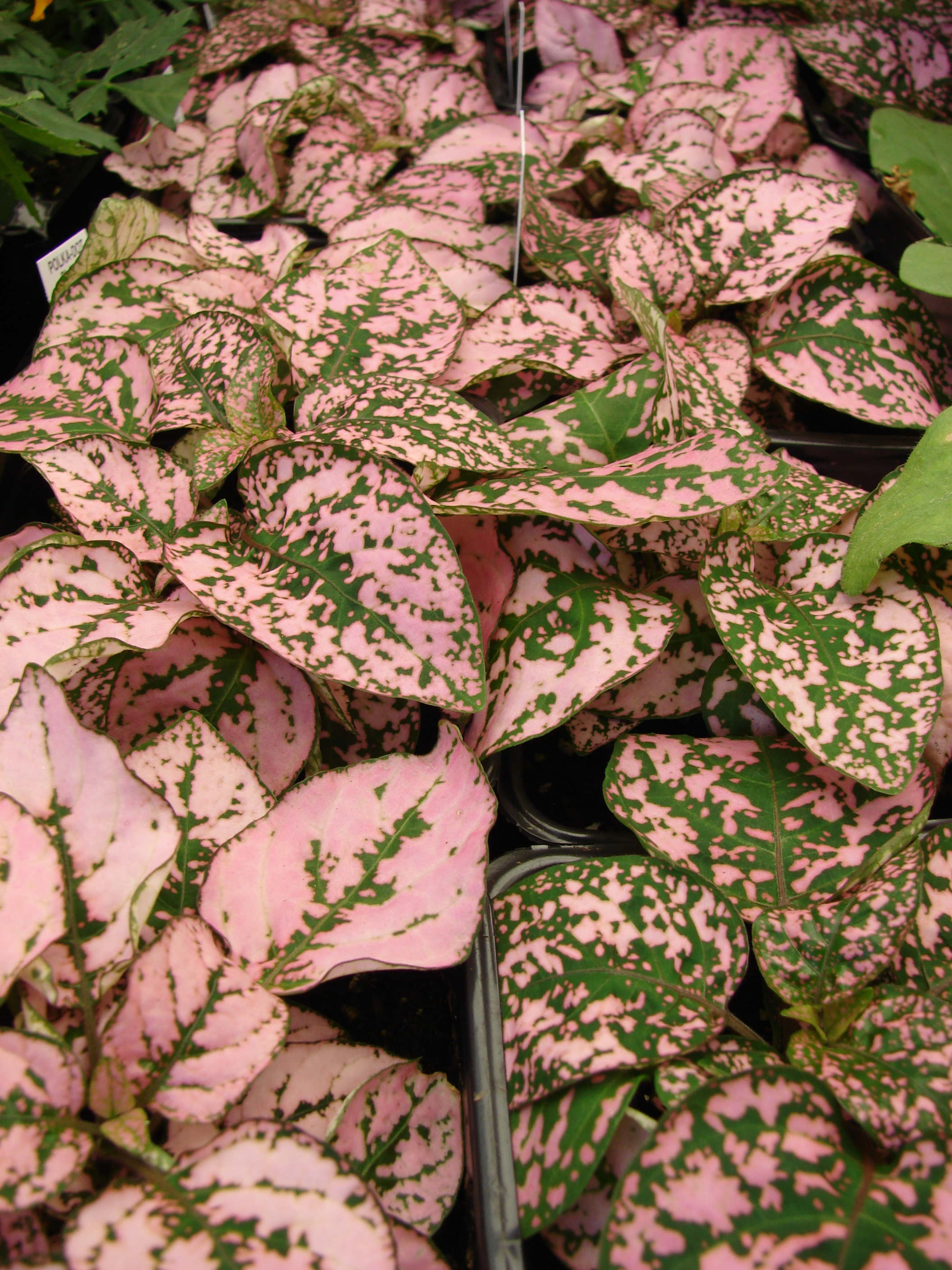
Hypoestes is a genus of roughly 150 flowering plant species in the family Acanthaceae (order Lamiales), placed within the subfamily Acanthoideae and the subtribe Justiciinae of tribe Ruellieae. This taxonomic position makes it a relative of Fittonia (mosaic plants), Justicia (water-willows), and Carlowrightia (wrightworts).
Plants in the genus are typically herbaceous to small shrubby, growing in the undergrowth of tropical and subtropical habitats. Many species are distinguished by boldly patterned foliage, often marked with red, pink, or white spots and patches against a green background. The genus name comes from the Greek hypo ("under") and estia ("house"), a reference to the distinctive way the flowers are concealed beneath fused bracts.
Hypoestes is widely distributed around the Indian Ocean basin, spanning tropical Africa, Madagascar, and into South and Southeast Asia. Madagascar is a particular center of diversity for the genus. The most widely cultivated member is H. phyllostachya (polka dot plant), native to Madagascar, which is popular as an ornamental houseplant and garden annual for its vivid spotted leaves.
Etymology
The genus name Hypoestes derives from the Greek hypo ("under") and estia ("house"), describing the way the small flowers are hidden beneath the fused bracts that surround them.
Distribution
Hypoestes species are distributed throughout tropical and subtropical regions bordering the Indian Ocean, with strongholds in Madagascar, continental Africa, and parts of South and Southeast Asia.
Cultivation
Several Hypoestes species, most notably H. phyllostachya (polka dot plant), are widely grown as ornamental houseplants and seasonal bedding plants for their vividly spotted or marbled leaves. They are valued for adding bold foliage color to indoor and outdoor plantings in temperate climates.










