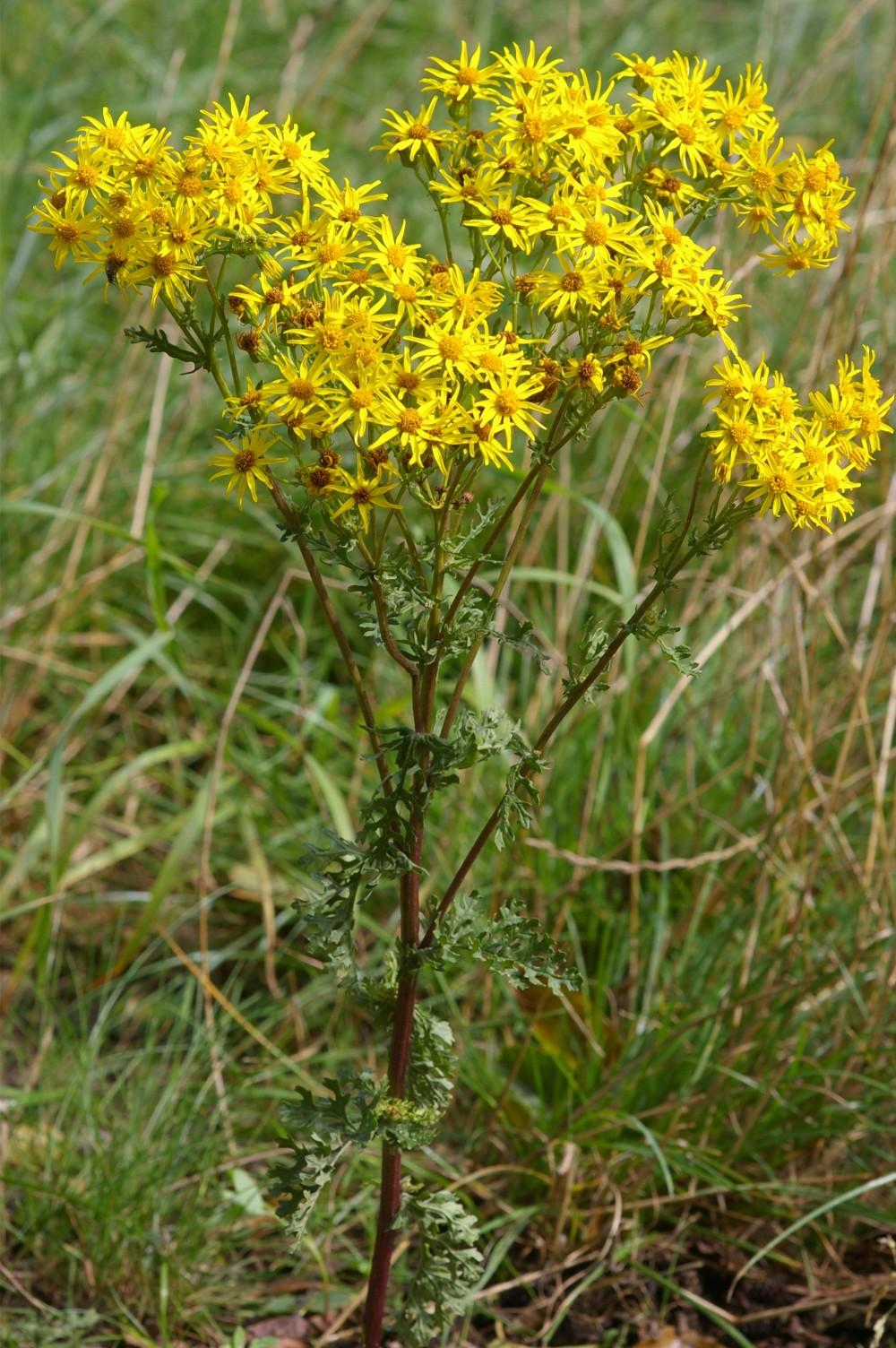
Jacobaea is a genus of flowering plants in the tribe Senecioneae of the daisy family (Asteraceae). The genus was originally described by the English botanist Philip Miller, and its members were for centuries treated as part of the much larger genus Senecio. Following molecular phylogenetic work on the tribe Senecioneae — most notably the 2007 study by Pelser and colleagues based on ITS DNA sequence data — a distinct ragwort lineage was separated out of Senecio into the segregate genus Jacobaea in order to keep both genera monophyletic. Modern checklists place roughly 30 to 70 accepted species in the genus, with GBIF recording 147 names beneath the accepted concept "Jacobaea Mill."
Members of the genus are mostly herbaceous perennials and biennials, although a few are woody at the base. They share the bright yellow, daisy-like flower heads characteristic of many former Senecio species: small disc florets surrounded by ray florets, grouped into branched corymbs. Leaves are typically alternate and often pinnately lobed or pinnatifid, sometimes deeply dissected, and in several species — most famously J. maritima — clothed in dense white-woolly hairs that give the foliage a silvery appearance.
The genus is centered on Eurasia, with species spanning the European lowlands, Mediterranean coasts, alpine grasslands, and temperate Asia; several species reach North Africa, and a few have been introduced far beyond their native range as agricultural weeds or garden ornamentals. Habitats range from coastal cliffs and sand dunes to wet meadows, mountain slopes, pastures, waste ground and roadsides.
The defining chemistry of Jacobaea is the production of pyrrolizidine alkaloids — including jacobine, retrorsine and senecionine — which make many species toxic to grazing livestock, especially horses and cattle, when consumed in hay or silage. The same alkaloids underpin a rich ecology of specialist herbivores: ragworts support large communities of host-specific insects, of which the cinnabar moth (Tyria jacobaeae) is the best known, sequestering the plant's toxins and advertising its unpalatability with bright warning colors.
Two species dominate everyday encounters with the genus. Common ragwort (J. vulgaris) is the type species — a tall yellow-flowered biennial of pastures and waysides, native to northern Eurasia and naturalized as a weed on several continents. Silver ragwort (J. maritima), formerly Senecio cineraria, is the silvery-leaved Mediterranean perennial widely grown in gardens as "dusty miller."
Etymology
The genus name Jacobaea derives from a long-standing common name for the type species: in English, "St. James-wort" — and in many other European languages an equivalent reference to St. James (James, son of Zebedee). The plant traditionally flowers around St. James's Day (25 July), and the name passed from the medieval vernacular into the Latin specific epithet jacobaea long before Philip Miller formalized it at genus rank.
Distribution
Jacobaea is centered on Eurasia. Its species are recorded across Europe, the Mediterranean basin and temperate Asia, with some extending into North Africa. The type species, J. vulgaris, originates from northern Eurasia, particularly in dry, open habitats, but has spread widely as an introduced weed across North America, South America, Africa, parts of Asia and Australasia. J. maritima is native to the western and central Mediterranean — northwest Africa, southern Europe and western Asia — and has naturalized further north in Great Britain and Ireland.
Ecology
Jacobaea species occupy a wide ecological amplitude, from coastal cliffs and rocky shorelines (J. maritima) to wet meadows, sand dunes, roadsides, railways, pastures and low-fertility waste ground (J. vulgaris). They are characteristic plants of disturbed, sunny, low-nutrient sites.
The genus is defined chemically by its production of pyrrolizidine alkaloids — including jacobine, retrorsine and senecionine in J. vulgaris. These compounds are toxic to vertebrate herbivores, especially horses and cattle, which are at greatest risk when ragwort is dried into hay or silage. The alkaloids do not accumulate directly in the liver, but a breakdown product damages DNA and progressively kills hepatic cells.
The same alkaloids support a substantial specialist insect fauna. In the United Kingdom alone, at least 77 insect species depend on ragwort. The most conspicuous specialist is the cinnabar moth (Tyria jacobaeae), whose larvae feed on ragwort foliage and flowers, sequester the plant's alkaloids and advertise their toxicity through aposematic black-and-yellow striping. Adult cinnabar moths carry the same warning system into their pinkish-red and black wings. Silver ragwort additionally provides nesting material for specialist bees, which collect the dense leaf hairs.
Cultivation
The principal ornamental member of the genus is J. maritima (silver ragwort, dusty miller), grown for its dense, white-woolly silver foliage. Selected cultivars include 'Silverdust' and 'Silver Dust', chosen for thicker and brighter indumentum. The species is tolerant of drought, fire, deer browsing and salt exposure, which makes it useful for coastal, Mediterranean-climate and low-water plantings. Most other Jacobaea species are wild plants rather than garden subjects; J. vulgaris in particular is considered a weed rather than a horticultural plant in most of its range.
Conservation
Conservation concerns for Jacobaea are dominated not by rarity but by management of weedy and toxic species. In the United Kingdom, J. vulgaris is listed as an "injurious weed" under the Weeds Act 1959, although growing it is not itself illegal and landowners have no statutory duty to control it. Outside its native range — particularly in the western United States, parts of Australia and New Zealand — J. vulgaris has been a significant invasive pasture weed, and biological control programs have deployed the cinnabar moth (Tyria jacobaeae), used in combination with the tansy ragwort flea beetle, to suppress invasive populations.
Cultural uses
Ragwort carries unusually rich cultural baggage for a pasture weed. J. vulgaris is the national flower of the Isle of Man, where it is known by its Manx name Cushag. In Celtic folklore, fairies were said to use ragwort stems as transport between the islands and Ireland. The genus and the type species both ultimately take their Latin name from St. James — "St. James-wort" being an old English vernacular for the plant, tied to its flowering around St. James's Day.
History
The name Jacobaea was first applied at genus rank by Philip Miller in the 18th century, but for most of the subsequent two centuries its species were absorbed back into Senecio and treated as the Senecio jacobaea group. The modern reinstatement of Jacobaea as a separate genus dates to molecular phylogenetic work on tribe Senecioneae, notably the 2007 ITS-based phylogeny by Pelser and colleagues. That study showed that Senecio as traditionally circumscribed was not monophyletic, and recommended carving out several segregate genera — Jacobaea among them, alongside Ligularia, Tephroseris, Packera, Brachyglottis, Dendrosenecio and others — to bring the classification in line with the underlying evolutionary tree.
Taxonomy notes
Jacobaea Mill. is placed in tribe Senecioneae of the family Asteraceae (Compositae), order Asterales. GBIF records "Jacobaea Mill." as the accepted genus concept (taxon key 7678064) with 147 descendant names beneath it; older or homonymous applications of the name by Burman and by Burman ex Kuntze (1891) also appear in some datasets and should not be confused with Miller's genus. SEINet catalogs 33 species, while Wikipedia reports approximately 70 recognized species across the main checklists — the exact total depends on how aggressively recent molecular treatments split or lump species. The genus is the largest segregate to be carved out of Senecio in the 2007 reorganization, which left Senecio s.s. with around 1,250 species but still not strictly monophyletic.

