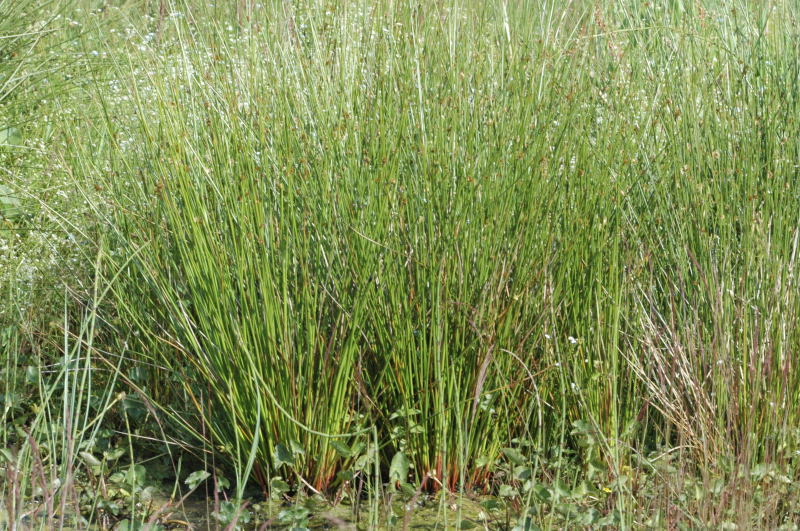
Juncus is a genus of herbaceous flowering plants in the family Juncaceae, commonly called rushes. Carl Linnaeus established the genus in Species Plantarum in 1753, designating Juncus acutus as the type, and it remains one of the largest genera among the monocot order Poales. Plants of the World Online accepts roughly 340 species worldwide, although regional treatments such as those used by SEINet historically cited closer to 200 — a reflection of how actively the genus has been revised, including the separation of Oreojuncus in 2013 and a 2022 proposal to break Juncus into six smaller genera.
Rushes are easy to confuse with grasses and sedges at a glance, but the differences are reliable. Juncus species have round, often pithy stems (rather than the triangular culms of true sedges), open leaf sheaths, and leaves that in many sections are reduced to little more than basal sheaths. The inflorescence is typically a cyme of small, wind-pollinated flowers built on a six-tepal plan: three sepal-like outer tepals and three inner ones, with two to six stamens and a three-lobed stigma. The fruit is a septicidal capsule, one- or three-locular, packed with numerous tiny ellipsoid to ovoid seeds that disperse readily by water and on muddy feet.
The genus is cosmopolitan, present on every continent except Antarctica. Most species occupy cold or persistently wet habitats — bogs, fens, lake margins, ditches, salt marshes, wet meadows, dune slacks — and in the tropics rushes are concentrated in montane wetlands. This ecological niche makes rushes important structural plants in waterlogged soils, where their dense rhizomatous clumps stabilise sediments and provide cover and food for microbes, invertebrates, amphibians, fish, and waterbirds. The same affinity for saturated ground has driven interest in Juncus species for phytoremediation, where plantings can help take up water-borne pollutants in constructed wetlands.
Rushes also have a long human history. Indigenous peoples across multiple continents used the fibrous, pith-filled stems for woven baskets, mats, cordage, thatching, and the wicks of rush-light candles; traditional Chinese and Indigenous American medicine record several Juncus species, and modern pharmacological research has begun to investigate the secondary chemistry of the group. Horticulturally, a handful of species — especially Juncus effusus (the common or soft rush) and Juncus inflexus (hard rush) — are widely grown as architectural plants for bog gardens, pond margins, and contemporary container plantings, with curl-leaved selections such as J. effusus f. spiralis ('Curly-wurly', 'Blonde Ambition', 'Unicorn') popular for their corkscrew foliage.
Etymology
The genus name Juncus was published by Carl Linnaeus in Species Plantarum in 1753, with Juncus acutus designated as the type species. The common English name "rush" — and equivalent vernaculars in other European languages — long predates Linnaean botany and refers to the slender, pith-filled stems that have been used for matting, basketry, and candle wicks since antiquity.
Distribution
Juncus has a true cosmopolitan distribution, with species recorded on every continent except Antarctica. Rushes reach their greatest diversity in cool-temperate and boreal wetlands of the Northern Hemisphere, but the genus also penetrates the Southern Hemisphere strongly — Australia alone hosts more than 100 native and naturalised taxa according to the Australian Plant Census — and in the tropics rushes persist mainly in cool montane wetlands. Individual species ranges can be intercontinental: Juncus acutus, for example, spans Southern Europe, North Africa, Macronesia, temperate Asia, the Americas, and parts of Africa.
Ecology
Rushes are characteristic plants of wet ground — bogs, fens, salt marshes, dune slacks, lake margins, and seasonal pools — and their dense rhizomatous clumps physically modify waterlogged soils. The genus supports a wide range of wetland fauna, providing food and cover for microbes, insects, amphibians, fish, and birds. Several Juncus species are studied for their ability to take up water-borne pollutants from saturated substrates, and they are routinely incorporated into constructed wetlands and phytoremediation plantings for that reason.
Cultivation
A handful of Juncus species and selections are widely grown as ornamental wetland or container plants. Missouri Botanical Garden's Plant Finder lists more than a dozen taxa, including the common rush Juncus effusus (recognised by MOBOT as a Plant of Merit), the hard rush Juncus inflexus, and the corkscrew rushes Juncus effusus f. spiralis with cultivars such as 'Curly-wurly', 'Blonde Ambition', and 'Unicorn'. Coloured-foliage selections such as J. inflexus 'Afro', BLUE MOHAWK, and 'Lovesick Blues' are popular for modern container plantings. Across the genus, rushes prefer a heavy soil in full sun to light shade, growing best in consistently moist ground, bog gardens, or shallow standing water; many tolerate heavy clay and brackish conditions.
Propagation
Juncus is straightforward to propagate. Seed is fine and is typically surface-sown in a cold frame, where natural temperature cycling improves germination. Established clumps divide cleanly in spring, and division is the standard route for named cultivars (which usually will not come true from seed).
Cultural uses
Rushes have one of the deepest material-culture records of any wetland plant group. Indigenous peoples on multiple continents used the long, pith-filled stems for woven baskets, mats, cordage, thatching, and the wicks of rush-light candles. Traditional Chinese medicine and Indigenous American pharmacopoeias both record medicinal uses of Juncus species, and modern phytochemical and pharmacological work has begun to characterise the genus's secondary metabolites.
Taxonomy notes
Juncus sits in family Juncaceae within the monocot order Poales. GBIF lists 813 descendant taxa under the genus — a figure that includes synonyms and infraspecific names — while POWO currently accepts about 340 species. SEINet's older Flora of North America-derived treatment cites roughly 200 species, illustrating how much the species concept has shifted with molecular work. Recent revisions have already carved Oreojuncus out of Juncus (2013), and a 2022 study proposed splitting what remains into six segregate genera; the broad Linnaean Juncus concept is nevertheless still in widespread use. The genus name Tenageia is treated as a synonym.










