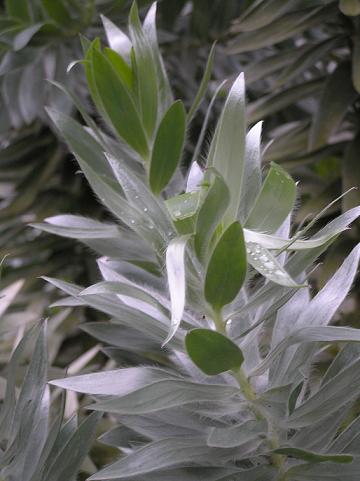
Leucadendron is a genus of approximately 85 species of evergreen shrubs and small trees in the family Proteaceae, endemic to South Africa. The genus was formally described by the Scottish botanist Robert Brown in 1810 in the Transactions of the Linnean Society of London, where it was published as a conserved name. Plants range in stature from compact shrubs around a metre tall to multi-stemmed trees that occasionally reach 16 m, and they bear elliptical, leathery, or needle-like leaves that are often coated in silky hairs.
Members of the genus are unusual among flowering plants for the degree of sexual dimorphism they display. Leucadendrons are dioecious — male and female flowers are borne on separate plants — and in some species the two sexes look so different in foliage, habit and floral display that they could be mistaken for separate species. Around half of the species are serotinous, retaining their seeds inside woody, fire-resistant cones that open only after fire passes through the vegetation. This cone-like fruiting habit is the source of the widely used common name "cone-bush." Male inflorescences are typically clusters of small flowers surrounded by colourful, often yellow or red modified leaves (involucral bracts), while female plants produce the persistent cones for which the genus is best known.
The genus is a defining element of the fynbos vegetation of the Cape Floristic Region, where it shares the landscape with related Proteaceae such as Protea and Leucospermum. Pollination involves a mix of small insects — beetles in particular — rather than the birds or rodents that visit some other proteas. Fire is a central force in their ecology: adult plants of many species are killed by fire while their stored seed bank is released, germinates after the rains, and re-establishes the population from seed.
Leucadendron is also one of the most economically significant proteaceous genera in horticulture. The bright, long-lasting bracts and structural cones of cultivars and hybrids are widely used in the international cut-flower and dried-flower trade, and propagation in commercial nurseries is largely from cuttings to keep cultivars uniform.
Etymology
The name Leucadendron is formed from the Greek words leukos, meaning "white," and dendron, meaning "tree," echoing the Dutch settlers' name witteboom (white tree) for the silver-leaved species growing on the slopes of Table Mountain. The genus name therefore literally translates as "white tree," a reference to the dense, silky hairs that give Leucadendron argenteum and several relatives their characteristic silvery sheen.
Distribution
Leucadendron is endemic to South Africa. Its centre of diversity is the Cape Floristic Region — the Cape Provinces (Western and Eastern Cape) — with outlying species reaching into KwaZulu-Natal. The genus does not occur naturally outside South Africa, although several species and hybrids are cultivated worldwide for the cut-flower trade.
Ecology
Leucadendrons are quintessential fynbos plants, adapted to a Mediterranean climate of wet winters, dry summers, nutrient-poor soils, and recurrent fire. Roughly half the species are serotinous: they hold their seeds in tightly closed, woody cones for years, releasing them only after the parent plant has been killed by fire. Seedlings then establish in the post-fire seedbed, and in the best-studied species the seedbank can remain viable in the soil for decades — up to about 80 years in Leucadendron argenteum. Pollination is generally by small insects, with beetles documented as the main visitors to some species. The genus is dioecious, and in many species males and females differ markedly in leaf shape, size and floral display, an unusually pronounced form of sexual dimorphism for flowering plants. The lineage is ancient within Proteaceae, with the genus thought to have diversified during the Cenozoic, roughly 30 million years ago.
Cultivation
Leucadendrons are grown both as ornamental shrubs and as commercial cut-flower crops. As a group they require well-drained, low-nutrient soils, full sun, and good air circulation; rich or poorly drained soils and root disturbance both predispose plants to Phytophthora root-rot, which is the most common cause of failure in cultivation. Regular watering through the cooler half of the year suits the Mediterranean-climate species, while frost protection extends their range outside South Africa. The bright bracts produced around male inflorescences make the genus an important component of the international floricultural trade.
Propagation
Commercial growers propagate Leucadendron mainly from cuttings, because cuttings yield uniform plants that match the parent cultivar, whereas seedlings can vary widely. Seed is also viable: in Leucadendron argenteum, fresh autumn seed germinates in three to six weeks, and autumn is likewise the recommended time for taking semi-hardwood cuttings. Seeds of many species mature slowly — about a year — inside woody cones.
Conservation
Leucadendron is a genus of high conservation concern. A 2021 assessment reports that 51.1% of species are threatened and 71.8% are of conservation concern, driven by habitat loss to agriculture and urbanisation, invasive alien plants, overgrazing, and inappropriate fire regimes — either fire exclusion or excessive burning. The flagship species Leucadendron argenteum is classified as endangered: it persists in only a handful of small Cape Peninsula populations, has lost roughly three-quarters of its historical population, and is further threatened by Phytophthora root-rot and by fire-exclusion management that has left ageing, moribund stands behind.
Cultural Uses
The most familiar use of Leucadendron today is in the global cut- and dried-flower industry, where stems, bracts and woody cones are prized for their bright, long-lasting colour. Historically, the silver tree (L. argenteum) and other large Cape leucadendrons were felled in quantity for firewood during the 17th and 18th centuries — a use long since abandoned but still cited as a factor in the species' decline. Today female cones, male flower heads and silvery foliage continue to be used in floristry, dried arrangements and Cape souvenir crafts.
History
Leucadendron was formally described by Robert Brown in 1810 in the Transactions of the Linnean Society of London (volume 10, page 50), and the name is conserved. The plants themselves were known to Europeans much earlier: the first European record of the silver tree dates to 1620, when the French navigator Augustin de Beaulieu noted it at the Cape, and Linnaeus praised it in 1737 as "the most shining and splendid of all plants."
Taxonomy
Leucadendron sits in family Proteaceae, order Proteales. Plants of the World Online treats it as an accepted, conserved genus with 85 accepted species and several historical synonyms, including Lepidocarpus Adans. and the rejected Protea L. (nom. rej.), as well as Chasme Salisb., Euryspermum Salisb., Gissonia Salisb. ex Knight, and Vionaea Neck. Common names include cone-bush, in reference to the woody seed-bearing cones characteristic of female plants.










