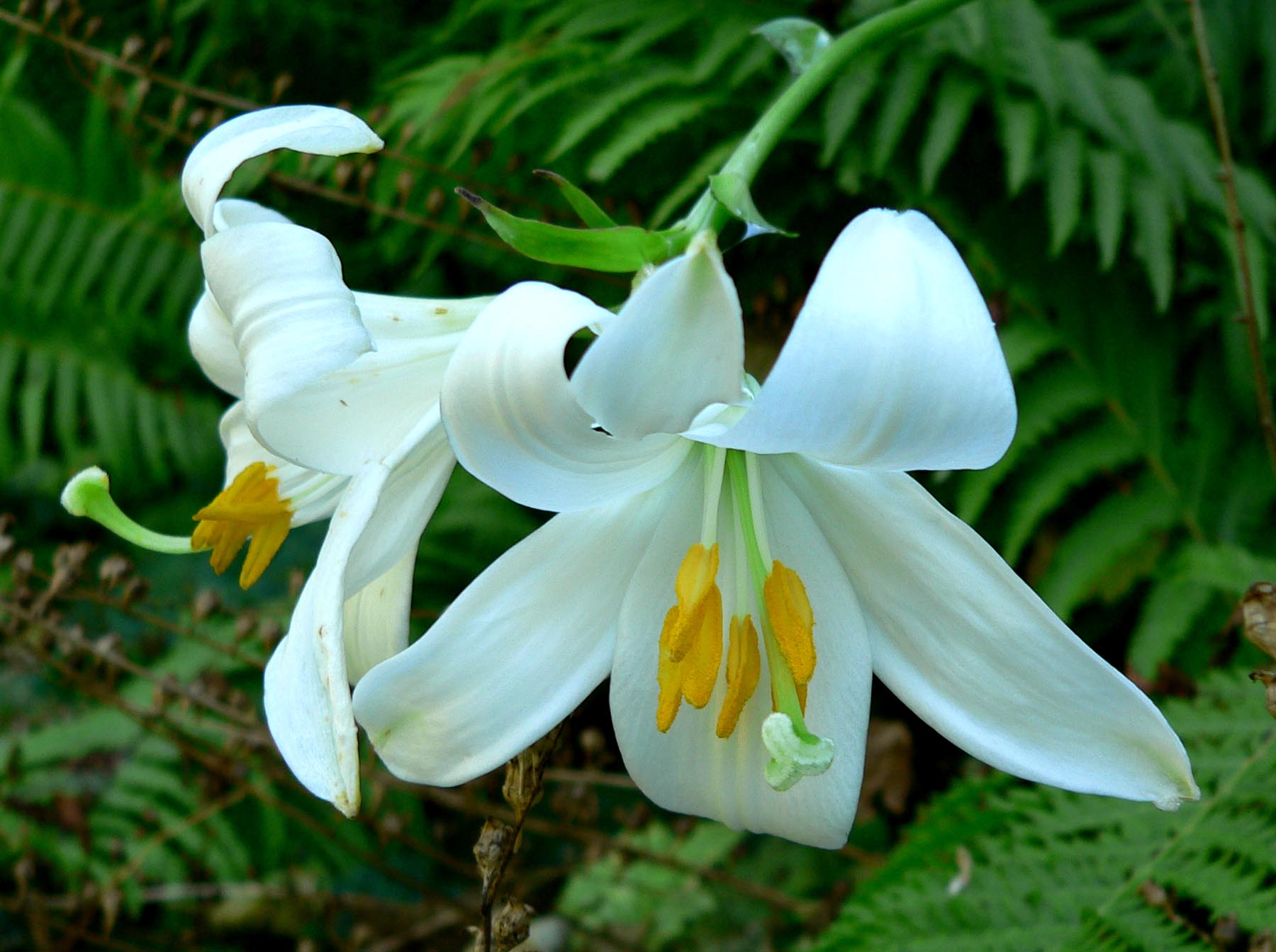
Lilium (Tourn. ex L.), commonly called the lilies, is a genus of bulbous herbaceous perennials in the family Liliaceae, first described by Linnaeus in Species Plantarum in 1753. Plants of the World Online currently recognises 124 accepted species, while other authorities such as Wikipedia and GBIF report figures around 80 to 119, reflecting ongoing taxonomic revision within the genus. The type species is Lilium candidum, the Madonna lily of the Mediterranean. The botanical name derives from Greek leírion, ultimately tracing back through Coptic to Egyptian ḥrr.t, meaning simply "flower."
Lilies are native to the temperate Northern Hemisphere, with the Old World range stretching from western Europe across most of Asia to Japan, south to India, and east through Indochina to the northern Philippines. In the New World they occur from southern Canada through much of the United States and into Mexico. The genus has been widely introduced beyond this range and has naturalised in parts of Africa, South America, Australasia, and northern Europe. Lilies favour woodland, often montane, or grassland habitats with moderately acidic, lime-free soils.
The plants grow from scaly bulbs and produce unbranched leafy stems topped by clusters of large, six-tepalled flowers in cream, yellow, orange, pink, purple, red, white, or variegated colours. Most species flower in June, July, or August in the northern hemisphere. Lilies are an old and important horticultural genus: numerous ornamental hybrids have been developed and are organised into nine recognised horticultural divisions (Asiatic, Martagon, Candidum, American, Longiflorum, Trumpet, Oriental, Other hybrids, and Species). They are also crops and traditional medicines — starchy edible bulbs of species such as L. brownii, L. lancifolium, and L. pumilum are used in Chinese, Japanese, and North American cuisines and in kanpō and Traditional Chinese medicine. In Western symbolism the white lily is a long-standing emblem of purity. Gardeners should note, however, that true lilies are highly toxic to cats and can cause acute kidney failure.
Etymology
The genus name Lilium is the classical Latin form of the Greek leírion, the word the ancient Greeks applied to white lilies and especially to what is now L. candidum, the Madonna lily. The word was itself a loan into Greek from Coptic ϩ̀ⲣⲏⲣⲓ, and its ultimate source is Egyptian ḥrr.t, meaning "flower." Linnaeus formally adopted Lilium as the genus name in Species Plantarum in 1753, attributing the older usage to Tournefort, which is why the standard authorship today is "Tourn. ex L."
Distribution
Lilium is native throughout the temperate Northern Hemisphere, with its southern limit at the northern Philippines. In the Old World the genus ranges from western and southern Europe — including France, Spain, Italy, Greece, Albania, Bulgaria, Austria, Hungary, Germany, Poland, Switzerland, Turkey, and Ukraine — across the Caucasus and Iran into Afghanistan, Pakistan, India, Nepal, and Tibet, then through China, Korea, Japan, Taiwan, Vietnam, and Thailand to the northern Philippines. In the New World it occurs from southern Canada through much of the United States to Mexico. The genus has been introduced and naturalised well beyond its native range, including in Great Britain and Ireland, Scandinavia and the Netherlands, Belgium, Denmark, Finland, the Canary Islands, Algeria, Kenya, Argentina, Brazil, and New Zealand.
Ecology
Lilies are typical inhabitants of temperate woodlands — often montane — and grasslands, where they grow from a bulb on a single unbranched stem each season and overwinter as dormant bulbs in the soil. They generally prefer moderately acidic, lime-free soils rich in leaf mould, with cool roots and adequate moisture during the growing season. The flowers, often large and fragrant, attract butterflies and hummingbirds and act as significant nectar and pollen sources for these visitors. In several parts of the genus's range, overabundant deer populations have been linked to declines of wild lily populations through repeated browsing.
Cultivation
Garden lilies are hardy bulbous perennials grown across USDA zones 3 to 9, with most species comfortable in zones 6 to 8. They thrive in a sunny to part-shaded position — the traditional rule is "head in the sun, feet in the shade" — with full sun or afternoon sun on the foliage and a cool, mulched root zone below. Soils should be deep, fertile, and well drained, moderately acidic (pH around 6 to 6.5), and ideally enriched with leaf mould; persistently wet soils risk bulb rot. Bulbs are typically planted in autumn at a depth of around 8 inches, or roughly two and a half times the bulb's own height, and flower the following June to August in the northern hemisphere. Most lilies are excellent long-lasting cut flowers, though the pollen stains clothing and skin and many gardeners pinch the anthers from cut stems. Common problems include aphids — which can vector lily mosaic virus — bulb mites, narcissus bulb fly, slugs, snails, voles, and Botrytis. The flowers and other plant parts are highly toxic to cats.
Propagation
Lilies can be raised by several complementary methods. Mature bulbs naturally produce offset bulblets at the base of the parent bulb after flowering, which can be lifted and grown on; in the open ground these typically need three to five years to reach flowering size. Many species and cultivars also form bulbils — small dark bulb-like propagules — in the leaf axils along the stem, which can be detached and sown. Scaling, in which individual scales are pulled from a healthy bulb and incubated in moist medium, is a standard nursery technique. Seed propagation is possible but slow: germination is often delayed and cold stratification may be required, sometimes producing seedlings only after two years. Commercial production today relies heavily on micropropagation through tissue culture, which allows rapid bulking of clean stock of named hybrids.
Cultural uses
Lilies have a long history of use beyond the ornamental border. The starchy bulbs of several Asian species, notably Lilium brownii var. viridulum, L. lancifolium, and L. pumilum, are eaten as a root vegetable in Chinese, Japanese, and parts of North American cuisine; in Japan they are known as yuri-ne and appear in dishes such as chawan-mushi and in confections. The same species also figure prominently in Traditional Chinese and Japanese kanpō medicine, where the dried bulb is used as a tonic. Beyond food and medicine, the white lily — above all L. candidum — has been a Western emblem of purity, beauty, and chastity for millennia, and in modern Japanese popular culture white lilies have become the de facto symbol of the yuri genre.
History
The genus has been at the heart of ornamental horticulture for centuries. Linnaeus formalised the name in 1753, but cultivation of species such as the Madonna lily reaches back into antiquity. From the late 19th and early 20th centuries onwards, breeders crossed Asian, North American, and European species to create the wide spectrum of garden lilies now grown worldwide. These hybrids are organised under the International Lily Register into nine horticultural divisions — Asiatic, Martagon, Candidum, American, Longiflorum, Trumpet, Oriental, Other hybrids, and Species — and most modern commercial production relies on tissue culture to bulk up named cultivars.
Taxonomy notes
Lilium sits in the family Liliaceae, order Liliales, with Lilium candidum as its type species. Authorities differ slightly on the number of accepted species: Plants of the World Online currently lists 124, Wikipedia cites 119, and the GBIF Backbone Taxonomy resolves a somewhat smaller set in the low-80s among its accepted children. Internally the genus has traditionally been divided into seven sections — Martagon, Pseudolirium, Liriotypus, Archelirion, Sinomartagon, Leucolirion, and Daurolirion — though section boundaries have been revised in light of molecular phylogenetics.










