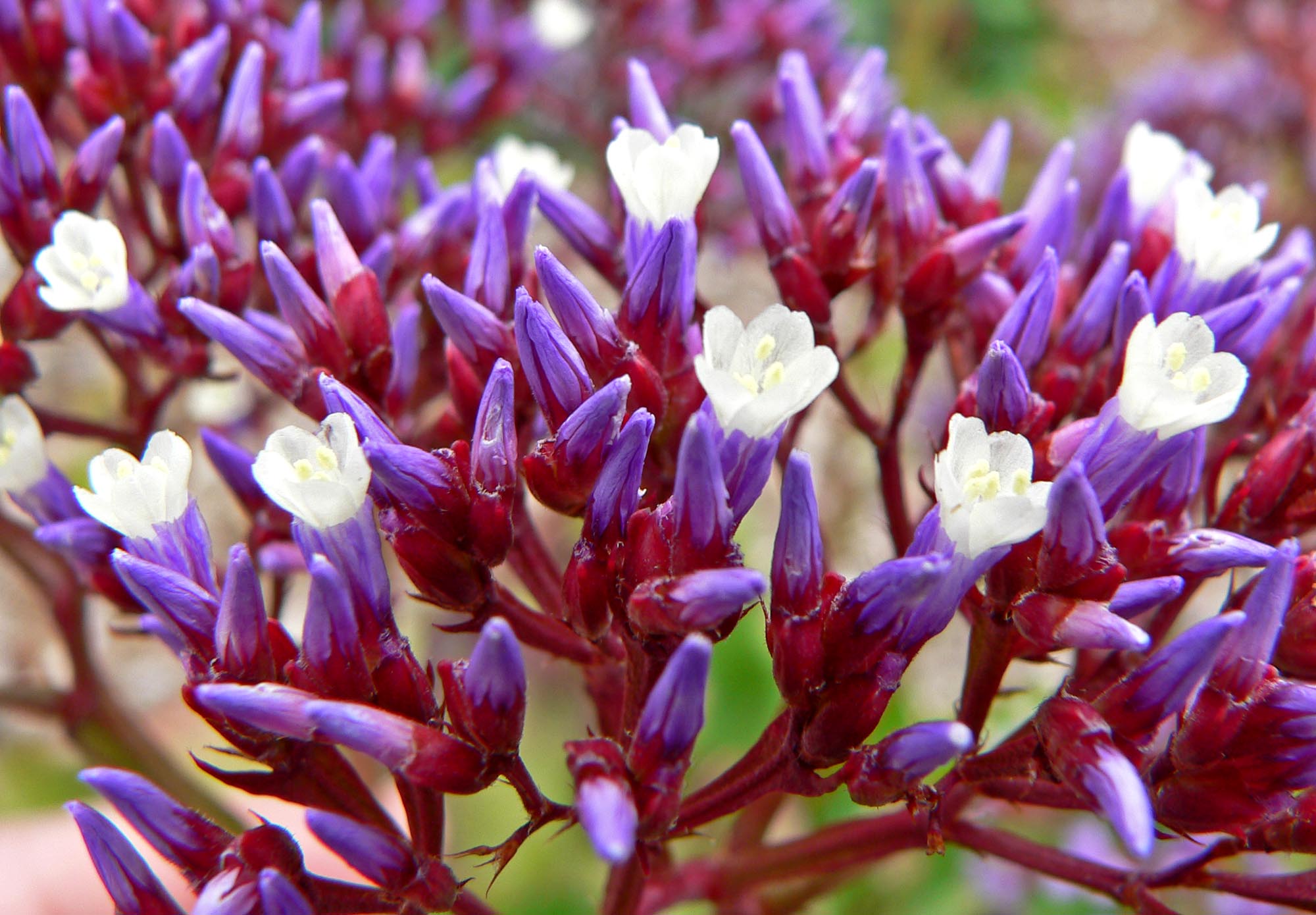
Limonium (sea-lavender, statice) is a genus of approximately 600 flowering plant species in the family Plumbaginaceae, distributed across every major continent except Antarctica. Despite their common names — sea-lavender, marsh-rosemary, and caspia — these plants are unrelated to true lavenders or rosemary; the resemblance is purely superficial.
Most species are herbaceous perennials growing 10–70 cm tall from rhizomes, though several Canary Island species develop into woody shrubs reaching 2 m. Leaves are simple, entire to lobed, ranging from 1 to 30 cm long, and are arranged in characteristic dense basal rosettes. Flowers are borne on branched panicles or corymbs; each bloom measures 4–10 mm with a five-lobed calyx and corolla. Colors run predominantly to pink, violet, and purple, with some species producing white or yellow flowers.
One of the genus's most commercially important traits is the persistent calyx, which remains intact and colourful long after the true petals fall — giving rise to their status as classic "everlasting flowers" in the cut-flower trade. Many species also reproduce apomictically, a feature that contributes to the high number of microspecies recorded in the genus. The genus was formally established by Philip Miller in 1754 and currently includes 814 recorded species and lower taxa in GBIF.
Etymology
The genus name Limonium derives from the Latin līmōnion, a word employed by Pliny the Elder for a wild plant. Latin līmōnion in turn traces to the Ancient Greek leimon (λειμών), meaning "meadow" — likely a reference to the moist, grassy, or coastal lowland habitats where many species grow. The genus was formally established by Philip Miller in 1754.
Distribution
Limonium has a subcosmopolitan distribution, occurring across Europe, Asia, Africa, North America, and Australia. The centre of diversity lies in a broad arc from the Canary Islands east through the Mediterranean basin to central Asia, where more than 100 species are native. By contrast, only three species are native to North America. The genus shows a strong affinity for coastal and halophytic environments globally, though some inland and steppe species occur in the Mediterranean and Asian ranges.
Ecology
Members of Limonium are characteristic plants of saline and coastal habitats. They thrive in salt marshes, sea cliffs, coastal dunes, and alkaline inland flats — environments that many other plants cannot tolerate. Their exceptional salt tolerance makes them prominent components of halophytic vegetation communities. Several species are important nectar sources for bees and other pollinators, with flowers produced from late summer through autumn (August–October in temperate regions). Many species reproduce apomictically, a trait that favours rapid local adaptation and explains the proliferation of microspecies in geographically isolated coastal populations.
Cultivation
Limonium species are straightforward to grow in open, sunny positions. They require full sun (at least six hours daily) and well-drained soil; sandy or loamy substrates are ideal. While tolerant of acidic soils, most species prefer neutral to slightly alkaline pH. Hardy to USDA zones 4a–9b depending on species, with some tolerating temperatures down to around −20°C. Plants are notably salt-tolerant and well-suited to coastal gardens.
Good air circulation is important to prevent crown rot and root rot, which are the most common disease problems. Tall-growing forms may benefit from staking in heavy clay soils. Limonium is generally free of serious pests and diseases. The plants are prized as fresh and dried cut flowers; the persistent calyces retain their colour for months after harvest, making them a staple of the everlasting-flower trade.
Propagation
Limonium can be propagated by seed or by division. Seed is typically sown in a greenhouse in spring; seedlings are pricked out individually and kept under glass through winter before planting out after the last frost. Division is possible in spring but is considered difficult, as established plants dislike disturbance and divisions may be slow to re-establish. In commercial cut-flower production, vegetative propagation from cultivar material is standard to ensure uniformity.
Cultural Uses
Roots of Limonium species contain substantial amounts of tannin and have historically been used in folk medicine as a powerful astringent. Traditional preparations include decoctions of the root to treat diarrhea and dysentery, and dried powdered root applied locally for mouth ulcers, cankers, and sore gums. In contemporary use, the genus is primarily valued horticulturally — as a cut flower and dried-flower crop — rather than for medicinal or food purposes.
Taxonomy Notes
Limonium Mill. belongs to the order Caryophyllales, family Plumbaginaceae (the leadwort or plumbago family). Despite common names shared with unrelated plants — sea-lavender (Lamiaceae), marsh-rosemary (Ericaceae) — Limonium is not closely related to either. GBIF records 814 species and lower taxa; the high number reflects widespread apomictic reproduction, which generates numerous locally differentiated microspecies, especially around the Mediterranean and the Macaronesian islands. Taxonomic boundaries within the genus remain actively studied.










