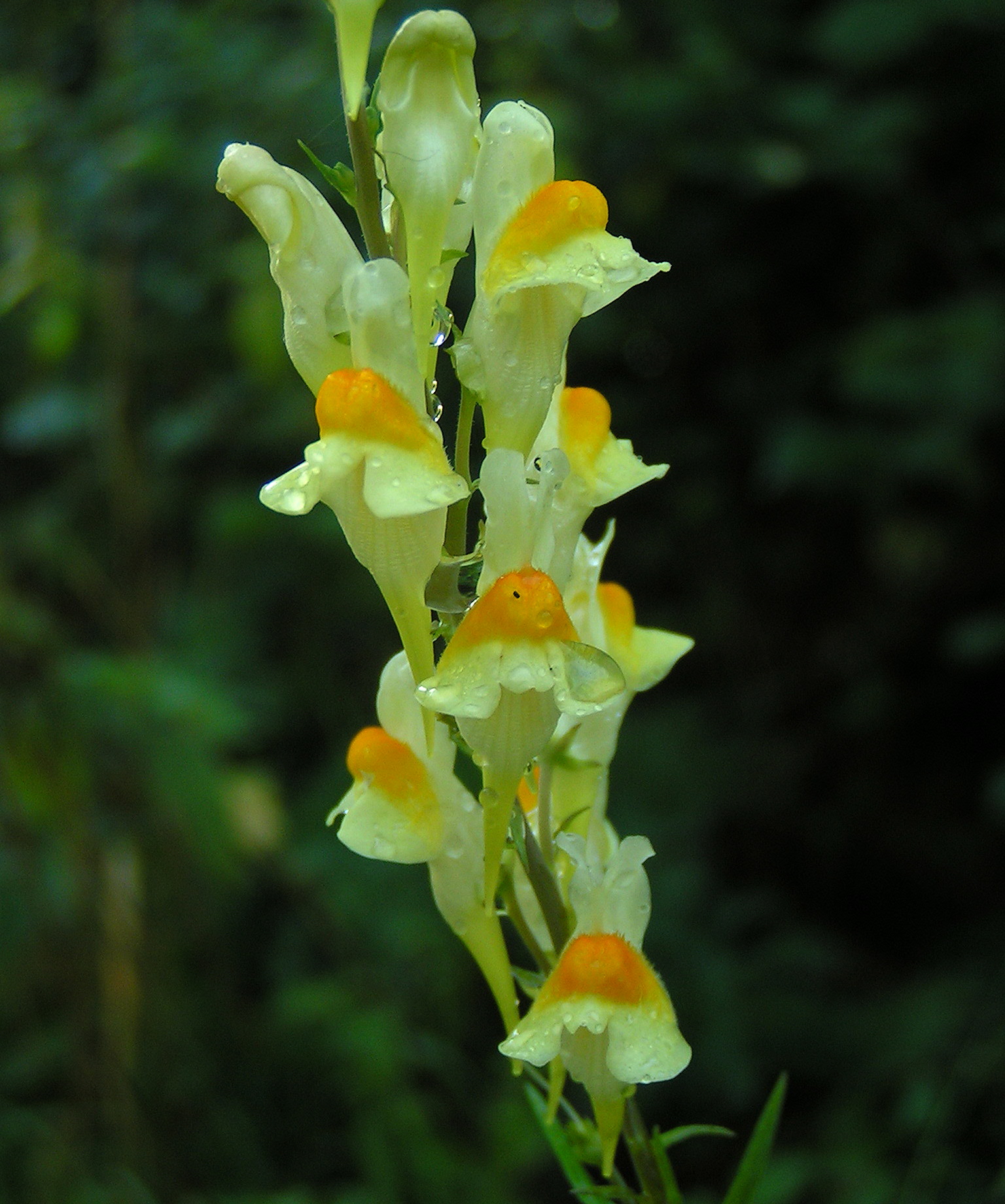
Linaria, commonly known as toadflax, is a genus of nearly 200 species of annuals and herbaceous perennials in the family Plantaginaceae (plantain family), order Lamiales. It is the largest genus in the tribe Antirrhineae, which also includes the closely related snapdragons (Antirrhinum), ivy-leaved toadflaxes (Cymbalaria), and North American toadflaxes (Nuttallanthus). The genus was established by Philip Miller in 1754 and was formerly placed in the Scrophulariaceae before molecular phylogenetic analysis led to its reclassification into Plantaginaceae.
The center of diversity for Linaria lies in the Mediterranean region, with the genus distributed across temperate Europe, northern Africa, and Asia. Species range from delicate alpine mat-formers such as L. alpina to robust perennials like L. vulgaris (common toadflax) and L. dalmatica (Dalmatian toadflax). The flowers are distinctly zygomorphic, two-lipped and spurred — resembling miniature snapdragons — and occur in a wide palette from yellow and orange to purple, pink, and white.
Several species are valued garden ornamentals, notably L. purpurea (purple toadflax), L. maroccana (Moroccan toadflax, a popular bedding annual), and L. alpina. Some species, particularly L. vulgaris and L. dalmatica, have naturalized widely outside their native range and are considered noxious weeds in parts of North America, where they invade pastures, roadsides, and disturbed habitats. Livestock generally avoid toadflaxes, as the plants are considered potentially toxic. Plants in this genus are known to contain alkaloids, iridoids, terpenes, phenolic acids, and flavonoids — compounds that have attracted interest in ethnobotany and pharmacognosy. Linaria vulgaris, in particular, has a long history of use in traditional herbal medicine.
Etymology
The genus name Linaria derives from Linum, the Latin word for flax, reflecting the resemblance of the narrow, grass-like leaves of some species to those of flax plants. Philip Miller coined the name when he formally described the genus in 1754. The common name toadflax has a more convoluted origin: one etymology links it to the resemblance of the closed flower (before a pollinator forces it open) to a toad's mouth; another traces it to a historical association with treating bubonic plague, drawing a spurious linguistic connection between bubo (the swollen lymph node of plague) and Bufo (the toad genus).
Distribution
Linaria is centered in the Mediterranean Basin, which harbors the greatest species richness. The genus extends through temperate Europe, northern Africa, and temperate Asia. In Switzerland alone, InfoFlora documents 14 species and subspecies, including L. alpina, L. arvensis, L. genistifolia, L. purpurea, L. repens, L. simplex, L. supina, L. vulgaris, and the rare endemic L. tonzigii. Several species have been introduced far beyond their native range: L. vulgaris and L. dalmatica are now naturalized across North America, where they occur on roadsides, disturbed ground, rangeland, and open grasslands.
Ecology
Toadflaxes occupy a range of open, often disturbed habitats — roadsides, grasslands, rocky slopes, arable margins, and scree. The flowers are strongly protandrous and rely on long-tongued bees capable of forcing open the closed corolla to reach the nectar spur; short-tongued insects sometimes rob nectar by piercing the spur. Linaria species serve as larval food plants for certain Lepidoptera, including the mouse moth and the common buckeye butterfly. Livestock generally avoid toadflaxes, consistent with the plants' reputation for toxicity; phytochemical screening has revealed alkaloids, iridoids, terpenes, phenolic acids, and flavonoids (including vasicine, luteolin, quercetin, and aucubin). Introduced species such as L. vulgaris and L. dalmatica are aggressive colonizers of disturbed ground and can form dense monocultures that displace native vegetation.
Cultivation
Several Linaria species are grown as ornamentals for their colorful, snapdragon-like flowers. Linaria maroccana (Moroccan toadflax) is a popular cool-season annual for beds and containers, available in mixed colors from white through pink, red, purple, and bicolors. Linaria purpurea (purple toadflax) is a slender perennial widely grown in cottage gardens, self-seeding freely in well-drained soil. Linaria alpina is suited to rock gardens and troughs. Most species prefer full sun and sharply drained, moderately fertile soil; they are generally drought-tolerant once established. Some perennial species, particularly L. vulgaris, spread vigorously by both seed and creeping rhizomes and may become invasive in garden settings.
Propagation
Annual species such as L. maroccana are easily raised from seed sown in situ in early spring or autumn (in mild climates). Seed requires light for germination and should not be covered. Perennial species can be propagated by seed, division of established clumps in spring, or stem cuttings taken in early summer. Most species self-sow freely in suitable conditions; deadheading after the main flush reduces unwanted spread. Rhizomatous species like L. vulgaris regenerate from root fragments, so removal must be thorough to prevent regrowth.
Conservation
No global conservation assessment exists for the genus Linaria as a whole. Conversely, certain introduced species — notably L. vulgaris (common toadflax) and L. dalmatica (Dalmatian toadflax) — are considered invasive weeds in North America, listed as noxious weeds in multiple US states and Canadian provinces, where they colonize rangelands and crowd out native plants. Biological control programs using specialist insects have been developed to manage these introductions. Several native Mediterranean and mountain species may face localized threats from habitat loss, but no species-level IUCN Red List assessments were available in the sources consulted.
Cultural Uses
Linaria vulgaris has the longest ethnobotanical record within the genus. It was used in European folk medicine as a diuretic, laxative, and treatment for jaundice and skin conditions; a yellow dye can be extracted from the flowers, though it is not considered lightfast. The plant has also been investigated pharmacologically for its iridoid glycoside aucubin and for flavonoids such as luteolin and quercetin, which show antioxidant activity in laboratory studies. Historically, preparations of toadflax were applied externally as poultices.
Taxonomy Notes
Linaria was long placed in the family Scrophulariaceae alongside foxgloves, mulleins, and figworts. Molecular phylogenetic studies in the late 20th and early 21st centuries demonstrated that the traditional Scrophulariaceae was polyphyletic, and Linaria — together with Antirrhinum, Cymbalaria, and other Antirrhineae — was transferred to the expanded Plantaginaceae. Within Plantaginaceae the genus belongs to the tribe Antirrhineae and is considered its largest member, with around 200 accepted species. GBIF records 417 described descendant taxa under the accepted name Linaria Mill., a figure that includes synonyms and infraspecific taxa. The genus is most closely allied to Nuttallanthus (North American toadflaxes, once included in Linaria), Antirrhinum (snapdragons), and Cymbalaria (ivy-leaved toadflaxes, also formerly included in Linaria).










