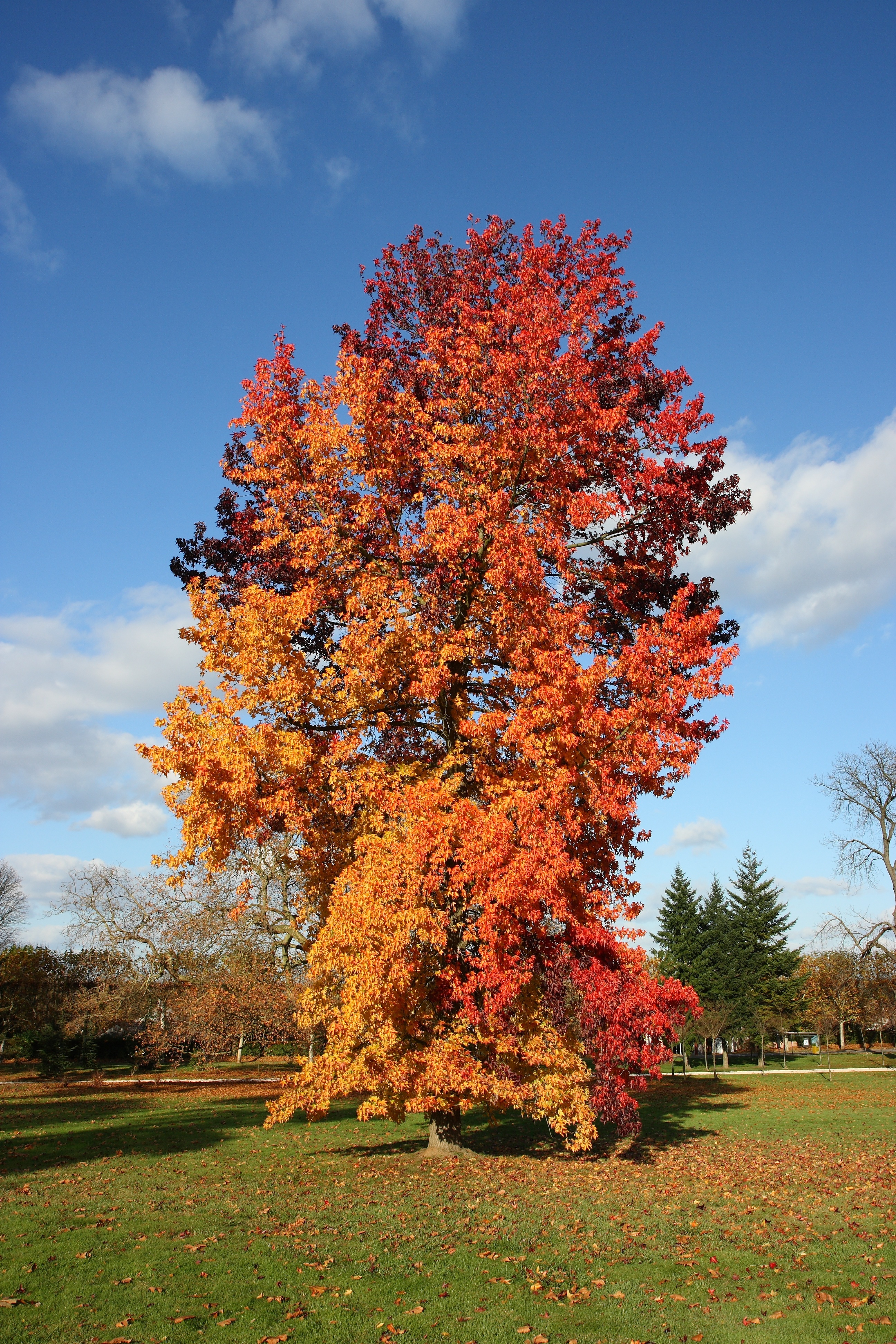
Liquidambar, commonly known as sweetgum, is the only extant genus in the flowering plant family Altingiaceae (order Saxifragales), comprising approximately 15 species of large deciduous trees. The genus was formerly placed in Hamamelidaceae before molecular studies established Altingiaceae as a distinct family.
Trees are typically 25–40 m (82–131 ft) tall, with palmately 3- to 7-lobed leaves 12.5–20 cm long arranged spirally on the stems. The leaves emit a pleasant fragrance when crushed and produce some of the most spectacular autumn colour of any temperate tree, turning shades of red, orange, yellow, and purple — most brilliantly where nights are cool. Mature bark is grayish and vertically grooved. Flowers are small and inconspicuous, borne in dense globular inflorescences on pendulous stems. The distinctive fruit is a woody multiple capsule 2–4 cm in diameter — popularly called a "gumball" — covered in sharp woody spines and containing numerous seeds.
The genus has a famously disjunct distribution, with species native to eastern North America, Central America, Southeast and East Asia, and the eastern Mediterranean (Turkey and the Greek island of Rhodes). The American sweetgum (Liquidambar styraciflua) is the most widely known species, prized as an ornamental street and park tree across warm-temperate regions worldwide. The Formosan sweetgum (L. formosana), native to China and Taiwan, and the oriental sweetgum (L. orientalis) of Turkey and Rhodes are also cultivated ornamentally.
The hardened resin ("storax" or "styrax") exuded from wounds in the trunk has been used medicinally and as a chewing gum for centuries. The wood, classified as hardwood, is used for furniture, veneers, paper pulp, and engineered wood products. In Traditional Chinese medicine, the dried spiky fruit of native species (lu lu tong) has been documented since at least 720 AD.
Etymology
The genus name Liquidambar derives from the Latin liquidus ("liquid") and the medieval Latin ambar ("amber"), referring to the sweet, amber-coloured resinous sap exuded from the trunk when cut. The English common name "sweetgum" and the older names "satin-walnut" and "American storax" also reference this fragrant resin.
Distribution
Species are native to a disjunct range spanning eastern North America (eastern United States from Texas to Connecticut, plus Mexico and Central America), Southeast and East Asia (Indonesia, Malaysia, Thailand, Cambodia, Vietnam, China, Taiwan, South Korea, Laos, Myanmar, Bhutan), and the eastern Mediterranean (Turkey and Rhodes, Greece). The genus is considered artificially introduced in India, Italy, Spain, and Belgium. In cultivation it is grown across warm-temperate and subtropical climates worldwide.
Ecology
Liquidambar trees are among the last deciduous trees to leaf out in spring and among the last to drop leaves in autumn. The spiky woody capsules may function as epizoochory dispersal units, attaching to animal fur. The trees serve as larval foodplants for various caterpillar species.
Cultivation
The American sweetgum (L. styraciflua) is widely planted as an ornamental within and beyond its native range; autumn foliage is most vivid where nights are cool, though selected cultivars perform well in warmer climates. The fallen spiky seedpods can be a nuisance on lawns and pavements. The wood is commercially valued for furniture, veneers, paper pulp, flake board, and strand board.
Cultural Uses
The hardened sap of sweetgum has long been chewed as gum in the southern United States and was historically believed to treat sciatica and nerve weakness. The resin has economic value for its balsam content, use in cosmetics, and medicinal applications. In Traditional Chinese medicine, the dried fruit (lu lu tong, "all roads open") of native sweetgum species has been documented since 720 AD in Omissions from the Materia Medica by Chen Cangqi; it is used to promote circulation, water metabolism, and to relieve pain and stiffness.










