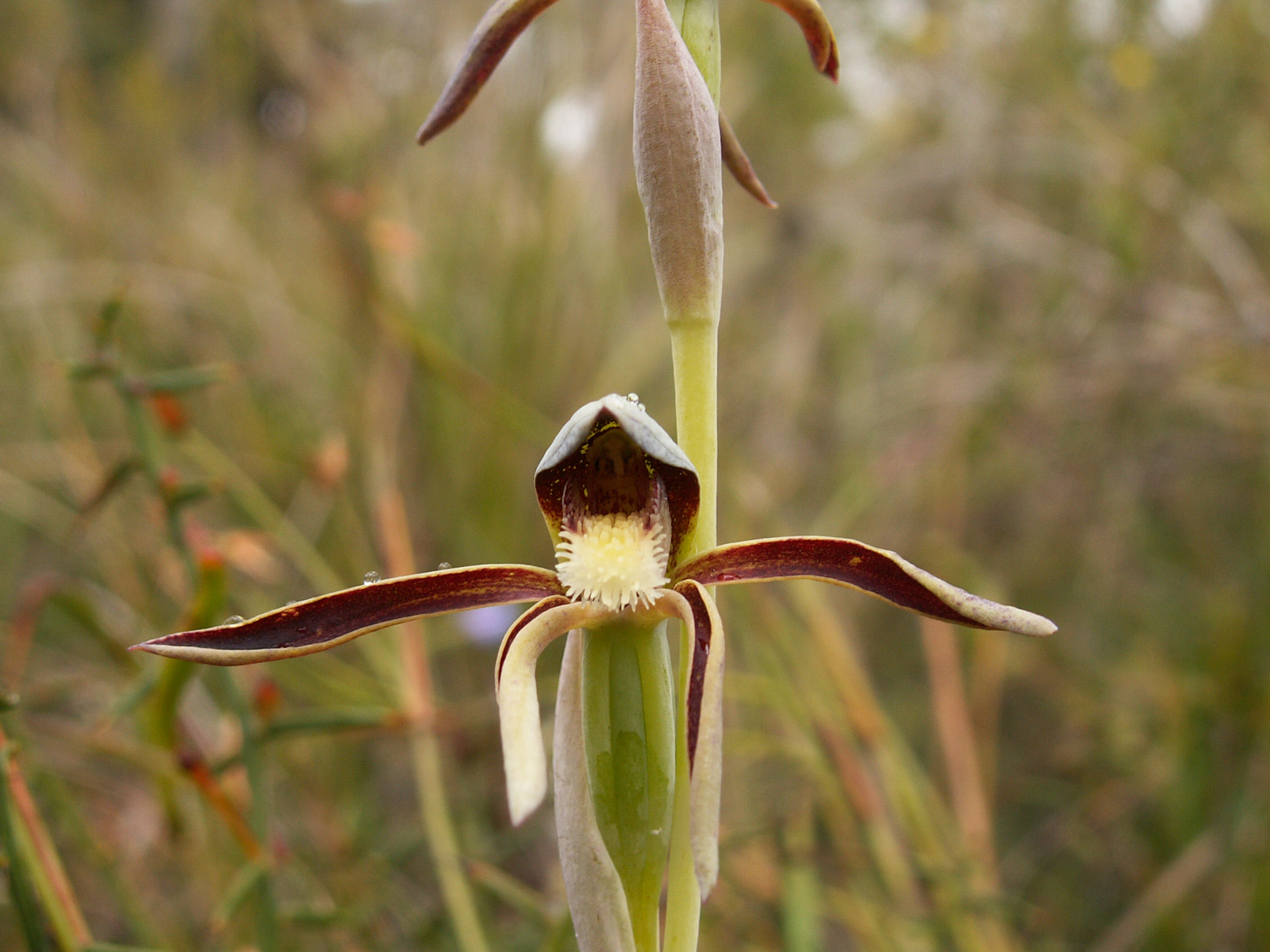
Lyperanthus, commonly known as beak orchids, is a small genus of terrestrial orchids in the family Orchidaceae (order Asparagales), endemic to Australia and containing exactly two accepted species. The genus was first formally described in 1810 by the botanist Robert Brown in his landmark work Prodromus Florae Novae Hollandiae.
Plants are terrestrial, perennial, deciduous, sympodial herbs that grow from oval-shaped tubers lacking a protective sheath. Each season, new tubers develop at the ends of long, root-like stolons. The most conspicuous vegetative feature is a single, erect, leathery, stiff, linear to lance-shaped leaf, 12–40 cm long and 12–15 mm wide, bearing tiny pimple-like glands on the lower surface. This distinctive leaf often protrudes above surrounding vegetation and is frequently the first part of the plant noticed in the field.
The inflorescence is a raceme carrying one to eight resupinate flowers on an erect stem reaching up to 50 cm in height. Flowers are brownish, reddish, and green in colour. The dorsal sepal is lance-shaped, about 2 cm long, and arches to form a hood over the column, while the two lateral sepals are stiff, leathery, roughly 3 cm long, and often have their edges rolled inwards. The labellum — the highly modified central petal characteristic of orchids — is 9–10 mm long, gently curved, three-lobed, and densely covered with rows of rounded or erect calli; it is this feature of dull flowers crowded with calli that gives the genus both its common name (beak orchids) and its botanical epithet. Flowering occurs from August to November, followed by dehiscent capsule fruits containing up to 500 seeds.
Lyperanthus serratus (rattle beaks) is restricted to Western Australia, while Lyperanthus suaveolens (brown beaks) occurs across New South Wales, Victoria, Queensland, and Tasmania. Both species form loose colonies that reproduce both asexually via tubers and sexually via insect-pollinated flowers.
Etymology
The genus name Lyperanthus is derived from the Ancient Greek words lypros, meaning "poor" or "wretched," and anthos, meaning "flower," a reference to the dull, sombre colouring of the flowers that distinguishes this genus from many of its more showy orchid relatives.
Distribution
Lyperanthus is endemic to Australia. Lyperanthus serratus is confined to Western Australia, while Lyperanthus suaveolens has a broader eastern distribution spanning New South Wales, Victoria, Queensland, and Tasmania. Both species grow as terrestrial orchids in their respective native habitats.
Ecology
The precise pollination mechanism of Lyperanthus is not documented in the scientific literature. L. suaveolens produces a strong fragrance in warm weather and both species offer nectar to visitors, suggesting bee pollination is likely. Unlike many other Western Australian terrestrial orchids, neither species of Lyperanthus is known to require fire as a trigger for flowering.
Taxonomy Notes
Lyperanthus was first formally described in 1810 by Robert Brown and published in Prodromus Florae Novae Hollandiae. The genus once included additional species that have since been transferred to other genera: L. antarcticus is now Waireia stenopetala, L. ellipticus is now Rimacola elliptica, L. forrestii is now Pyrorchis forrestii, and L. nigricans is now Pyrorchis nigricans. GBIF recognises two accepted descendants in the genus.










