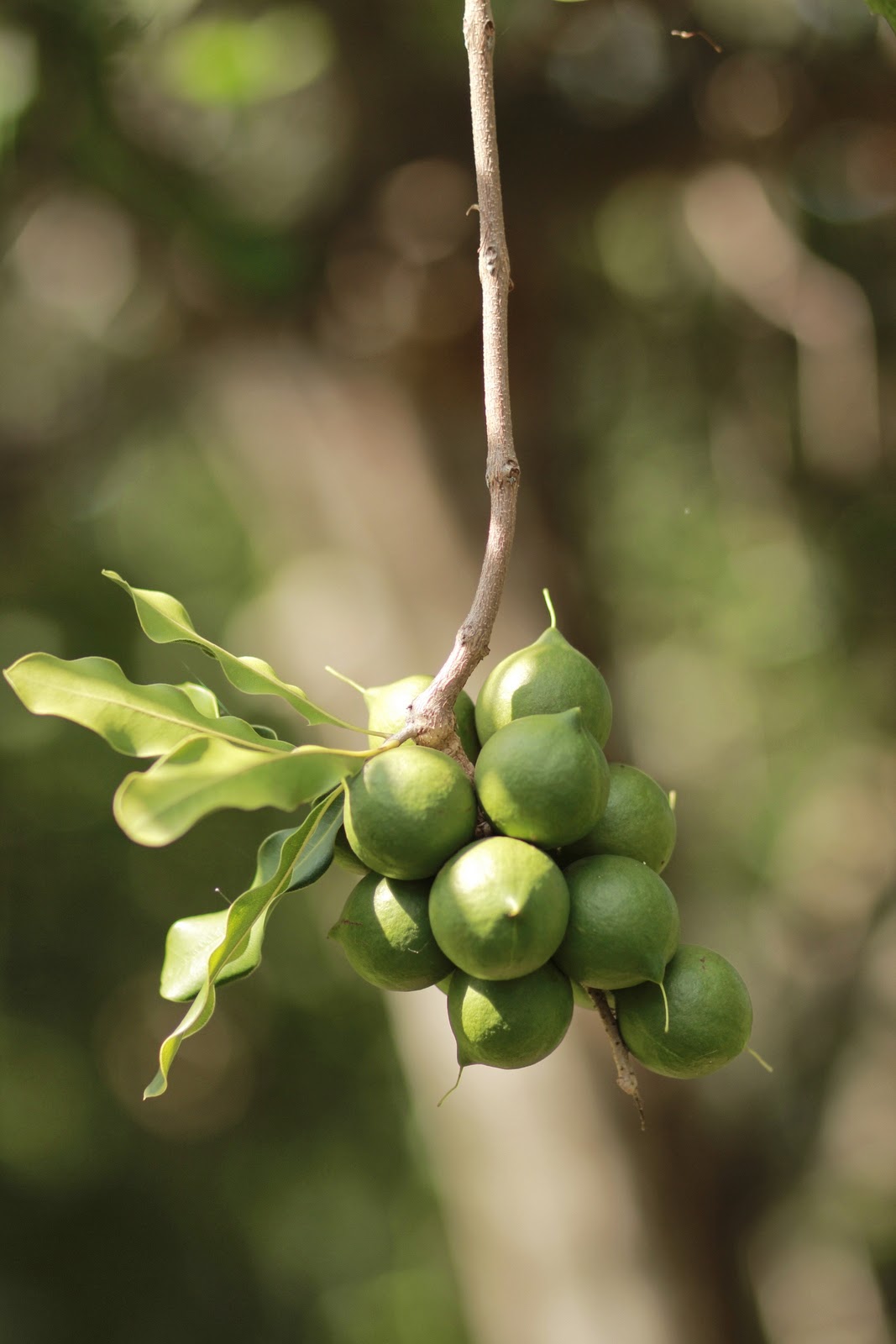
Macadamia is a genus of four species of evergreen trees in the family Proteaceae (order Proteales), native to Australia. The trees grow 2–12 metres tall and are distinguished by their whorled leaves — arranged in groups of three to six — that are lanceolate to obovate in shape with entire or spiny-serrated margins. Flowers are produced in long, slender racemes and range from white to pink or purple. The fruit is a hard, woody, globose follicle containing one or two seeds enclosed in a shell so tough — approximately 2,000 newtons to crack — that it has mechanical properties comparable to aluminium.
The genus is indigenous to northeastern New South Wales and central and southeastern Queensland, Australia, making the macadamia the only widely grown food plant native to that continent. Two species — Macadamia integrifolia and Macadamia tetraphylla — are cultivated commercially for their edible nuts, known as macadamia nuts or Queensland nuts. Global production reached 344,000 tonnes in 2025, with South Africa overtaking Australia as the world's largest producer in the 2010s. Before commercial cultivation, macadamia nuts were an important bushfood for Aboriginal peoples of eastern Australia.
The genus was formally described in 1857 by German-Australian botanist Ferdinand von Mueller, who named it in honour of Scottish-Australian scientist and politician John Macadam. Earlier phylogenetic work had placed several additional species in Macadamia, but genetic and morphological studies published in 2008 resulted in those species being reassigned to the genera Lasjia, Catalepidia, and Virotia. The genus as currently circumscribed contains four species; nuts from M. jansenii and M. ternifolia contain cyanogenic glycosides and are not commercially exploited.
Etymology
The genus name Macadamia was coined in 1857 by the German-Australian botanist Ferdinand von Mueller in honour of John Macadam, a Scottish-Australian chemist, medical teacher, and politician who served as honorary Secretary of the Philosophical Institute of Victoria from 1857. The common name "macadamia nut" derives directly from the genus name, while regional synonyms include Queensland nut, bush nut, maroochi nut, and bauple nut.
Distribution
Macadamia is indigenous to northeastern New South Wales and central and southeastern Queensland, Australia. Seeds were introduced to Hawaii in 1882, where large-scale commercial cultivation began in the 1920s; genetic studies (2019) determined that virtually all Hawaiian orchard trees descend from a small wild population near Gympie, Queensland. South Africa surpassed Australia as the world's largest producer between 2012 and 2015, and the crop is now grown commercially across tropical and subtropical regions worldwide.
Cultivation
Macadamia trees are typically propagated by grafting and require 7–10 years before producing commercial quantities of nuts, though once established they can bear for over 100 years. They favour fertile, well-drained soils, annual rainfall of 1,000–2,000 mm, and temperatures above 10 °C (withstanding light frosts once established), with an optimum growing temperature of 25 °C. Their shallow root systems make them susceptible to windthrow, and like most Proteaceae they are vulnerable to Phytophthora root disease. The first commercial orchard was planted at Rous Mill, New South Wales, in the late 1880s.
History
Allan Cunningham was the first European to record encountering the macadamia plant in Australia in 1828. Ferdinand von Mueller formally named the genus in 1857–58. William H. Purvis introduced seeds to Hawaii in 1882, initially as a windbreak for sugar cane; commercial Hawaiian cultivation expanded through the 1920s–1940s, establishing the nut's international reputation. Australia overtook the United States as the leading producer in 1997, and South Africa surpassed Australia between 2012 and 2015. A 2019 genetic study found that essentially all Hawaiian cultivated trees trace back to a single small Australian wild population, raising concerns about genetic vulnerability in the commercial crop.
Taxonomy Notes
The genus Macadamia as currently accepted contains four species following a major revision based on genetic and morphological studies published in 2008. Several species previously assigned to Macadamia were transferred to the genera Lasjia (formerly Macadamia until 2008), Virotia (renamed from 1975 onward), and Catalepidia (separated in 1995). These former members, mostly from New Caledonia, Sulawesi, and northeastern Queensland, may still informally be called "macadamias" in a non-scientific sense.

