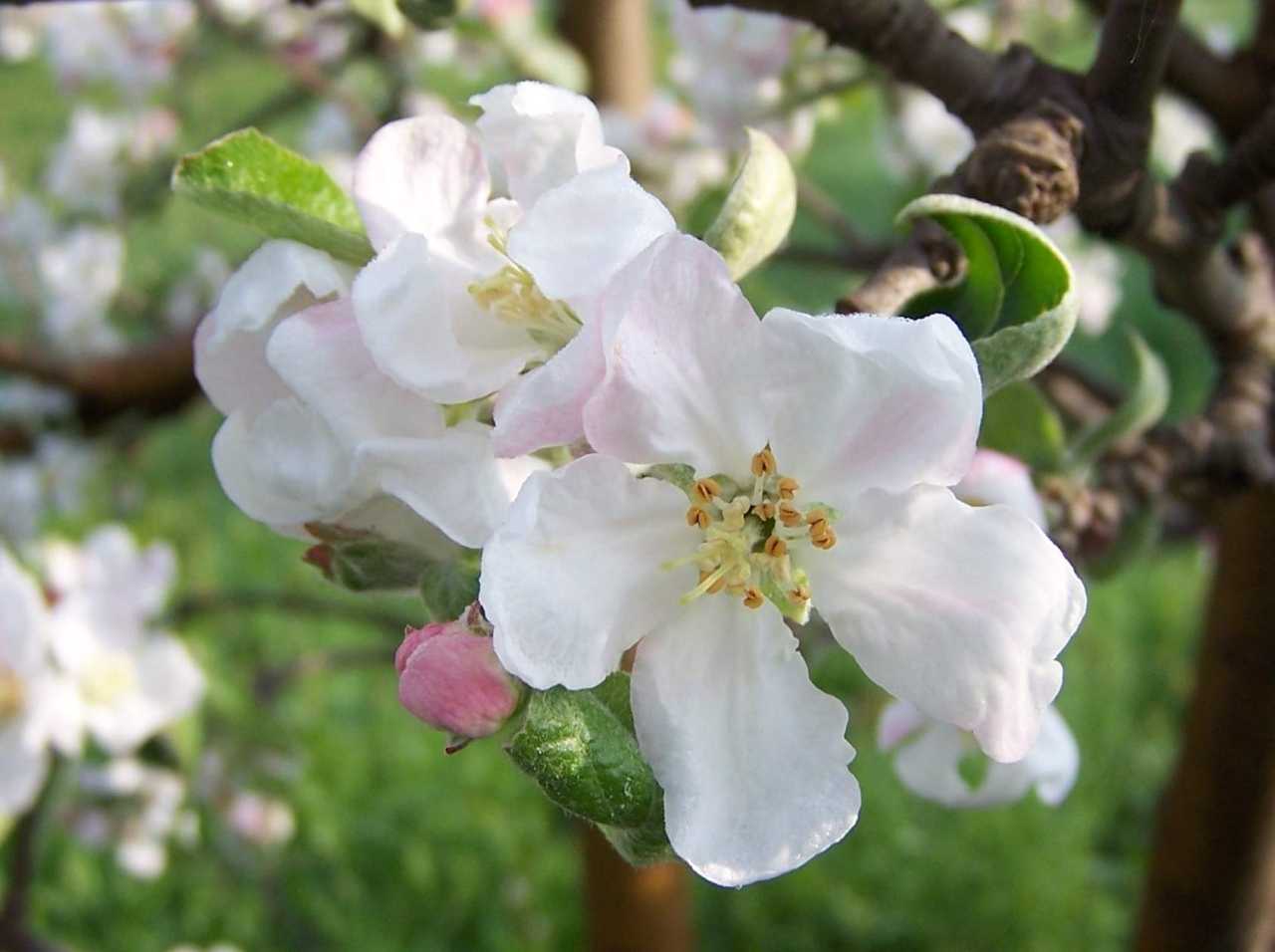
Malus Mill. is a genus of 32–57 species of small deciduous trees and shrubs in the rose family (Rosaceae), subfamily Amygdaloideae, tribe Maleae. The genus was established by Philip Miller and published in his Gardeners Dictionary in 1754, with Malus sylvestris (the European crabapple) designated as the type species. Members of the genus are collectively known as apples and crabapples.
Trees in the genus typically reach 4–12 metres in height and form dense, twiggy crowns. Leaves are 3–10 centimetres long with serrated margins. Flowers are five-petalled, ranging from white through pink to deep red, with red stamens that produce abundant pollen attractive to bees and other pollinators. The fleshy pome fruits vary from under 1 centimetre (in many wild crabapple species) to the large cultivated fruits of Malus domestica.
The genus is native to the temperate Northern Hemisphere, distributed across Europe, Asia, and North America. The wild ancestor of the domesticated apple, Malus sieversii, originates in the mountains of Central Asia, while other notable species include the Siberian crabapple (Malus baccata), the European crabapple (Malus sylvestris), and several ornamental species from China and Japan such as Malus hupehensis and Malus floribunda.
A caution applies to the seeds of all Malus species: they contain hydrogen cyanide compounds, and while small amounts are generally not harmful, consuming large quantities of seeds can be dangerous.
Etymology
The genus name Malus is the classical Latin word for apple. It was applied to these trees by Philip Miller, the British botanist who published the name in his Gardeners Dictionary in 1754. The word derives from earlier Latin usage referring broadly to apple-type fruits, and cognates appear across many European languages.
Distribution
Malus is native to the temperate zone of the Northern Hemisphere, with species spread across three broad regions: Europe (notably Malus sylvestris), Asia (including Central Asian Malus sieversii, East Asian Malus baccata, Malus hupehensis, Malus floribunda, and many others), and North America (including Malus coronaria in eastern North America from Maryland south to Florida and west to Texas, Malus ioensis, Malus fusca on the Pacific coast, and Malus angustifolia in the southeast).
In Europe, Malus sylvestris and Malus pumila are documented in Switzerland. In North America, species occur across USDA hardiness zones 3a–9b.
Ecology
Malus trees are important components of temperate woodland edges, hedgerows, and scrub. They are pollinated by bees, butterflies, and moths, and the flowers are a significant early-season nectar source. The fruits are consumed by birds and mammals, making the genus an important wildlife food source. Several butterfly and moth larvae feed on Malus leaves.
Wild species tend to be short-lived in their natural habitats. All Malus species produce seeds that contain hydrogen cyanide compounds; while the fruits themselves are safe, excessive seed consumption poses a health risk to humans and animals.
The oldest known Malus fossils date to the Eocene period, from deposits in Idaho and Kamchatka, indicating a long evolutionary history in the Northern Hemisphere.
Cultivation
Malus species and cultivars are grown both as fruit trees and as ornamental garden trees. They perform best in full sun (at least 6 hours daily) in moist but well-drained, humus-rich, slightly acidic soil, though they tolerate heavy clay. Cold winters and cool summers suit them best; high summer humidity increases susceptibility to fungal diseases including fire blight, rust, apple scab, and powdery mildew. Once established, they show good drought tolerance.
Growth rate is medium and the genus generally requires high maintenance. Regular pruning is essential to thin dense branch growth and open the crown to good air circulation, which reduces disease pressure. Many cultivated forms are grafted; the graft union must be kept above ground. Crabapples serve as rootstocks and pollinizers for commercial apple orchards. The genus is also popular in bonsai cultivation. Flowers of some species emit a perfume likened to violets.
Propagation
Species Malus can be propagated from seed or stem cuttings. Seeds require cold stratification: either autumn sowing directly into cold frames or three months of chilling at approximately 1°C before spring sowing. Germination can take 12 or more months. Hardwood cuttings from mature wood are taken in November. In horticultural practice, named cultivars and rootstock selections are almost always propagated vegetatively — by budding or grafting — to maintain uniformity.
Cultural Uses
Malus domestica, the domesticated apple, is one of the world's most important fruit crops. Wild and semi-wild species produce small, often astringent fruits that are used for preserves, cider, jellies, and similar processed products rather than fresh consumption. The wood of Malus is hard, heavy, and close-grained (approximately 43 lbs per cubic foot), and though not commercially important as timber, it is valued locally for tool handles, levers, and small turned objects.
Taxonomy Notes
Malus is placed in the family Rosaceae, subfamily Amygdaloideae (formerly Spiraeoideae in some treatments), tribe Maleae, subtribe Malinae — the so-called "apple tribe" that also includes Pyrus (pears), Sorbus, and related genera. The genus was authored as Malus Mill. and published in Miller's Gardeners Dictionary in 1754; it contains 32–57 accepted species depending on the treatment (36 species and 4 hybrids under current GBIF/Wikipedia counts, with around 246 total described taxa including infraspecific entities).
The type species is Malus sylvestris (L.) Mill. Accepted synonyms of the genus-level name include Chloromeles (Decne.) Decne. (1882), Sinomalus Koidz. (1932), and Prameles Rushforth (2018). In Switzerland, the Info Flora checklist recognises Malus pumila and Malus sylvestris as the two main species.










