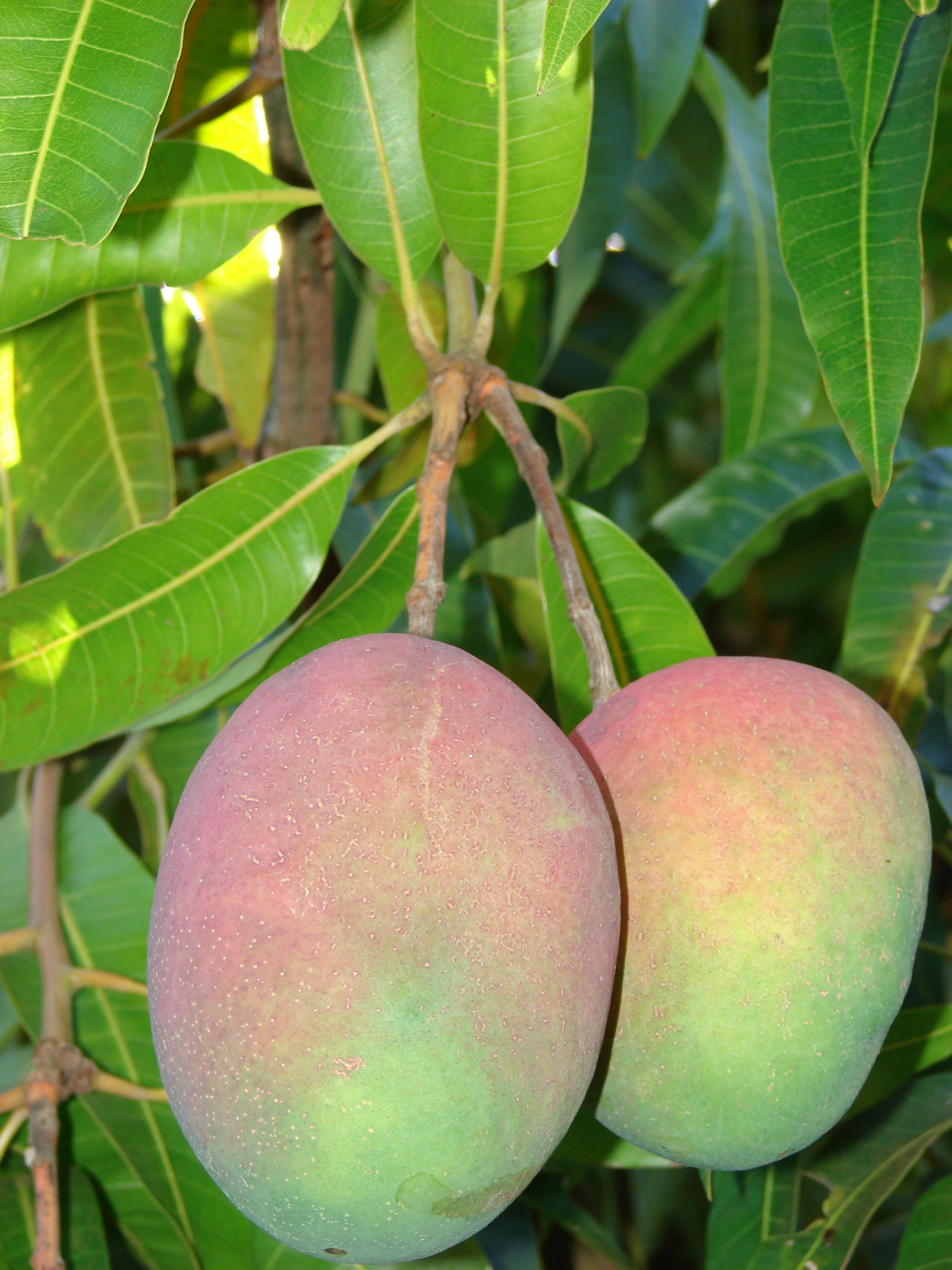
Mangifera is a genus of approximately 64 flowering plant species in the family Anacardiaceae (order Sapindales), native to tropical and subtropical Asia. The genus was formally described by Carl Linnaeus in 1753 in his landmark work Species Plantarum, with Mangifera indica — the common mango — designated as the type species. The genus is classified in two subgenera: Mangifera (comprising four sections: Marchandora, Euantherae, Rawa, and Mangifera) and Limus.
Members of the genus are large, long-lived evergreen trees, typically reaching 10–45 metres in height with characteristic umbrella-shaped, dense canopies and deep taproot systems extending up to 5 metres. They function as canopy trees in lowland tropical rainforests, typically in humid secondary formations below 500 metres elevation, though some species extend to 1,700 metres.
The centre of diversity lies in the Malesian ecoregion — particularly Sumatra, Borneo, and the Malay Peninsula — and the genus extends west across the Indian subcontinent and Myanmar. Of the roughly 64 accepted species, more than 27 produce edible fruits, making Mangifera one of the most economically significant tropical fruit genera in the world. Mangifera indica, the common mango, is among the oldest domesticated fruit trees, cultivated in India for at least 4,000 years, and is today the national fruit of India, Pakistan, and the Philippines, and the national tree of Bangladesh.
Beyond the common mango, the genus includes species such as M. foetida (horse mango, whose astringent fruits are popular pickled across Southeast Asia), M. odorata (Saipan mango), and M. caesia (binjai). The fossil record of the group extends into the upper Palaeocene of northeastern India, with leaf impressions confirmed from Oligocene or early Miocene sediments in Thailand, indicating a long evolutionary history in the Indo-Malesian region.
Distribution
The genus is centred in the Malesian ecoregion of Southeast Asia, with peak diversity in Sumatra, Borneo, and the Malay Peninsula. Its native range extends west across the Indian subcontinent to Myanmar. Mangifera indica is considered native to the Indian subcontinent and Myanmar and has been cultivated across tropical Asia for at least 4,000 years. Today, members of the genus are widely cultivated throughout tropical Asia and in other tropical regions worldwide, primarily for their fruit.
Taxonomy
Mangifera L. was described by Carl Linnaeus in Species Plantarum (1753) and belongs to the family Anacardiaceae, subfamily Anacardioideae, within the order Sapindales. The genus is classified in two subgenera: Mangifera (with four sections: Marchandora, Euantherae, Rawa, and Mangifera) and Limus. The type species is Mangifera indica. GBIF recognises approximately 71 accepted species within the genus (usage key 3075453), while some treatments cite around 64; approximately 125 total descendant taxa (including synonyms and infraspecific names) are recorded in the GBIF backbone.
Ecology
Mangifera species are canopy trees of lowland humid tropical rainforests, reaching 30–45 m in height. They are most common in secondary formations below 500 m elevation, though some species occur up to 1,700 m. Trees are long-lived, potentially exceeding 100 years, with irregular flowering cycles; some individuals exhibit dormancy periods of 10–20 years between significant flowering events. Certain cultivars of M. indica are polyembryonic, producing multiple genetically identical seedlings per seed. As members of the Anacardiaceae, mango species produce urushiol-related compounds; skin contact with sap can cause reactions in individuals sensitive to poison ivy.
Cultivation
Mangifera species require a tropical to frost-free subtropical climate, ideally with a marked dry or cool season of at least three months to promote flowering. Optimal growing temperatures are 24–30 °C, with tolerance from roughly 8 °C to 48 °C. Dormant plants can survive brief exposure to -1 °C, but young growth is damaged at 0 °C. Annual rainfall of 600–1,500 mm is ideal, though the genus tolerates a wide range (300–2,600 mm). Soil requirements are undemanding — sandy, loamy, or clay soils are all acceptable — provided drainage is adequate; soil pH of 5.5–7.5 is suitable, with 6–7 optimal. Full sun and shelter from strong winds are preferred. Commercial cultivation is typically limited to elevations below 600 m. Trees thrive in USDA hardiness zones 10–12.
Propagation
Mangifera seeds should be sown fresh immediately after the fruit ripens; germination takes approximately 18–30 days. Seeds are planted convex-side-up at about 5 cm depth. Seedlings are best raised in containers and transplanted before the taproot becomes deeply established. Commercially, grafting onto polyembryonic rootstock is the standard practice: it accelerates fruiting to 3–5 years compared with 5–8 years from seed and ensures consistent fruit quality. Most cultivars are self-fertile but produce larger crops when cross-pollinated.
Uses
Mangifera is one of the world's most culturally and economically significant tropical fruit genera. The fruit of M. indica — ranging from 50 g to 1.5 kg — is consumed fresh and processed into juices, jams, chutneys, pickles, and dried products. It contains approximately 15% sugars, 0.5% protein, and substantial vitamins A, B, and C. Dried unripe fruit is powdered and widely used as a souring agent in Indian cooking. Seeds are a source of starch, edible fat, and kernels consumed as famine food after processing. Young leaves and flowers are edible. Beyond M. indica, more than 27 species in the genus bear edible fruit; M. foetida fruits are traditionally eaten pickled across Southeast Asia.
The timber is moderately coarse-grained, pale yellowish-brown to reddish-brown, and used for construction, furniture, flooring, boat-building, and decorative veneer. Bark and leaves yield a yellowish-brown dye for silk. Flowers have traditional use as a mosquito repellent. The wood has a calorific value of approximately 4,200 kcal/kg and is used as charcoal and firewood.
In traditional medicine, leaf infusions are used to treat hypertension, angina, asthma, coughs, and diabetes; seed preparations are anthelmintic and antidiarrheal; and bark is used as an astringent and haemostatic. Mangifera indica is the national fruit of India, Pakistan, and the Philippines, and the national tree of Bangladesh.
History
The fossil record of Mangifera and its relatives extends into the upper Palaeocene of northeastern India (the fossil leaf taxon Eomangiferophyllum damalgiriense), with confirmed Mangifera leaf fossils from Oligocene or early Miocene sediments in Thailand. The common mango has been cultivated on the Indian subcontinent for at least 4,000 years, making it one of the oldest continuously cultivated fruit trees. The genus was formally circumscribed by Carl Linnaeus in 1753 in Species Plantarum, the foundational work of modern botanical nomenclature.










