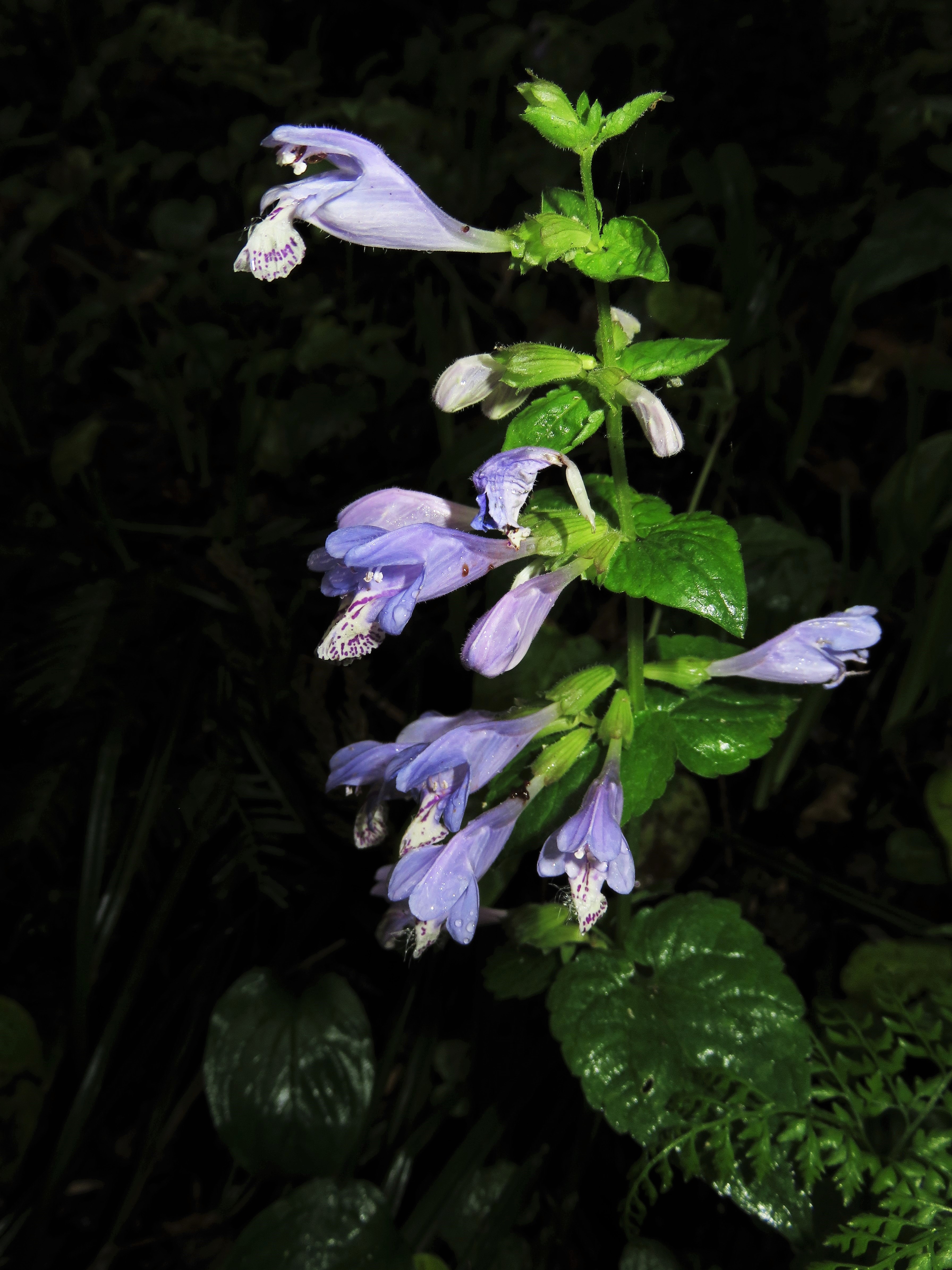
Meehania is a small genus of low-growing perennial herbs in the mint family Lamiaceae (order Lamiales), first formally described by Nathaniel Lord Britton in 1894. The genus comprises around seven accepted species with a striking disjunct distribution: most species are native to eastern Asia — particularly China, Japan, and Korea — while one species, Meehania cordata, is native to the Appalachian Mountains of the eastern United States.
Plants in this genus are stoloniferous ground-cover herbs, typically growing to about 30 cm in height and spreading laterally via long stolons that root at the nodes, forming dense patches over time. The leaves are opposite, often resembling those of nettles (hence the epithet urticifolia in the most widely cultivated species). Flowers are bilabiate (two-lipped) and tubular, borne in whorls along upright stems, typically in shades of violet to purple — characteristic of the Lamiaceae.
The genus favours shaded, moist, woodland environments. Meehania urticifolia, the species best documented in cultivation, grows naturally in rich damp deciduous mountain forests of China, Japan, and Korea, and is hardy to approximately −15 °C. Meehania cordata occupies a similar niche in the Appalachian region of the eastern United States (Tennessee, North Carolina, Kentucky, Virginia, West Virginia, Pennsylvania, and Ohio). The Asian species include M. faberi (Gansu and Sichuan), M. fargesii (widespread in southern China), and several others confined to Chinese provinces.
GBIF recognises 16 descendants within the genus.
Etymology
The genus name Meehania honours Thomas Meehan (1826–1901), a prominent Philadelphia nurseryman, botanist, and horticulturalist who was influential in 19th-century American botany. The genus was established by Nathaniel Lord Britton in 1894.
Distribution
Meehania has a disjunct distribution across eastern Asia and eastern North America. Most species occur in China (including Gansu, Sichuan, Yunnan, Guizhou, Hubei, and Zhejiang provinces), with M. urticifolia extending into Japan, Korea, and the Russian Far East. Meehania cordata is the sole New World representative, restricted to the Appalachian Mountains of the eastern United States (Tennessee, North Carolina, Kentucky, Virginia, West Virginia, Pennsylvania, and Ohio).
Ecology
Members of Meehania grow in shaded, moist deciduous woodland, typically in mountainous terrain. They prefer semi-shade to full shade and moist, humus-rich soils ranging from mildly acidic to mildly alkaline. The stoloniferous growth habit allows them to spread rapidly and form dense ground-covering patches in dappled or deep shade, including in exposed but sunless positions. Meehania urticifolia is documented in rich damp deciduous mountain forests of southern and central Japan, and is cold-hardy to approximately −15 °C.
Cultivation
Meehania urticifolia is cultivated as a ground-cover plant for shaded gardens. It requires partial to dappled shade and consistently moist soil, tolerating sandy, loamy, and clay soils across a broad pH range. It spreads vigorously via long stolons rooting at the nodes and can form large patches; USDA hardiness zones 4–8. Young leaves of M. urticifolia are reportedly edible when cooked.










