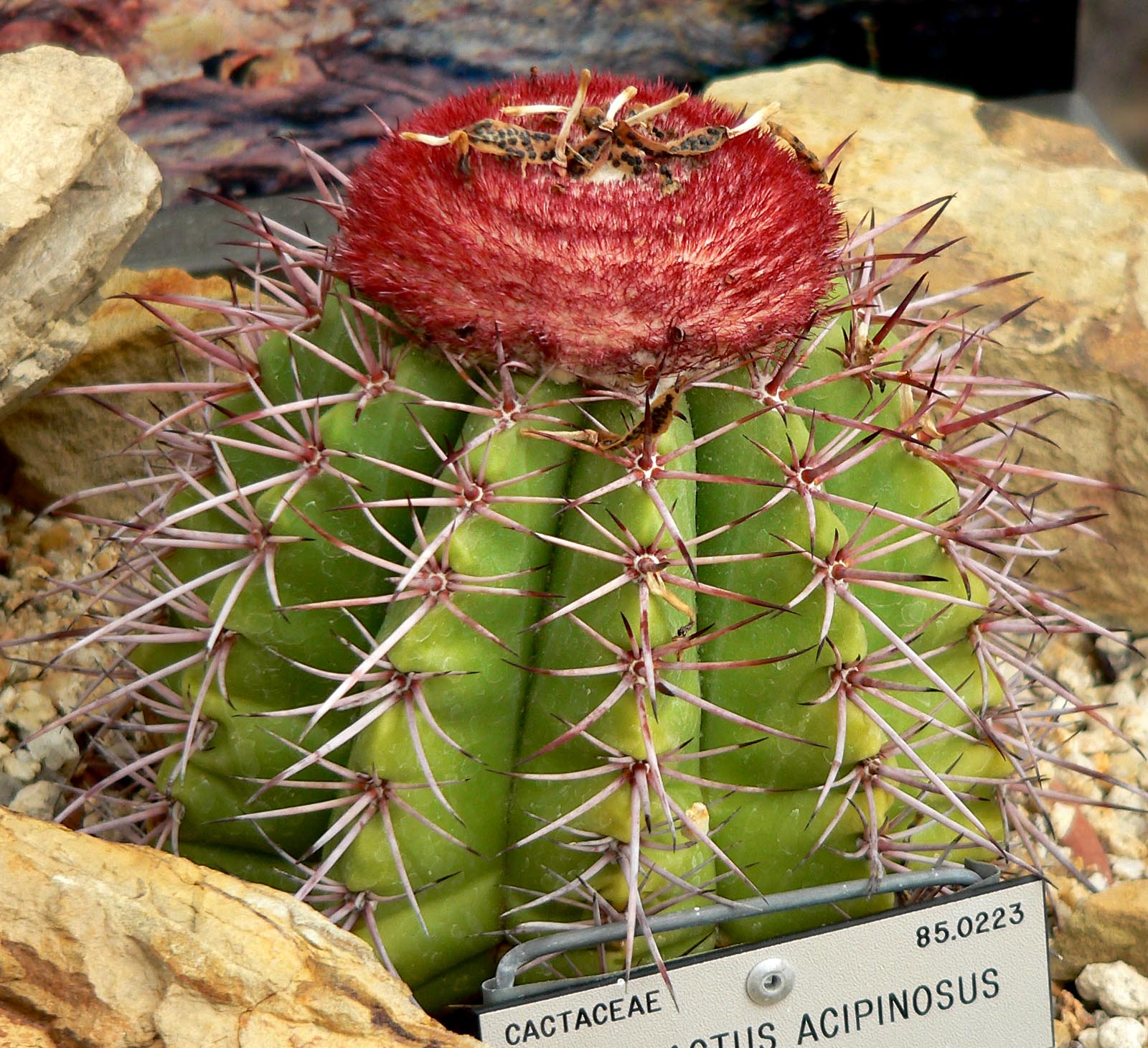
Melocactus is a genus of roughly 40–49 species of cacti in the family Cactaceae, immediately recognizable by the distinctive structure that develops at the apex of mature plants: the cephalium. This woolly, bristle-covered cylinder—often vivid red or orange—is unique among cacti and sets Melocactus apart from all other genera. The cephalium contains the flowering areoles, from which small pink or magenta flowers emerge, followed by slender, pink, edible fruits that resemble tiny peppers.
The genus is native to the Caribbean islands, western Mexico, Central America, and South America, ranging from the northern coasts south along the Andes to Peru. Northeastern Brazil is a particular center of diversity. Plants grow in hot, dry, exposed habitats—coastal scrub, rocky hillsides, and open thornbush—usually at lower elevations, often in full sun on shallow, well-drained soils.
Before producing a cephalium, individual plants closely resemble other globose cacti: they are spherical to slightly cylindrical, ribbed, and armed with stout spines. Once the cephalium appears—typically after the plant reaches sexual maturity, which may take a decade or more—the vegetative body ceases to grow and all reproductive activity is concentrated in the cephalium for the remainder of the plant's life.
The fruits are eagerly eaten by lizards and birds, the principal dispersal agents in the genus's native range. Melocactus species have long been collected for horticulture and botanical curiosity; they were among the first American cacti to reach European botanical gardens in the 16th century. Several species, particularly Brazilian endemics with restricted ranges, are threatened by habitat loss, and some are listed on national or international conservation registers.
Etymology
The genus name Melocactus is a pre-Linnaean Latin compound combining "melo-" (from Greek melon, melon) and "cactus," likely a reference to the rounded, melon-like form of the plant body. The species was first formally named by Carl Linnaeus in 1753 as Cactus melocactus; when the group was separated into its own genus, the pre-existing name Melocactus was carried forward, with Link & Otto as authorities (1827).
The most familiar common names—Turk's head cactus, Turk's cap cactus—refer to the red, wool-covered cephalium, which resembles the fez hat historically associated with Ottoman dress. The Turks Islands in the Turks and Caicos Islands are themselves said to be named after this cactus, whose red-topped silhouette was visible from the sea. Other vernacular names include melon cactus and Pope's head cactus.
Distribution
Melocactus occurs naturally in the Caribbean archipelago, along the coasts and lowlands of Central America, western Mexico, and across northern and eastern South America from Venezuela and Colombia south along the Andean foothills to Peru. The genus reaches its greatest diversity in northeastern Brazil, particularly in the Caatinga dry scrub biome, where many endemic species with narrow ranges occur. Additional centers of diversity include the Caribbean islands (Cuba, Hispaniola, Puerto Rico, the Lesser Antilles) and the Venezuelan and Colombian coasts.
Most species occupy hot, sunny, seasonally dry habitats: coastal rocky outcrops, sandy restinga vegetation, thornbush, and dry hillside scrub, typically at low to moderate elevations on well-drained mineral soils.
Ecology
Melocactus species are adapted to seasonally arid, high-insolation environments. They grow on thin, rocky, or sandy soils in full sun, often on limestone or granite outcrops. The cephalium structure channels all reproductive effort once vegetative growth has ceased, concentrating flowers and fruit production at the apex where pollinators and dispersers can access them most easily.
Pollination is carried out primarily by hummingbirds and bees attracted to the small tubular flowers. The slender, fleshy fruits are consumed by birds and lizards, which are the main seed dispersers in the genus's range. This dispersal mode ties the genus's range closely to the presence of vertebrate frugivores in open, dry habitats.
Conservation
Several Melocactus species face conservation pressure, particularly narrow Brazilian endemics. Melocactus conoideus and Melocactus glaucescens, both restricted to small areas of Bahia state in Brazil, are considered endangered, threatened primarily by agricultural expansion, urban development, and limestone quarrying in their restricted habitats. Melocactus matanzanus, endemic to Cuba, is also of conservation concern.
The genus as a whole has historically been subject to overcollection from the wild for the horticultural trade, and many species were once heavily exploited. Traffic in wild-collected specimens is now restricted under CITES (all Cactaceae are listed on CITES Appendix II), which regulates international trade.
Cultivation
Melocactus species are cultivated as ornamental cacti in specialist collections worldwide, prized for the striking cephalium that develops on mature plants. They require warm, frost-free conditions and perform best in full sun with very well-drained, mineral-rich substrate. Plants are sensitive to cold and to root rot if overwatered; watering should be reduced substantially in winter.
Cultivation to cephalium maturity requires patience—plants may take 10–20 years under optimal conditions before the cephalium begins to form. Once the cephalium develops, routine repotting should be done with care to avoid damaging it. Melocactus species are not cold-hardy and are best kept above 10 °C (50 °F) year-round in temperate climates.
Propagation
Melocactus is propagated almost exclusively from seed, as the plants do not produce offsets or branch in a manner suitable for cuttings. Seeds require warmth (24–28 °C) for germination and should be sown in well-drained, sandy cactus mix kept lightly moist until germination. Seedlings grow slowly and must not be overwatered. Grafting onto vigorous rootstocks (such as Selenicereus or Myrtillocactus) is occasionally used to accelerate growth of rare species in ex-situ conservation programs.
Taxonomy notes
Melocactus Link & Otto (1827) is placed in family Cactaceae, subfamily Cactoideae, tribe Cereeae, subtribe Cereinae. The genus contains approximately 47–49 accepted species plus three documented natural hybrids (×albicephalus, ×horridus, ×trachycephalus) according to GBIF. The order is Caryophyllales.
Linnaeus originally placed the type in Cactus (1753). In 1922, Britton and Rose proposed resurrecting the genus name Cactus, but this attempt was invalidated because the 1905 Vienna International Botanical Congress had already formally rejected the name Cactus as a genus name; Melocactus Link & Otto therefore remains the correct and accepted designation. One synonym recorded in GBIF is Cactus Britton & Rose.










