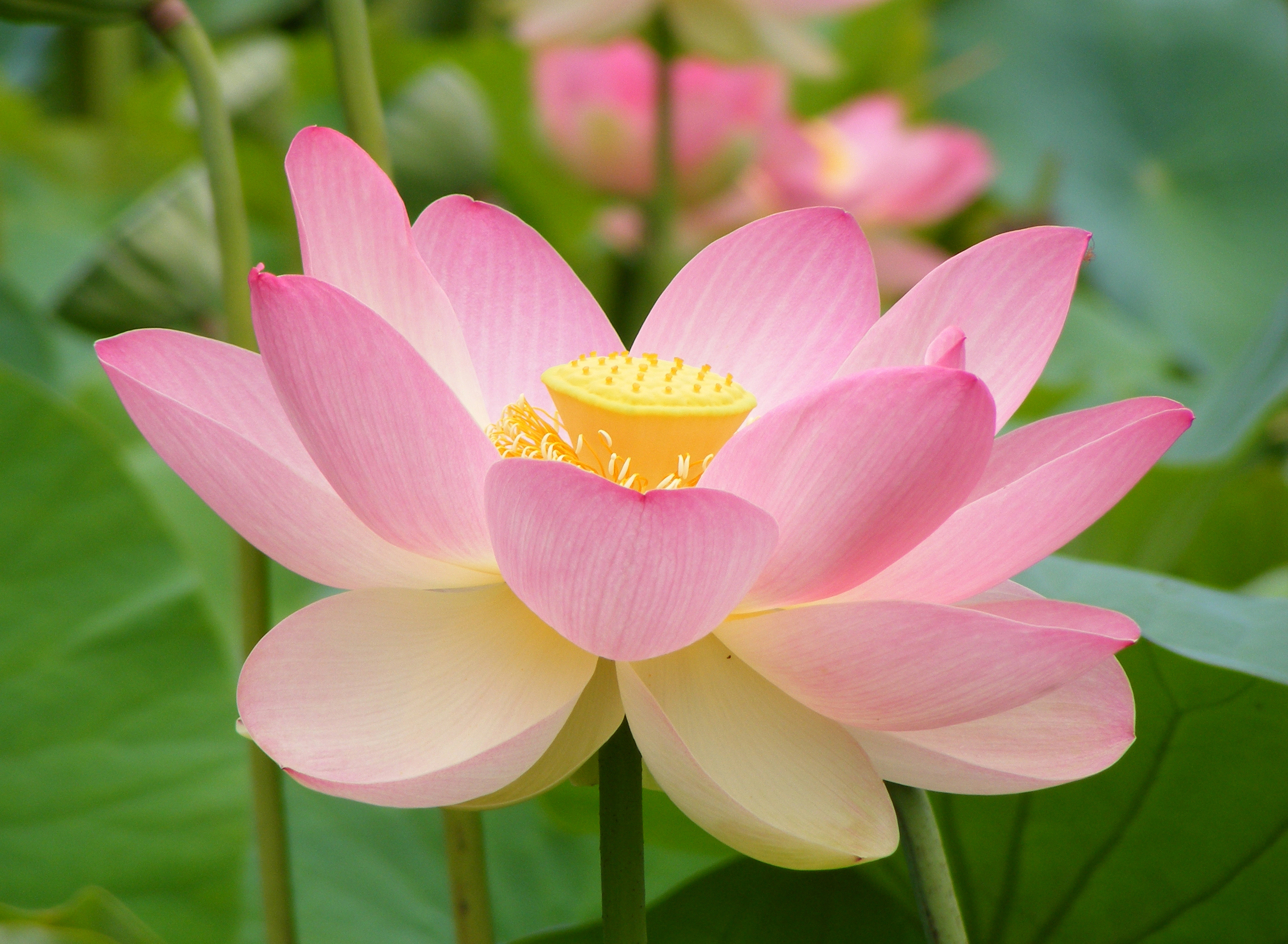
Nelumbo is a small genus of aquatic flowering plants in the family Nelumbonaceae, placed within the order Proteales — a position that surprised earlier botanists who classified it alongside water lilies based on superficial resemblance. The two groups are not closely related; the similarity is the result of convergent evolution as both lineages adapted to life in still or slow-moving water.
The genus is ancient by any measure. Fossil evidence documents Nelumbo from the Early Cretaceous, with nearly thirty extinct species described from sites across North America, Europe, and Asia, spanning the mid-Cretaceous to the Pliocene. Yet today only two living species survive: Nelumbo nucifera Gaertn., the sacred or Indian lotus, native to East Asia, South Asia, and Southeast Asia (and probably Australia), and Nelumbo lutea Willd., the American lotus, native to the Eastern United States, Mexico, the Greater Antilles, and Honduras. Horticultural hybrids between these two geographically separated species have been produced in cultivation.
Plants bear large, distinctively peltate leaves — fully circular, lacking the characteristic notch that identifies a true water lily (Nymphaea) — along with showy, elevated flowers and a highly recognizable flat-topped seedpod that remains ornamentally distinctive long after the petals fall. The submerged portions of the plant accumulate starch, and the entire plant is edible: rhizomes may be baked or boiled, young leaves can be cooked as a vegetable, seeds are eaten raw or ground into flour, and stem fibres are woven into lotus silk. Nelumbo nucifera holds deep cultural significance as the national flower of both India and Vietnam and is woven into the iconography of Hinduism and Buddhism.
Etymology
The genus name Nelumbo derives from Sinhala: නෙළුම් (neḷum), the traditional Sinhalese name for Nelumbo nucifera, the sacred lotus widely cultivated and revered across South and East Asia.
Distribution
The two living species occupy non-overlapping ranges: Nelumbo nucifera is native to East Asia, South Asia, and Southeast Asia (and probably northern Australia), while Nelumbo lutea is found in the Eastern United States, Mexico, the Greater Antilles, and Honduras. Both species are widely cultivated beyond their native ranges and have naturalised in many warm-temperate and tropical regions.
Cultural Uses
Nelumbo — especially Nelumbo nucifera — has been cultivated and revered for millennia. The entire plant is edible: starchy rhizomes are baked or boiled, young leaves cooked as a vegetable, seeds eaten raw or dried and ground into flour, and stem fibres woven into a fine textile known as lotus silk. Nelumbo nucifera is the national flower of India and Vietnam and carries profound symbolic weight in Hinduism and Buddhism. Its roots and seeds are also a staple ingredient in East Asian, South Asian, and Southeast Asian cuisines and traditional Chinese medicine.
Taxonomy Notes
Nelumbo was long placed within the water lily family Nymphaeaceae owing to its aquatic habit and similar leaf form, but this grouping reflects convergent evolution rather than true relationship. The Cronquist system (1981) recognised the distinct family Nelumbonaceae but kept it in Nymphaeales; the Dahlgren (1985) and Thorne (1992) systems gave it its own order, Nelumbonales. Modern molecular phylogenetics places Nelumbonaceae firmly in Proteales, far removed from the water lilies. The genus is one of the oldest known angiosperm genera, with fossil species documented from the Early Cretaceous (Albian) of Portugal.










