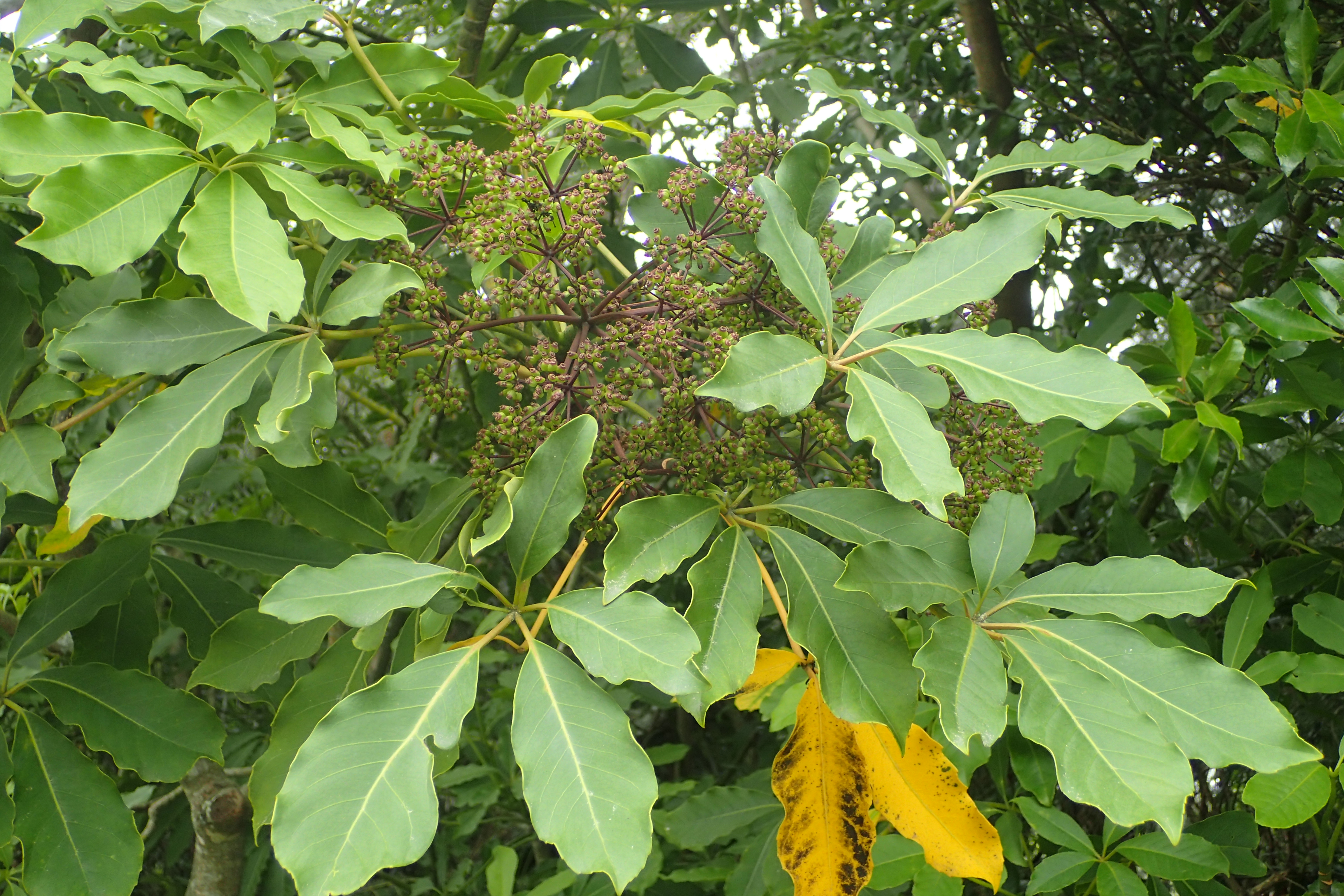
Neopanax is a small genus of evergreen flowering plants in the family Araliaceae (the ginseng family), order Apiales. It is endemic to New Zealand, with its range extending to the offshore Kermadec Islands. The genus comprises trees and shrubs that grow in forest and scrub habitats, and its members bear flowers in terminal umbels — a characteristic shared with the closely related genus Pseudopanax.
The taxonomic position of Neopanax is contested. A 2000 molecular study of Araliaceae demonstrated that the New Zealand species grouped here are a coherent clade, but their relationship to the broader Pseudopanax was debated; some authorities continue to treat Neopanax as a synonym of Pseudopanax. GBIF currently recognises Neopanax as an accepted genus with four species.
The genus includes notable New Zealand native trees such as Neopanax arboreus (five-finger or whauwhaupaku), Neopanax colensoi (mountain five-finger), and Neopanax laetus, as well as Neopanax kermadecensis, restricted to the Kermadec Islands. Several species are cultivated in New Zealand gardens and, less commonly, in mild oceanic climates such as coastal California and parts of Great Britain.
Etymology
The genus name Neopanax combines the Greek neo- ("new") with Panax (the ginseng genus), meaning roughly "new ginseng" — reflecting its placement in the ginseng family Araliaceae. The closely allied genus Pseudopanax is Latin for "false ginseng," and Neopanax has historically been treated as part of that group.
Distribution
Neopanax is endemic to New Zealand, occurring across both main islands and extending to the Kermadec Islands to the northeast. Species occupy forest and scrub environments across a range of altitudes, from lowland forest to montane zones; Neopanax colensoi in particular is associated with higher-altitude settings.
Ecology
Members of Neopanax grow in forest or scrub habitats in New Zealand. Like their close relatives in Pseudopanax, they are evergreen and flowers are borne in terminal umbels. The group includes species with markedly different juvenile and adult leaf forms, a trait characteristic of several New Zealand Araliaceae.
Cultivation
Several Neopanax species are grown in New Zealand gardens. They require mild, moist conditions without extremes of winter or summer temperature — conditions close to those of their native New Zealand habitats. Outside New Zealand, they are reportedly successful in Southern California and the warmer parts of Great Britain.
Taxonomy Notes
Neopanax has been treated as either a distinct genus or a synonym of Pseudopanax, and Wikipedia notes it constitutes a clade within Pseudopanax. A 2000 molecular study restructured the broader Pseudopanax group, removing distantly related species to the genus Raukaua; Neopanax species retained here represent the New Zealand endemic clade. GBIF currently accepts Neopanax as a valid genus (4 species), while some classifications synonymise it under Pseudopanax.

