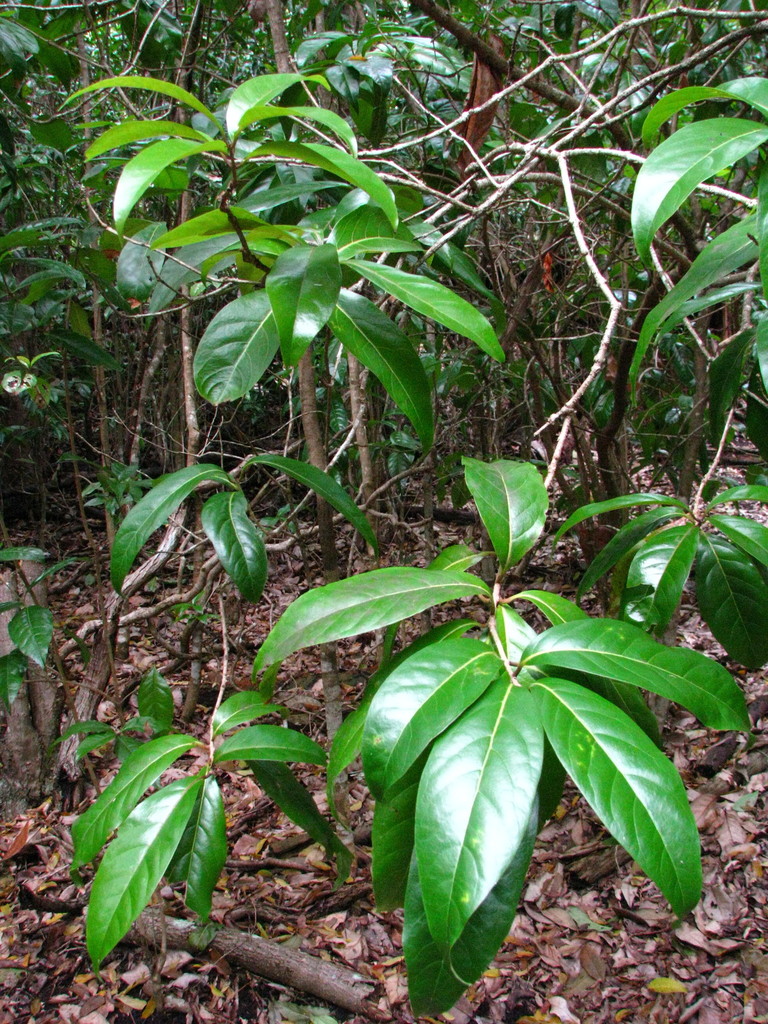
Nestegis is a genus of flowering trees and shrubs in the olive family (Oleaceae), placed within the order Lamiales. The genus is endemic to New Zealand, where its members are collectively known as maire (a Māori name applied to several of these trees). In a 2022 phylogenomic revision by Dupin et al., Nestegis was found to be paraphyletic and was consolidated into the broader genus Notelaea along with Osmanthus sect. Notosmanthus; consequently, the species are now formally treated as Notelaea, though the name Nestegis remains in widespread horticultural and common use.
Maire trees are gynodioecious (individual trees bear either bisexual or functionally female flowers) with a characteristic tessellated bark and opposite, simple, leathery leaves. Flowers are small, borne in axillary racemes, with a 4-lobed calyx, 4 petals joined in pairs at the base, and 2 stamens. The fruit is a drupe containing a single purple-brown seed, ripening to shades of red, orange, or purple-black depending on the species.
The three New Zealand species in this genus are all canopy trees of coastal to montane forest. Nestegis cunninghamii (black maire) is the largest, reaching 25 m with broad, dark green bullate leaves and pubescent inflorescences; it is particularly prominent in riparian podocarp forest and on the Central Volcanic Plateau, and serves as a common host for white mistletoe (Tupeia antarctica). Nestegis lanceolata (white maire) grows to 20 m with narrower, glossy leaves and is widespread across the North Island. Nestegis montana (narrow-leaved maire) is the most slender-leaved species, reaching 15 m, and ranges from Northland to Nelson. All three species produce drupes that are relished by kererū (New Zealand pigeon, Hemiphaga novaeseelandiae), making them ecologically important in forest bird communities. All are currently assessed as Not Threatened nationally under New Zealand's 2023 Threat Classification System.
Etymology
The genus name Nestegis has Greek roots but its precise derivation is not documented in the sources consulted. The Māori common name maire is applied collectively to the New Zealand species. Individual species epithets reflect habitat or history: montana derives from the Latin mons ('mountain'), and cunninghamii honours English botanist Allan Cunningham (1791–1839), who collected plants in New Zealand and Australia.
Distribution
Nestegis is endemic to New Zealand (North and South Islands). N. cunninghamii (black maire) ranges across both main islands from north to the central South Island; N. lanceolata (white maire) is widespread in the North Island with a restricted presence in Marlborough Sounds; N. montana (narrow-leaved maire) extends from near Kaitaia in Northland south to the Waimea Plain, Nelson. All species occur in coastal to montane forest, from sea level to subalpine margins.
Ecology
Maire trees grow in coastal to montane forest, frequently on steep hill slopes, ridge lines, and in riparian podocarp forest. N. cunninghamii is characteristic of frost-prone habitats and the pumice country of the Central Volcanic Plateau, where it commonly hosts white mistletoe (Tupeia antarctica). N. lanceolata tends to avoid frequently frost-prone or flood-prone sites. All species flower November–January and fruit December–May; their drupes are avidly consumed by kererū (Hemiphaga novaeseelandiae), making them important for native bird food webs. Chromosome number is 2n = 46 across all three NZ species.
Taxonomy Notes
Nestegis was placed in Oleaceae and long treated as a distinct genus of New Zealand (and formerly Pacific) trees. A 2022 phylogenomic study (Dupin et al.) based on plastid DNA and three nuclear regions demonstrated that Nestegis was paraphyletic with respect to Osmanthus sect. Notosmanthus; both were consequently consolidated into Notelaea. The New Zealand species formerly in Nestegis are now accepted as Notelaea cunninghamii, Notelaea montana, and Notelaea neolanceolata (white maire, previously Nestegis lanceolata, was renamed to avoid a nomenclatural conflict). GBIF retains Nestegis as an accepted genus with 5 descendants.

