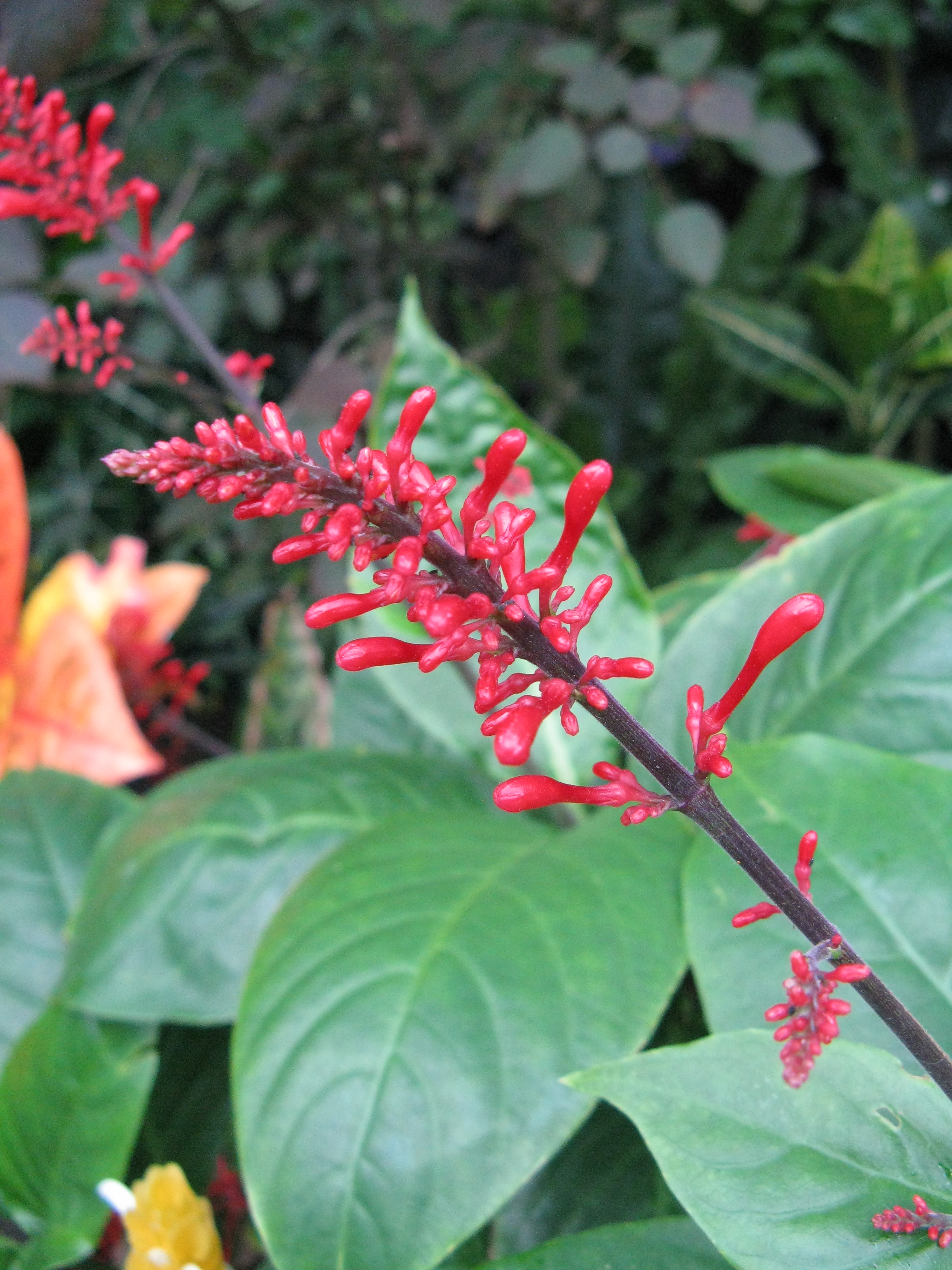
Odontonema is a genus of flowering plants in the family Acanthaceae, within the order Lamiales. Commonly known as firespikes or toothedthreads, the genus comprises 32 accepted species of shrubs and subshrubs native to the tropical Americas, with a distribution extending from Mexico south through Central America to Peru and southeastern Brazil.
Members of Odontonema are characterised by showy, tubular flowers typically arranged in slender, erect spikes or racemes. The flowers are most commonly red or scarlet, though some species produce white, pink, or bicoloured blooms, making them attractive to hummingbirds, butterflies, and other pollinators. The genus name derives from Greek, alluding to the toothed or ridged appearance of the flower tube. Leaves are generally opposite, simple, and often glossy.
Several species are widely cultivated as ornamental plants in tropical and subtropical gardens worldwide, notably Odontonema tubaeforme (Firespike), which is popular for its tall, brilliant-red flower spikes produced in autumn and winter. Odontonema cuspidatum (Mottled toothedthread) is another cultivated species valued for its ornamental foliage and flowers.
Etymology
The name Odontonema derives from the Greek words odous (tooth) and nema (thread), referring to the toothed or ridged filaments or flower tube characteristic of the genus. The common names "toothedthreads" and "firespikes" also reference these features — the latter alluding to the vivid red floral spikes of the most widely known species.
Distribution
Odontonema is native to the tropical Americas, ranging from Mexico through Central America south to Peru and southeastern Brazil. The genus is restricted to tropical and subtropical lowland and montane habitats within this range.
Cultivation
Several species of Odontonema, especially O. tubaeforme (Firespike), are popular ornamental shrubs in tropical and subtropical gardens. They are grown for their long-lasting, brightly coloured flower spikes, which are particularly attractive to hummingbirds. In temperate regions they may be grown as container plants or in frost-free conservatories. They generally prefer well-drained soils, partial to full sun, and regular moisture.

