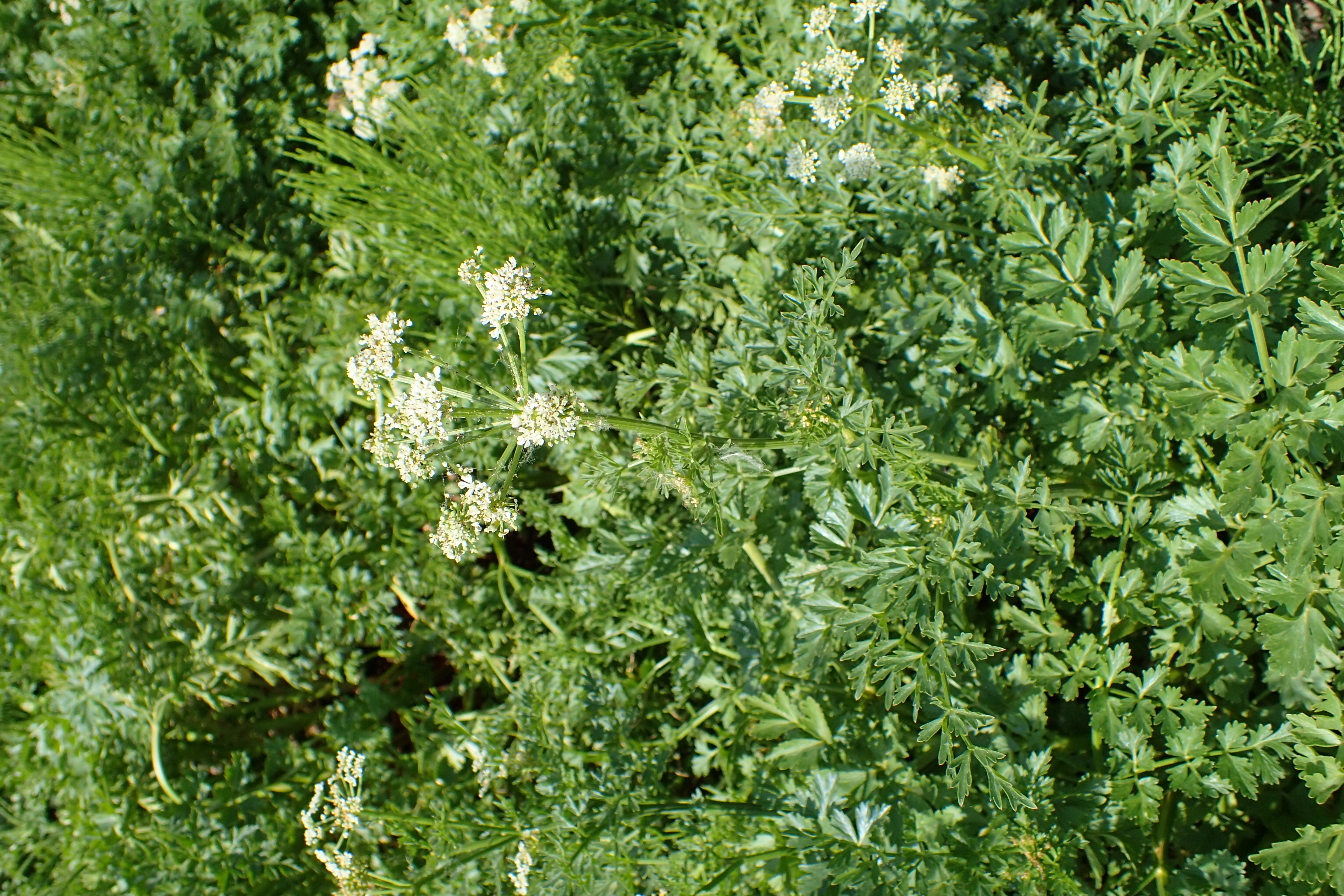
Oenanthe is a genus of flowering plants in the carrot family (Apiaceae), known collectively as water dropworts. Established by Linnaeus in Species Plantarum in 1753, the genus is placed in tribe Oenantheae and comprises around 35 accepted species according to Kew's Plants of the World Online, distributed from Alaska south to southwestern Mexico, across Madeira and northwestern Africa, and throughout Eurasia, with introductions reported in parts of North and South America and New Zealand.
True to their common name, almost all species are wetland plants. They typically grow in marshes, ponds, ditches, slow streams, and seasonally flooded ground, where their hollow stems and finely divided or pinnate leaves emerge from fibrous or tuberous root systems. Several European species are widespread enough to figure in regional floras: in Switzerland alone, Info Flora records six native species, including O. aquatica, O. fistulosa, O. fluviatilis, O. javanica, O. lachenalii, and O. peucedanifolia. Flowers are borne in characteristic compound umbels of small white blossoms, typical of the family.
What sets Oenanthe apart from most other umbellifers is its extraordinary toxicity. The genus produces oenanthotoxin, a polyunsaturated fatty alcohol that blocks GABA receptors in the central nervous system, and several species are among the most poisonous plants of the Northern Hemisphere. Oenanthe crocata, the hemlock water dropwort, has been called the most poisonous of all British plants — a single root is reportedly enough to kill a cow, and of thirteen documented human poisonings in Britain between 1900 and 1978, nine were fatal. The danger is compounded by the plant's resemblance to edible relatives such as parsnip, celery, water-parsnip, and cowbane. Researchers have linked O. crocata to the ancient "sardonic herb" of Nuragic Sardinia, the source of the rictus expression that gave us risus sardonicus.
A handful of species buck the toxic trend. Oenanthe javanica — known as seri in Japan, minari in Korea, and komprek in parts of northeast India — is widely cultivated as a leafy vegetable across East and Southeast Asia, as well as in Italy. It anchors Japanese nanakusa-gayu (seven-herb porridge), Korean namul preparations, and Manipuri dishes such as eromba and singju. Other notable members include O. pimpinelloides (corky-fruited water dropwort), O. fistulosa (tubular water dropwort), and O. aquatica (fine-leaved water dropwort). Given the genus's pharmacological hazard, ornamental cultivation is rarely recommended and handling — even of foliage and tubers, even by experienced botanists — calls for serious care.
Etymology
The genus name Oenanthe combines the Ancient Greek words oinos ("wine") and anthos ("flower"). Although the construction is botanically poetic, Wikipedia notes that the etymology "has no meaning when applied to the water-dropworts other than as an arbitrary name for the genus" — the connection to wine appears to be incidental rather than descriptive of the plants' appearance, scent, or use.
Distribution
Plants of the World Online gives the native range as "Alaska to SW. Mexico, Madeira, NW. Africa, Eurasia" — effectively the entire northern temperate world plus parts of subtropical Asia and Africa. POWO additionally records introductions in Arkansas, Illinois, Indiana, and Ontario in North America, Argentina and Uruguay in South America, and New Zealand. At a regional scale, Info Flora documents six native species in Switzerland alone (O. aquatica, O. fistulosa, O. fluviatilis, O. javanica, O. lachenalii, and O. peucedanifolia), and O. crocata is concentrated along the Atlantic seaboard of Europe from the Netherlands south to Spain and Portugal.
Ecology
Oenanthe species are overwhelmingly wetland plants. Wikipedia notes that "most of the species grow in damp ground, such as in marshes or in water," and Info Flora classifies the Swiss representatives as "water-associated species" of ponds and riparian zones. O. crocata in particular favours marshes, wet woodlands, and the margins of streams, typically below 300 m elevation. The hollow or fistulose stems and finely divided leaves of many species are characteristic adaptations to seasonally flooded ground, and the tuberous roots that make several species so dangerous to grazing livestock also serve as storage organs for emerging through high water tables in spring.
History
The genus was formally established by Carl Linnaeus in Species Plantarum in 1753 (volume 1, page 254). It has accumulated eight heterotypic generic synonyms over its 270-year history, including Phellandrium L., Dasyloma DC., and Globocarpus Caruel — a sign of repeated attempts at recircumscription as botanists wrestled with the boundaries of this morphologically variable wetland group. Modern molecular work has stabilized the genus within tribe Oenantheae of the Apiaceae. The classic illustrative plate widely cited for the genus comes from Köhler's Medizinal-Pflanzen (late 19th century), reflecting Oenanthe's long-standing interest to medical and toxicological botany.
Taxonomy notes
Family Apiaceae, order Apiales, tribe Oenantheae. POWO accepts 35 species in the genus; the GBIF backbone lists 80 descendant taxa, but that figure includes infraspecific names and synonyms and should not be read as a species count. Eight heterotypic synonyms exist at the genus level (Phellandrium L., Dasyloma DC., Globocarpus Caruel, among others). Caution: the genus name Oenanthe is a homonym — the bird genus Oenanthe Vieillot, 1816 (Muscicapidae, the wheatears) is an entirely unrelated animal taxon and is frequently the first hit on GBIF and Wikipedia searches; the plant disambiguation page is at "Oenanthe (plant)."
Cultivation
Cultivation of Oenanthe is the exception rather than the rule, and the genus is one where gardeners are generally advised against planting. Most species are extremely toxic to humans and livestock, and they closely resemble edible umbellifers such as parsnip, celery, and water-parsnip — making them an active hazard in any garden frequented by children, pets, or curious cooks. Even handling can be risky: a documented laboratory exposure to O. crocata sap caused 12 hours of poisoning symptoms from an eye splash. The clear exception is Oenanthe javanica, which is grown commercially as a leafy vegetable in China, India, Japan, Korea, Indonesia, Malaysia, Thailand, Taiwan, Vietnam, and Italy. Its ornamental cultivar 'Flamingo' (pink-edged foliage) is occasionally offered to gardeners — but even O. javanica is regarded as invasive in several U.S. states and should be sited with care.
Conservation
The conservation profile of Oenanthe is unusual in that the genus is primarily noted as a hazard to livestock and humans rather than being itself broadly threatened. Oenanthe crocata is implicated in repeated livestock and human poisonings — one root reportedly suffices to kill a cow — and the toxin oenanthotoxin remains dangerous even on topical contact. Info Flora records that Swiss populations of native species are tracked via the National Red List (2016) and Regional Red List (2019), indicating that several species do receive formal conservation attention at the regional level, but specific category assignments are not summarized at genus level on the overview page. Several species, notably O. javanica, have naturalized outside their native ranges and are flagged as invasive in parts of the United States.
Cultural uses
Oenanthe's cultural footprint pulls in two opposite directions. O. crocata has a long, dark reputation as a poison: Wikipedia documents nine fatalities out of thirteen British human-poisoning cases between 1900 and 1978, mostly from roots mistaken for parsnips. Researchers at the University of Eastern Piedmont have proposed it as the ancient Sardinian "sardonic herb," allegedly used in Nuragic ritual killings of the elderly and criminals — the muscle-contracting effects of oenanthotoxin producing the characteristic risus sardonicus, the rictus that gives us the word "sardonic." At the other end of the genus, Oenanthe javanica is a beloved vegetable across East and Southeast Asia. In Japan it is seri (セリ), a defining ingredient of nanakusa-gayu, the seven-herb rice porridge eaten on January 7; in Korea it is minari (미나리), prepared as namul and historically tied to Joseon-era symbolism of loyalty and learning; in Manipur (India) it is komprek, central to dishes like eromba and singju.










