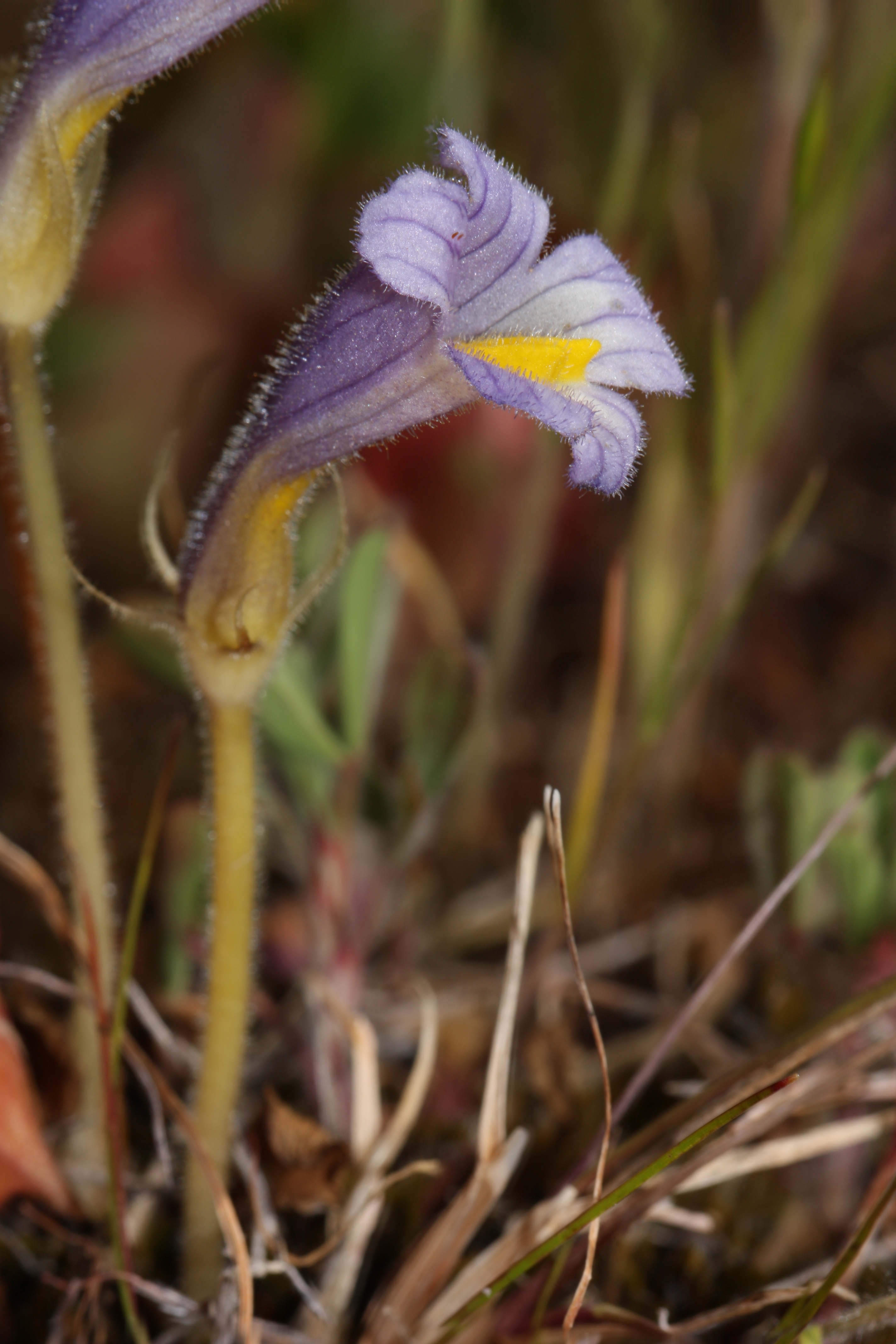
Orobanche, commonly known as broomrape, is a genus of roughly two hundred small parasitic herbaceous plants and the type genus of the family Orobanchaceae in the order Lamiales. The name was published by Linnaeus in Species Plantarum in 1753 and traces to the Greek words órobos, meaning bitter vetch, and ánkhō, meaning to strangle — a reference to the genus's habit of attaching itself to the roots of other plants. The English common name pairs the wildflower "broom" with the Latin rapum, "tuber," evoking the swollen underground attachment that broomrapes form on their hosts.
Broomrapes are immediately recognisable because they look almost nothing like a typical garden plant. They lack chlorophyll entirely, so their stems emerge from the ground in shades of yellow, straw, brown, or purplish rather than green. Plants typically reach ten to sixty centimetres in height. The leaves are reduced to small triangular scales pressed against the stem, and the bulk of the visible plant is given over to a dense raceme or spike of snapdragon-like flowers in yellow, white, cream, or shades of blue and violet. The corolla is tubular and usually downcurved, longer than its lobes, and the calyx is campanulate and variably lobed. After flowering the plants release vast numbers of minute tan to brown seeds.
Because they have no green tissue, Orobanche species are obligate holoparasites: every gram of carbon and water they need comes from a host plant. Within Orobanchaceae, Orobanche represents the first evolutionary transition from partial parasitism to complete parasitism, a lineage that the family's parasitic ancestor seeded roughly thirty-nine million years ago. Seeds remain dormant in the soil until chemical cues exuded by living host roots stimulate germination; the seedling then attaches to the host root with a specialised feeding structure called a haustorium and draws water, sugars, and nutrients directly from the host's vascular system. Host specificity varies between species: some, like ivy broomrape, are tied to a single host genus, while others such as lesser broomrape will exploit many legumes and other plants.
The genus is overwhelmingly a plant of the temperate Northern Hemisphere, with strong representation around the Mediterranean, across temperate Europe, and into central and eastern Asia. The Flora of Switzerland alone records at least twenty-eight species, and substantial diversity is also present in western North America. Several species, most notoriously branched broomrape (Orobanche ramosa), are serious agricultural pests of tomato, eggplant, potato, cabbage, and related crops, capable of causing total crop failure where infestations are severe, and are subject to mandatory destruction under weed laws in countries including Australia. Together with the related genus Striga, parasitic Orobanchaceae affect the livelihoods of over a hundred million people. A handful of species also have positive cultural footprints — the stems of bean broomrape (O. crenata) are still eaten as a seasonal vegetable in Apulia, Italy, and certain species are used in traditional Chinese medicine.
Etymology
The genus name Orobanche was coined by Linnaeus from the Greek órobos, the bitter vetch (a leguminous fodder plant), and ánkhō, "to strangle" — a literal description of the plant's habit of fastening onto and weakening the roots of its host. The English common name "broomrape" is a translation of the same idea into Latin and Old English: "broom" refers to the host genus on which several European species are commonly found, and the Latin rapum, "tuber" or "swollen root," refers to the bulbous underground attachment broomrapes form on host roots.
Distribution
Orobanche is overwhelmingly a temperate Northern Hemisphere genus, with its centre of diversity around the Mediterranean and across temperate Eurasia. Info Flora documents at least twenty-eight species from Switzerland alone, including O. alba, O. minor, O. ramosa, O. purpurea and O. lutea, illustrating how thickly the genus is represented within a single Central European country. In North America the genus also reaches the arid southwest, where regional records via SEINet include O. arizonica, O. californica, O. cooperi, O. fasciculata, and the introduced agricultural species O. crenata and O. aegyptiaca.
Ecology
Every Orobanche species is an obligate holoparasite. With no chlorophyll, the plant cannot photosynthesise and must extract water, sugars, and minerals from the roots of a living host. Seeds are tiny and produced in enormous numbers; they remain dormant in the soil and only germinate when chemical signals exuded by nearby host roots indicate a suitable host is present. The emerging seedling drills into the host root with a specialised feeding organ, the haustorium, fusing into the host's vascular tissue. Host specificity ranges from highly restricted (ivy broomrape on Hedera) to broad (lesser broomrape on clovers and other legumes). Within the wider Orobanchaceae, the Orobanche lineage represents the first evolutionary jump from partial parasitism to total parasitism.
Taxonomy
Orobanche L. (Species Plantarum, 1753) is the type genus of the family Orobanchaceae in the order Lamiales. Estimates of species number differ across sources: Wikipedia and POWO-aligned treatments cite "almost 200 species," while older Gleason & Cronquist material captured in SEINet records "100+, cosmopolitan." Modern molecular work has reorganised the genus considerably — several formerly included groups, most prominently Phelipanche and Orobanchella, are now treated as segregate genera and what were once "Orobanche" species in those clades have been transferred out. GBIF's child taxonomy records also flag at least one historic name (O. atropurpurea H.Gay) as taxonomically doubtful, reflecting ongoing reassessment of poorly-known European and Asian populations.
History
Phylogenetic work places the common ancestor of parasitic Orobanchaceae at roughly 38.6 million years ago, and identifies the Orobanche clade as the first transition within the family from partial (hemiparasitic) to complete (holoparasitic) lifestyles — making the genus a key landmark in the evolution of plant parasitism. Linnaeus formally established the genus in 1753 in Species Plantarum, codifying a name already in long use in European herbal and agricultural literature.
Conservation
Several Orobanche species are major agricultural problems rather than conservation concerns. Branched broomrape (Orobanche ramosa) is a serious pest of tomato, eggplant, potato, cabbage and related crops, with potential to cause total yield loss in heavily infested fields, and is a declared weed in Australia carrying mandatory destruction requirements. More broadly, parasitic Orobanchaceae — Orobanche together with Striga — affect the livelihoods of more than one hundred million people and can kill twenty to one hundred percent of crop stands in the worst-hit regions. Conservation of the genus itself is therefore typically managed at the species level, balancing the protection of locally rare native broomrapes against the suppression of a small number of economically damaging weeds.
Cultural uses
A few broomrapes have positive cultural roles alongside their reputation as crop pests. The young stems of bean broomrape (Orobanche crenata) are eaten as a seasonal vegetable in Apulia, Italy. Plants For A Future records that young Orobanche plants and roots have been used raw or cooked elsewhere as well, and that certain species are employed in traditional Chinese medicine, where the whole plant is used as a tonic and aphrodisiac and is said to invigorate the kidneys and strengthen the bones and muscles.










