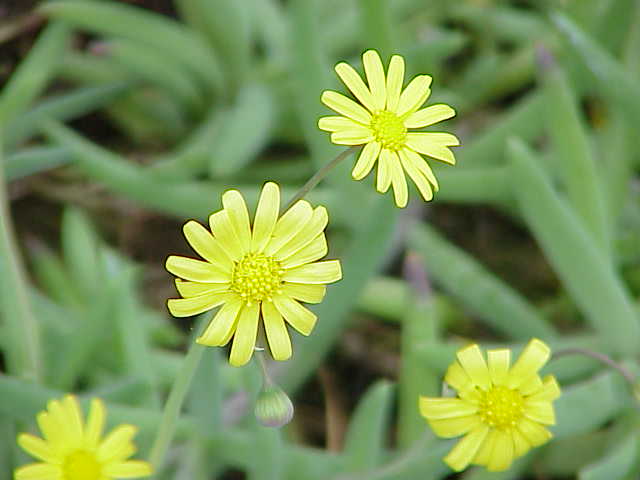
Othonna is a genus of roughly 90 species of succulent or subsucculent perennial herbs and shrubs in the family Asteraceae (daisy family), order Asterales. Its center of diversity lies in the Greater Cape Floristic Region (GCFR) of South Africa — one of the world's six floral kingdoms — with outlying species reaching into southern Namibia, Angola, and Zimbabwe.
The genus was formally established by Carl Linnaeus in 1753, originally comprising 14 species. Over subsequent centuries of taxonomic revision, most of those original members were reassigned to related genera including Cineraria, Euryops, Hertia, Ligularia, Senecio, and Tephroseris, leaving only four of Linnaeus's original species within Othonna. The genus is recognized as monophyletic. A major revision in 2012 erected the segregate genus Crassothonna B. Nord., transferring 13 species out of Othonna. A comprehensive modern taxonomic treatment of the remaining genus is ongoing, led by the Compton Herbarium and the South African National Biodiversity Institute; the first part — covering the bulbosa group of geophytic species with aerial stems — was published in 2019.
Several Othonna and Crassothonna species are known in Afrikaans as bobbejaankool, meaning "baboon cress" or "baboon cabbages," a folk name reflecting their palatability to baboons and other wildlife in their native scrubby and rocky habitats.
Etymology
The name Othonna traces to the Ancient Greek ὄθοννα (othonna) and the Latin othone, both denoting a linen cloth or napkin. The reference is to the soft, downy or woolly covering found on the leaves of several species known to early European botanists.
Distribution
Othonna is centered in the Greater Cape Floristic Region (GCFR) of South Africa, one of the world's most botanically rich areas. The genus extends marginally into southern Namibia, Angola, and Zimbabwe, but the vast majority of its roughly 90 species are endemic or near-endemic to the southwestern and southern Cape.
Taxonomy Notes
Othonna was established by Linnaeus in 1753 with 14 species; only four remain in the genus after extensive transfers to allied genera (Cineraria, Euryops, Hertia, Ligularia, Senecio, Tephroseris). The genus is confirmed monophyletic. In 2012 the segregate genus Crassothonna B. Nord. was erected to accommodate 13 species previously placed in Othonna. Ongoing revisionary work by the Compton Herbarium and the South African National Biodiversity Institute is producing a complete modern treatment; the bulbosa group (geophytic species with aerial stems) was revised in 2019.










