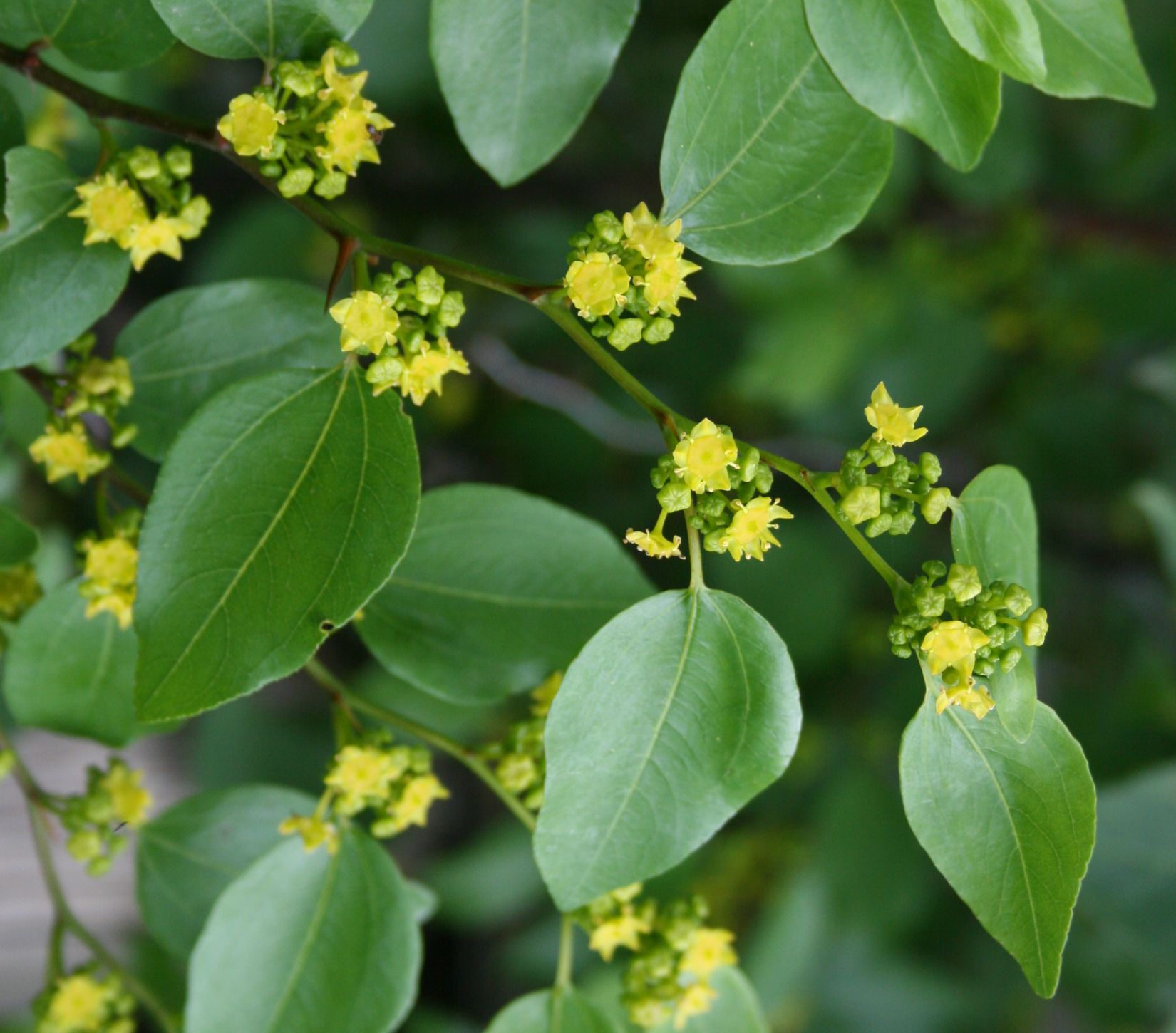
Paliurus is a genus of eight species of shrubs and small trees in the family Rhamnaceae (buckthorn family), order Rosales. The genus is native to warm, dry regions of Eurasia and North Africa, with its range extending from Morocco and Spain in the west across the Mediterranean, Middle East, and Central Asia to Japan and Taiwan in the east.
Plants in the genus grow 3 to 15 metres tall and share a distinctive zig-zagged shoot architecture: at each kink of the stem sits one leaf flanked by two stipular spines. The leaves are deciduous or evergreen depending on the species, oval in outline, 2 to 10 cm long and 1 to 7 cm broad, glossy green above, and marked by three conspicuous veins arising from the base. Leaf margins are entire to bluntly toothed. The fruit is an unusual dry woody nutlet enclosed within a broad circular wing 1 to 3.5 cm in diameter — a structure that aids wind dispersal and gives several species a characteristic disc-like appearance in fruit.
The best-known member is Paliurus spina-christi Mill., commonly called Christ's thorn or Jerusalem thorn, which has a long cultural and religious history around the Mediterranean. Other recognised species include Paliurus hemsleyanus from southern China, Paliurus orientalis from central China, and Paliurus ramosissimus from eastern Asia.
Several Lepidoptera larvae use Paliurus species as host plants, notably the specialist leaf-miners Bucculatrix albella (exclusive to P. spina-christi), B. paliuricola (exclusive to Paliurus spp.), and B. turatii.
Distribution
Paliurus is native to warm, dry regions of Eurasia and North Africa, ranging from Morocco and Spain in the west to Japan and Taiwan in the east. Individual species occupy distinct sub-ranges: P. spina-christi is widespread around the Mediterranean and into Central Asia, while P. hemsleyanus and P. orientalis are restricted to China.
Ecology
Paliurus species serve as exclusive larval host plants for several Bucculatrix leaf-miners, including B. albella (feeds only on P. spina-christi), B. paliuricola (feeds only on Paliurus spp.), and B. turatii (feeds only on P. aculeatus). The genus typically occurs in warm, dry habitats in seasonally arid Eurasian and North African regions.
Cultural Uses
Paliurus spina-christi, the most culturally prominent species, is widely associated in Christian tradition with the crown of thorns, an identification reflected in its common names "Christ's thorn" and "Jerusalem thorn." Its long, sharp stipular spines made it a practical hedging plant around fields and gardens throughout the Mediterranean region for centuries.

