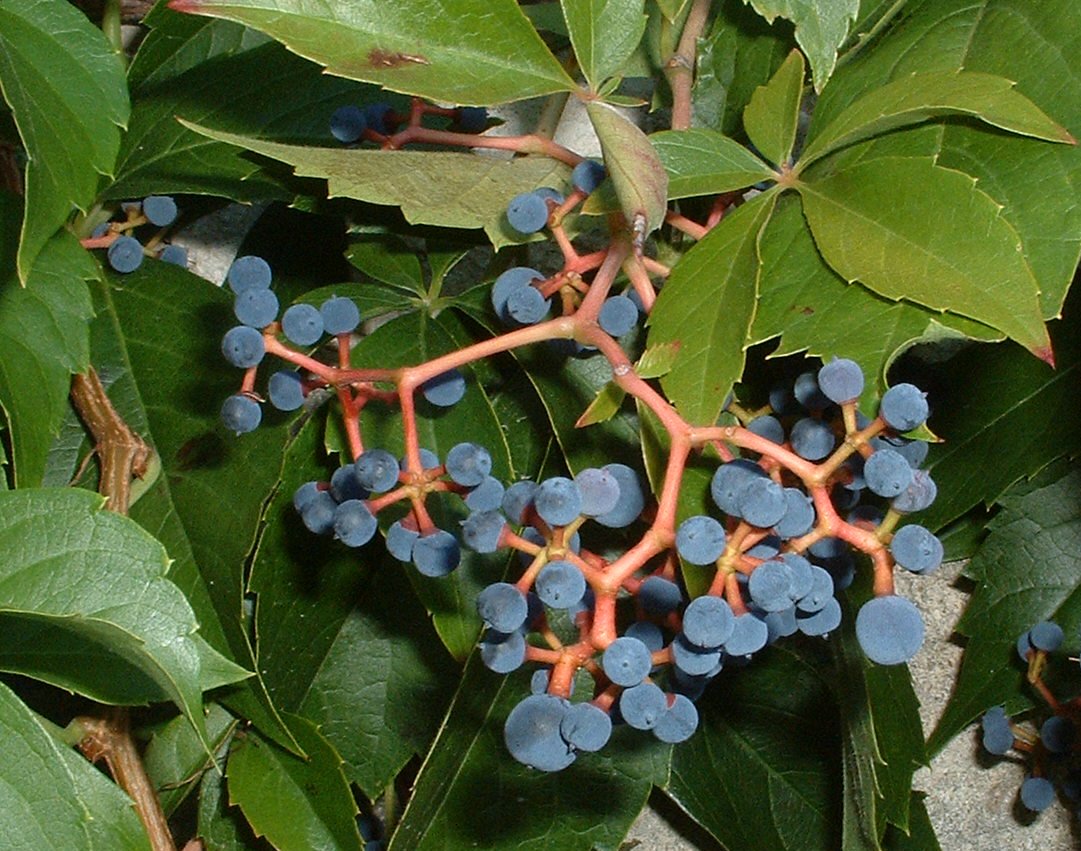
Parthenocissus is a small genus of tendril-climbing woody vines in the grape family, Vitaceae. The genus comprises roughly a dozen species distributed across the Himalayan region, eastern Asia, and temperate North America, where they grow as deciduous lianas reaching well over twenty metres when supported by trees or vertical structures. Several species are widely cultivated outside their native range as ornamentals, including the North American Virginia creeper (P. quinquefolia) and the East Asian Boston ivy (P. tricuspidata).
The defining feature of the genus is its climbing mechanism. Branched tendrils — modified shoots arising opposite the leaves — terminate in small adhesive pads that secrete mucilage through microscopic pores, allowing the plant to grip smooth, non-porous surfaces such as masonry, glass, and bark without penetrating them. A single pad can support many times its own weight, and the cumulative grip of a mature vine is strong enough to clothe a multi-storey wall. This trait separates Parthenocissus from related Vitaceae such as the true grapes (Vitis), whose tendrils coil around supports rather than adhering to them.
Leaves are deciduous and vary in form between species. P. quinquefolia and its close allies bear palmately compound leaves with five (occasionally three or seven) toothed leaflets, while P. tricuspidata bears simple, three-lobed leaves that superficially resemble those of a maple. In both cases the foliage emerges green and turns through bright scarlet, orange, and burgundy in autumn, a display that underpins the genus's horticultural popularity. Inflorescences are inconspicuous panicles of small greenish flowers; the resulting berries are 5–7 mm across, ripening purplish-black with a glaucous bloom, and are readily taken by birds even though they contain calcium oxalate raphides that are toxic to mammals.
Parthenocissus is placed in family Vitaceae, order Vitales. The genus was published by Jules Émile Planchon in 1887 in De Candolle's Monographiae Phanerogamarum, and the name combines the Greek parthenos ("virgin") with kissos ("ivy") — a reference variously interpreted as alluding to the plant's apparent ability to set seed without pollination or as a direct translation of the English common name "Virginia creeper". Several species have escaped cultivation and naturalised on every continent except Antarctica; P. quinquefolia in particular is now classed as invasive in parts of Europe, the United Kingdom, Australia, China, and Cuba.
Etymology
The genus name Parthenocissus was published by Jules Émile Planchon in 1887 and is built from the Greek parthenos ("virgin") and kissos ("ivy"). Two interpretations of the compound circulate. The first reads it as a reference to the apparent ability of some species to set fruit without pollination — a perceived parthenogenesis. The second treats it as a Greek translation of the English common name "Virginia creeper", which had long been applied to the North American type species P. quinquefolia. Both readings appear in the botanical literature; neither has been conclusively settled.
Distribution
The genus has a classic east-Asian / North American disjunct distribution typical of many temperate woody plant lineages. About twelve species occur natively across the Himalayan foothills, China, Korea, and Japan in Asia, with three species (P. quinquefolia, P. inserta, and P. heptaphylla) in temperate and subtropical North America extending south into Mexico and Guatemala. P. quinquefolia in particular has become widely naturalised: it is now recorded on every continent except Antarctica and is treated as an introduced neophyte in regions such as Switzerland, where four Parthenocissus taxa (P. inserta, P. quinquefolia, the P. quinquefolia aggregate, and P. tricuspidata) are documented but none are native.
Ecology
Parthenocissus species are temperate deciduous lianas that scramble through woodland edges, riverside thickets, and floodplain forests; P. tricuspidata, for example, occurs in floodplain bushes, riverside woodland, and moist mountain mixed forest in its East Asian range. Their adhesive-pad tendrils let them climb tree trunks and other vertical substrates without girdling them. The small fleshy berries are an important late-season food source for birds, which disperse the seeds; mammals are largely deterred by calcium oxalate raphides in the fruit and foliage. Several lepidopteran larvae — including the brown-tail moth, Gothic moth, and Virginia creeper sphinx moth — feed on Parthenocissus foliage in different parts of its range.
Cultivation
Three species dominate the horticultural trade: P. quinquefolia, P. tricuspidata, and P. henryana. All are grown for fast, self-supporting coverage of walls, fences, and pergolas and for spectacular autumn color that runs from orange-yellow to deep scarlet. The adhesive pads grip masonry and rendered surfaces directly, so no trellis is required, though the same trait makes them difficult to remove from painted or soft-mortar walls without surface damage. Foliage cover on building facades has a measurable cooling effect on adjacent interior walls in summer. The species are tolerant of a wide range of soils and exposures and require little intervention once established beyond seasonal pruning to keep growth off gutters, windows, and roof tiles.
Conservation
Conservation concerns for the genus relate almost entirely to invasiveness rather than rarity. P. quinquefolia is listed as invasive in the United Kingdom, Australia, several European countries, China, and Cuba; in Switzerland P. inserta and P. quinquefolia are documented as naturalised neophytes that have escaped from cultivation. Land managers in these regions treat established stands as a control target because of the species' capacity to smother native shrubs and small trees.
Cultural uses
Boston ivy (P. tricuspidata) is one of the most recognisable architectural plants of the temperate world, famously cloaking the outfield walls of Wrigley Field in Chicago and giving the "Ivy League" universities much of their visual identity. Virginia creeper plays a similar role in eastern North American landscapes, where its scarlet autumn foliage is a defining seasonal feature of woodland edges and old buildings.
Taxonomy notes
Parthenocissus belongs to family Vitaceae (order Vitales), the same family as the cultivated grape. The genus was established by Jules Émile Planchon in 1887 in his treatment of the Vitaceae for De Candolle's Monographiae Phanerogamarum (volume 5, page 447). GBIF's backbone classification currently recognises 27 descendant taxa under the genus, a figure that includes accepted species, infraspecific names, and synonyms; Wikipedia's overview gives the count of accepted species as roughly twelve. The genus sits near Vitis and Ampelopsis in the family and is distinguished from both by its adhesive-tipped tendrils.
History
A Middle Miocene (Sarmatian) palynoflora from the Lavanttal Basin in Austria contains Parthenocissus-type pollen, suggesting the genus or close relatives were present in central European subtropical vegetation roughly 12 million years ago. This fits the broader pattern of Vitaceae having a Northern Hemisphere temperate-subtropical history before being fragmented into the modern east-Asian / North American disjunct distribution.

