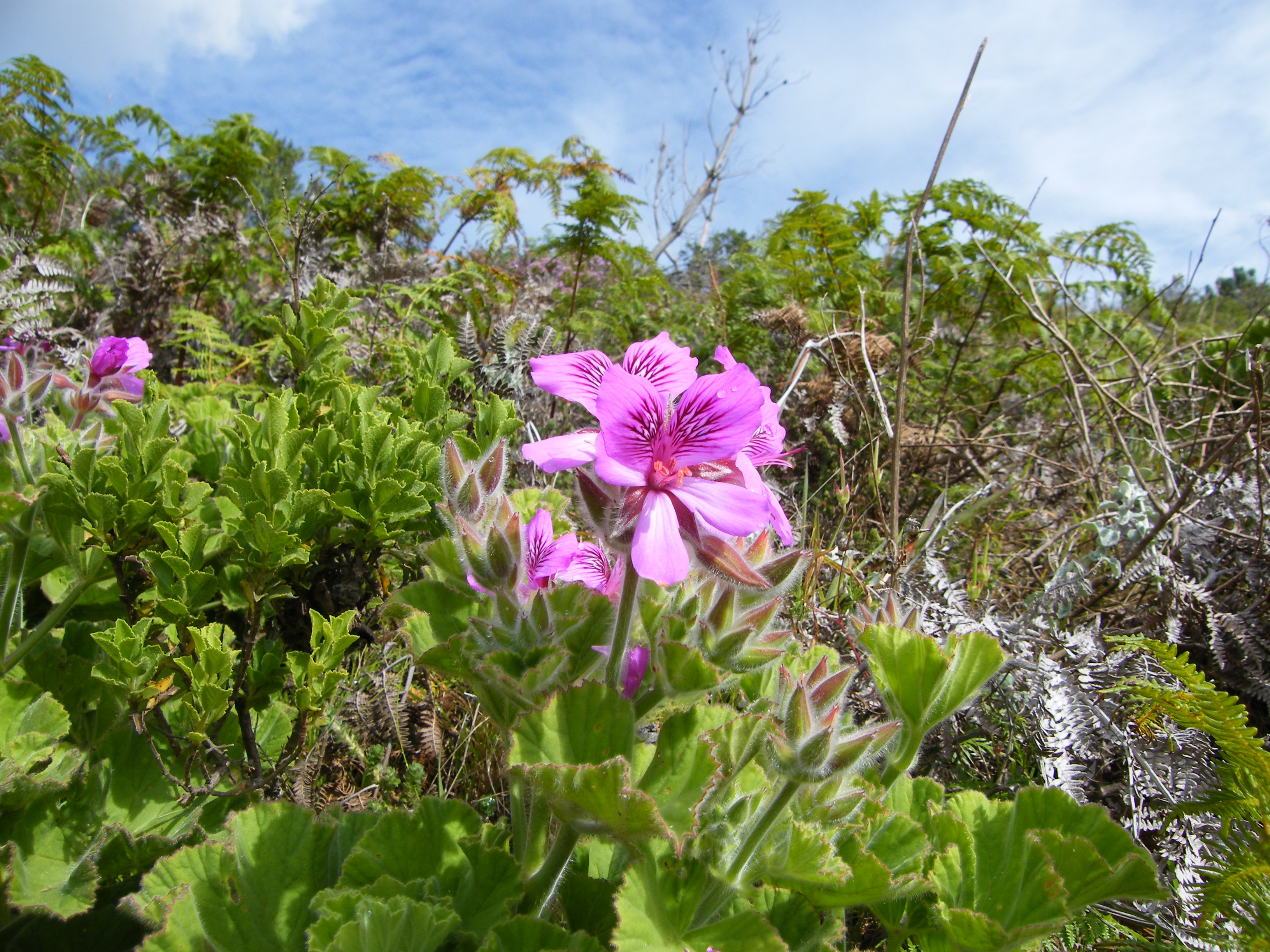
Pelargonium is a large genus of flowering plants in the family Geraniaceae, commonly known as geraniums, pelargoniums, or storksbills. POWO recognises 293 accepted species, while Wikipedia cites roughly 280; GBIF tracks 941 descendant names overall, reflecting the genus's heavily revised taxonomy. Members range from herbaceous perennials and tender shrubs to succulents and woody caudiciforms, with many species carrying strongly aromatic foliage.
The flowers are the genus's defining feature. Unlike true Geranium, which has radially symmetric blooms, Pelargonium flowers are zygomorphic — they have a single plane of symmetry. Five petals are arranged in umbel-like clusters, and the posterior sepal is fused to the pedicel to form a nectar-bearing hypanthium. Stamen count was the trait Charles L'Héritier used in 1789 to split the genus from Geranium: Pelargonium has seven fertile stamens. Leaves are usually alternate, palmately lobed or pinnate, and often borne on long stalks.
Plants are drought and heat tolerant but only marginally frost hardy. In cultivation they are treated as tender perennials and often overwintered indoors. Heights commonly run from one to two feet for bedding-type plants, though woody and shrubby species can be considerably larger. Flowers span reds, oranges, pinks, whites, and bicolours, and the long flowering season together with ease of vegetative propagation has made Pelargonium one of the most widely grown ornamental genera by wholesale value.
Etymology
The genus name comes from the Greek πελαργός (pelargós), meaning "stork", a reference to the long, beak-like shape of the fruit that the seeds develop in. The name was first proposed by the botanist Johann Jacob Dillenius in 1732 and was formally introduced by Johannes Burman in 1738. It only entered standard botanical usage after Charles L'Héritier de Brutelle split Pelargonium from Geranium in 1789, a separation that became authoritative through the publication of Hortus Kewensis 2: 417 (1789), where Pelargonium is credited to "L'Hér. ex Aiton".
Distribution
Pelargonium is overwhelmingly a southern African genus: roughly 90% of species are found in southern Africa, with the centre of diversity in the winter-rainfall region of southwestern South Africa. About 30 species occur elsewhere, concentrated along the East African rift valley (~20 species) and in southern Australia and Tasmania. Outlier populations exist in southern Madagascar, Yemen, Iraq, Asia Minor, northern New Zealand, Saint Helena, Tristan da Cunha, and Socotra.
POWO's accepted native range stretches from St. Helena and Eritrea down through southern Africa, across Madagascar, through Türkiye and the Arabian Peninsula, to northern Thailand, Australia, and New Zealand. As cultivated ornamentals, pelargoniums have naturalised widely in temperate and subtropical regions: Britain, Belgium, Spain, India, Myanmar, Korea, California, Mexico, the Caribbean, and several Pacific islands.
Ecology
Several Lepidoptera depend on or attack Pelargonium. Caterpillars of the angle shades moth (Phlogophora meticulosa) and others feed on the foliage, but the most economically significant species is the geranium bronze butterfly, Cacyreus marshalli. Its larvae bore into stems, causing blackening and plant death. Originally African, C. marshalli was accidentally introduced into Europe with the horticultural trade, naturalised in the Mediterranean, and is now listed as an A2 quarantine pest by EPPO.
Some Pelargonium chemistry has unusual interactions with introduced herbivores: Japanese beetles that feed on zonal geranium petals are rapidly paralysed by quisqualic acid present in the flowers, an effect that has prompted interest in using zonal geraniums as a trap crop.
Taxonomy
Pelargonium is the second largest genus in family Geraniaceae after Geranium, and is sister to the rest of the family (Erodium, Geranium, and Monsonia including Sarcocaulon). Carl Linnaeus originally grouped pelargoniums with true Geranium in 1753; Charles L'Héritier separated them in 1789 on the basis of stamen number (seven fertile stamens in Pelargonium) — a treatment formalised in Hortus Kewensis 2: 417 (1789).
Internal classification has been repeatedly revised. De Candolle proposed 12 sections in 1824, and Knuth raised this to 16 sections in 1912. Phylogenetic work by Röschenbleck et al. (2014) recognised four subgenera that correspond to major molecular clades: Magnipetala (24 species), Parvulipetala (39–42 species), Paucisignata (25–27 species), and Pelargonium s.s. (167 species). POWO currently lists 293 accepted species against 25 synonymised names; GBIF tracks 941 descendant taxa under the genus, the discrepancy reflecting the inclusion of infraspecific names, synonyms, and unresolved entries.
Cultivation
Pelargonium consistently ranks among the highest-value potted flowering crops worldwide. Most ornamental forms are grown as tender perennials, requiring full sun (6+ hours of direct light per day) and well-drained, neutral to alkaline soil. They tolerate heat and drought well but are damaged by frost, so in temperate climates they are usually overwintered indoors or under glass. Plants benefit from dry conditions, particularly in winter, and tolerate hard pruning — they can be cut back to the base to rejuvenate them.
Zonal geraniums (P. × hortorum) are reliable in USDA zones 9–12 and may overwinter as low as zone 7 with protection. Eight major cultivar groups exist — Zonal, Ivy-leaved, Regal, Angel, Unique, Scented-leaved, Species, and Primary hybrids — and the Pelargonium & Geranium Society (PAGS), formed in 2009, is the International Cultivar Registration Authority maintaining the International Register of Pelargonium Cultivars.
Propagation
Pelargonium is easy to propagate vegetatively. Stem cuttings taken with at least two nodes root readily at almost any time during the growing season, though early summer is generally considered the best window. Seed propagation is straightforward where viable seed is available: germination is best at a minimum of 13 °C and typically occurs within about two weeks.
History in cultivation
Pelargonium has one of the longer cultivation histories of any southern African genus. The first species in European gardens was Pelargonium triste, probably introduced to Leiden before 1600; John Tradescant the elder brought it to England in 1631 via seed obtained in Paris. By 1724, five species — P. inquinans, P. odoratissimum, P. peltatum, P. vitifolium, and P. zonale — were established in European collections.
Dillenius described and illustrated seven South African species in 1732, but Linnaeus's 1753 lumping with Geranium delayed formal recognition of the genus for nearly forty years until L'Héritier's 1789 separation. Liberty Hyde Bailey introduced the now-standard nothospecies names P. × hortorum (zonal pelargoniums) and P. × domesticum (regal pelargoniums) in 1916.
Cultural uses
Pelargoniums have culinary, medicinal, and industrial uses. The leaves and flowers of many species are edible: buds and young leaves can be eaten raw or cooked, with an acidic sorrel-like flavour, and scented-leaf cultivars — particularly rose-, lemon-, and peppermint-scented forms — flavour desserts, cakes, jellies, teas, herbal butter, and vinegar. All parts of the plant are astringent.
Several species feed the perfumery industry. Pelargonium graveolens is cultivated and distilled for "scented geranium oil"; P. capitatum is similarly rose-scented and grown commercially. The oils contain citronellol, geraniol, eugenol, alpha-pinene, and related terpenes, and geranium oil is widely used in aromatherapy.
Medicinally, pelargoniums have been used for intestinal complaints, wounds, respiratory ailments, fevers, and kidney problems. The most commercially significant medicinal species today is Pelargonium sidoides, whose root extracts (often combined with Echinacea) are sold across Europe and the United States as treatments for bronchitis and the common cold. P. odoratissimum is traditionally used for astringent, tonic, and antiseptic effects.
Toxicity
Pelargonium is listed by NCSU Extension as toxic to cats, dogs, and horses, with symptoms including vomiting, anorexia, and dermatitis; cats are the most sensitive. The active compounds implicated are geraniol and linalool, which can also cause contact dermatitis in sensitive humans handling the plants.










