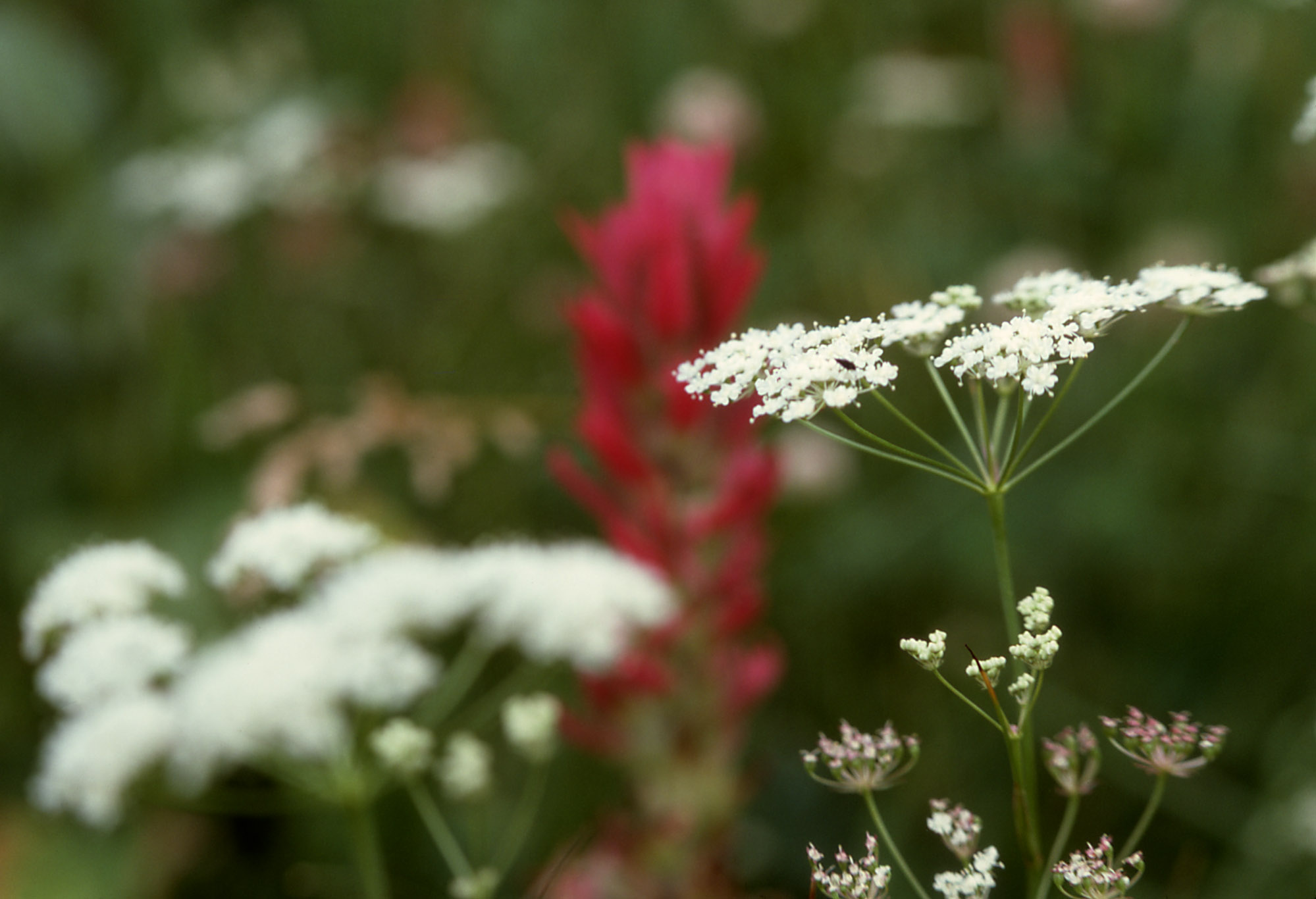
Perideridia, commonly known as yampah or yampa, is a genus of flowering plants in the carrot family Apiaceae (order Apiales), described by Reichenbach in 1837. The genus comprises roughly a dozen species native to western North America, where they grow in moist open meadows and grassy hillsides up to about 7,500 feet (2,300 m) elevation.
Plants are notably tall and slender — typically 1 to 3 feet in height — with extremely narrow, threadlike leaves 1 to 6 inches long that closely resemble grass blades. This grass-mimicry makes the plants nearly invisible in the meadow communities they inhabit until they produce their distinctive umbels of small white flowers, a characteristic shared with other members of the parsley family.
Like many Apiaceae, yampah produces small fleshy roots — roughly the size of a large unshelled peanut — that are starchy and mildly sweet, with a texture compared to water chestnut. Perideridia gairdneri was a particularly important food plant for Native American peoples of western North America, whose roots were baked or steamed and whose seeds were used as a caraway-flavored seasoning. The roots are high in readily assimilable carbohydrates and were prized as an endurance food. Caution is warranted in the field: yampah closely resembles the highly toxic poison hemlock (Conium maculatum) and water hemlock (Cicuta spp.).
Etymology
The genus name Perideridia derives from the Greek word perideri, meaning "necklace," coined by Reichenbach in his 1837 Handbuch.
Distribution
Perideridia species are native to western North America, growing in moist open meadows and hillsides from lowlands up to approximately 7,500 feet (2,300 m) elevation.
Ecology
Plants grow in grassy open meadows and sunlit hillsides, preferring full sunlight. Their narrow, grass-blade-like leaves allow them to blend almost invisibly into meadow grasses until flowering.
Cultural Uses
Yampah roots have been a significant food source for Indigenous peoples of western North America. Plains Indians called the plant "yampah" and ate the starchy roots, which taste mildly of carrot. Perideridia gairdneri in particular was a staple crop — roots were baked or steamed and noted for excellent flavor and nutrition; seeds served as a caraway-like spice. The roots, rich in rapidly assimilatable carbohydrates, were used by hunters and runners for sustained energy. In moderation the roots are edible; in excess, uncooked roots act as a gentle laxative, a property also used medicinally.










