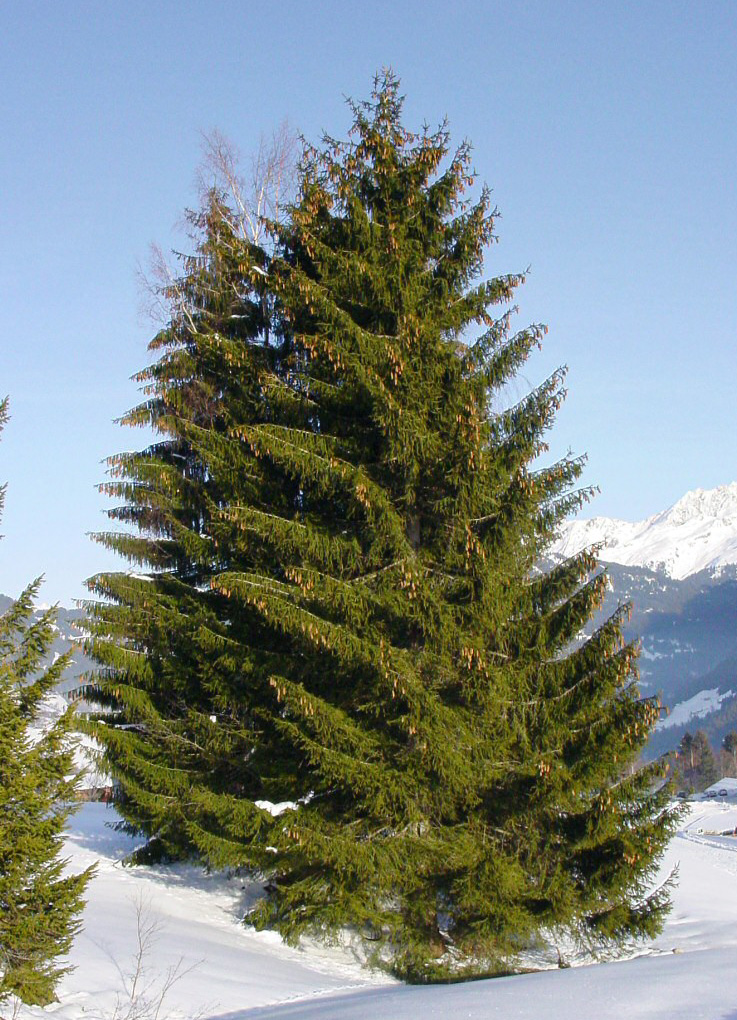
Picea — the spruces — is a genus of about 35 to 37 species of evergreen coniferous trees in the pine family Pinaceae, placed in the small subfamily Piceoideae. The genus encircles the cool Northern Hemisphere, dominating vast tracts of boreal taiga from Alaska and Canada across northern Eurasia, with a secondary diversity hotspot in the mountains of western China.
Spruces are unmistakable conifers. Most are tall, straight-trunked trees with a conical crown that gradually flattens into a roughly cylindrical column with age. Picea sitchensis, the Sitka spruce of the Pacific Northwest, reaches 100 m and ranks among the world's tallest trees. The needles are four-sided and square in cross-section, persist up to ten years, and attach singly to tiny woody pegs (pulvini) on the twigs. When a needle falls the peg remains, leaving each shoot distinctly rough to the touch — the simplest field mark that separates a spruce from a fir. Female cones hang pendulous from the upper branches, mature in a single season, and provide the most reliable characters for telling species apart.
The genus name Picea is borrowed from Latin pix, "pitch," a reference to the abundant resin the trees produce. The English word "spruce" entered the language in the Middle Ages by way of "spruse" — goods imported from Prussia (Old French Pruce). The genus was formally established as Picea A.Dietr. by Albert Gottfried Dietrich in 1824, with Picea abies (the Norway spruce) as the type species.
Ecologically, spruces are foundation species of the boreal and montane coniferous forests. They tolerate cold and acidic soils that defeat most broadleaved trees but are less heat-tolerant than firs. Regeneration is precarious: more than half of all spruce seedlings die during their first growing season. Mature stands sustain specialised herbivores and pathogens, including the European spruce bark beetle, the eastern spruce budworm, and the green spruce aphid.
Few groups of trees have done more for human economies. Spruce lumber, marketed in North America as SPF (spruce-pine-fir) and in Europe as whitewood, is one of the world's most important construction softwoods. Spruce is the standard tonewood for the soundboards of acoustic guitars, violins, and pianos, and its long-fibred wood is prized for strong pulp and paper. Picea abies has become the archetypal Christmas tree across Europe and beyond. Indigenous peoples across the boreal zone have woven baskets from the pliable surface roots of several species, and the vitamin C-rich young shoots have long been brewed into spruce beer — a practice Captain Cook used to fight scurvy at sea.
Etymology
The genus name Picea is taken from the classical Latin pix, meaning "pitch," in reference to the resin that exudes copiously from the trunk and cones of these trees. The English common name "spruce" has a different and considerably more recent origin: it appears in Middle English as "spruse" or "Sprws," originally an adjective denoting goods (timber, leather, cloth) imported from Prussia. The Middle English form traces back through Old French Pruce, the name for Prussia itself, so "spruce wood" literally meant "wood from Prussia" before the word narrowed to the tree. The genus was formally erected as Picea A.Dietr. by the German botanist Albert Gottfried Dietrich in 1824.
Distribution
Picea is a Northern Hemisphere genus, distributed across the temperate and boreal (taiga) regions of Europe, Asia, and North America. The largest concentration of species lies in eastern and especially western China, with additional centres of diversity in the mountains of Central Asia, the Himalayas, Japan, the Balkans, and the cordilleras of western North America. The range stretches from subarctic latitudes — where Picea mariana and P. glauca form the green belt of the North American taiga — south into the temperate zones, generally at increasing elevation. In the southwestern United States, for example, the genus is represented only by the high-elevation Engelmann spruce (P. engelmannii) and blue spruce (P. pungens). Spruces have been widely planted as ornamentals and forestry crops outside their native range, with naturalised populations recorded as far afield as Australia.
Ecology
Spruces are the dominant trees of much of the world's boreal forest and a major component of montane coniferous forests further south. They tolerate long cold winters, short growing seasons, and acidic soils that defeat most broadleaved trees, but they are less tolerant of heat than firs and retreat upslope or northward as climate warms. Regeneration is a numbers game: in many species more than half of all seedlings die during their first growing season, so cone production must be heavy and recurrent. Mature stands support a characteristic suite of specialist herbivores, including the European spruce bark beetle (Ips typographus), the eastern spruce budworm, and the green spruce aphid (Elatobium abietinum), any of which can drive landscape-scale mortality during outbreak years.
Cultivation
Spruces are widely planted as forestry crops, screening trees, and ornamentals in cool-temperate climates. They thrive in deep, moist, acid soils in full sun and resent prolonged summer heat or drought. The genus contains some of the largest cultivated conifers — Picea sitchensis reaches 100 m in its native Pacific Northwest range and is the backbone of British and Irish commercial conifer plantations — alongside compact dwarf cultivars selected from species such as P. glauca and P. pungens that have become staples of small gardens and rock gardens. Most species are reliably hardy in cold continental winters but suffer from green spruce aphid and bark beetle outbreaks where stands are planted off-site or stressed by heat.
Cultural Uses
Few tree genera carry the cultural and economic weight of Picea. Spruce timber, sold as SPF (spruce-pine-fir) in North America and as whitewood in Europe, is one of the world's most heavily used softwoods for construction lumber and engineered wood products. Its uniquely long, strong fibres make it the preferred raw material for high-grade paper pulp. Acoustically, spruce is the tonewood of the soundboards of acoustic guitars, violins, cellos, and pianos, valued for its strength-to-weight ratio. Norway spruce (Picea abies) is the archetypal Christmas tree across Europe and much of North America. Indigenous peoples of the boreal zone have long used the pliable surface roots of several species — notably P. mariana and P. glauca — to weave watertight baskets and lace birch-bark canoes. The young shoots are a rich seasonal source of vitamin C and have been fermented into spruce beer at least since the eighteenth century; Captain James Cook famously used spruce-beer rations to keep scurvy at bay on his Pacific voyages.
Conservation
The Global Invasive Species Database holds no records for Picea, so no member of the genus is currently flagged as a globally significant invasive — a reflection of the cold, infertile habitats spruces favour and the slow generation times of their seedlings. Conservation concern in the genus instead lies at the species level, where several narrow-range species (for example Picea omorika in the Balkans and various Asian endemics) are threatened by habitat loss, fire, and bark-beetle outbreaks amplified by climate warming.
Taxonomy Notes
Picea was formally erected by Albert Gottfried Dietrich in 1824, with Picea abies (Norway spruce) as the type species; the earlier name P. rubra A.Dietr. is treated as invalid. The genus is placed in family Pinaceae and is the sole modern genus of subfamily Piceoideae (sometimes treated as part of Pinoideae). Estimates of accepted species vary modestly between authorities — Wikipedia cites "about 37" as of September 2025 while Wikispecies lists roughly 35, drawing on Farjon's World Checklist and Bibliography of Conifers and the regional treatments in Flora of China and Flora of North America. GBIF accepts the genus as Picea A.Dietr. (taxon key 7606064) with chromosome number 2n = 24 reported by herbarium treatments such as SEINet.










