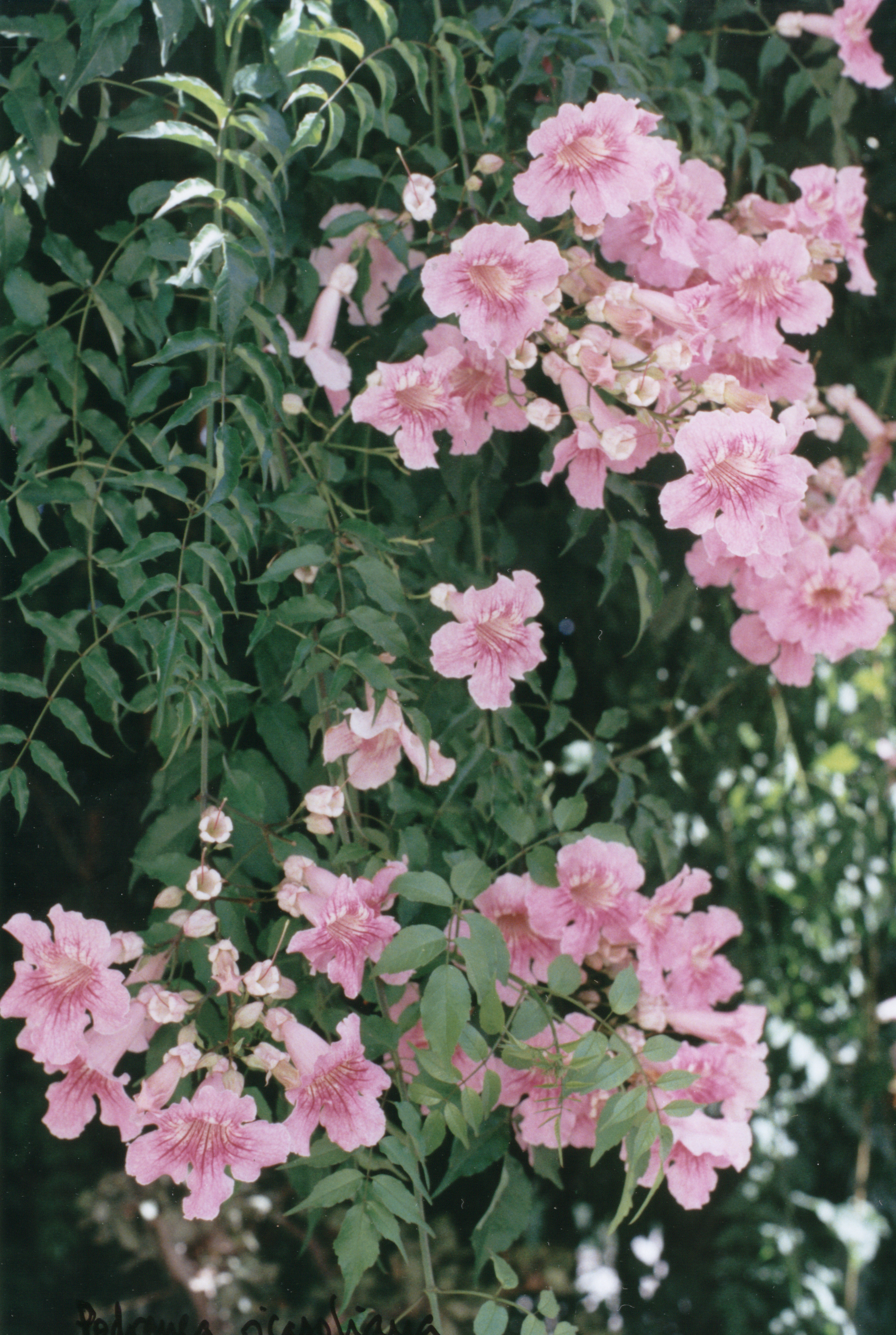
Podranea is a small genus of flowering vines in the family Bignoniaceae, order Lamiales, comprising one or two species depending on the taxonomic treatment applied. Native to sub-Saharan Africa, these woody climbers are valued ornamentally for their showy trumpet-shaped flowers, which are characteristic of the broader Bignoniaceae family.
The genus is most commonly represented in cultivation by Podranea ricasoliana, known as the pink trumpet vine or Port St. Johns creeper, which produces large clusters of pink to lilac tubular flowers. Podranea brycei, the Zimbabwe creeper, is closely related and is sometimes treated as a synonym of P. ricasoliana rather than a distinct species.
Podranea was separated from the related genus Pandorea and formally circumscribed by the British botanist Thomas Archibald Sprague in 1904, published in Flora Capensis. The genus name is itself an anagram of Pandorea, reflecting this close relationship. Both genera belong to Bignoniaceae, a family renowned for its ornamental vines and trees with large, often trumpet-shaped corollas.
Etymology
The name Podranea is an anagram of Pandorea, the closely related Bignoniaceae genus from which Podranea was segregated when Thomas Archibald Sprague described it in 1904.
Distribution
Podranea is native to southern tropical Africa and southern Africa, with its natural range spanning Malawi, Mozambique, Zambia, Zimbabwe, and the Cape Provinces and KwaZulu-Natal regions of South Africa.
Cultivation
Both species of Podranea are grown as ornamental climbers in warm-temperate and subtropical gardens worldwide, prized for their abundant pink to lavender trumpet-shaped flower clusters. They thrive in full sun with well-drained soil and are drought-tolerant once established, though they perform best with moderate irrigation during the growing season. In frost-prone climates they are typically grown under glass or as conservatory plants.
Taxonomy Notes
Podranea was circumscribed by Thomas Archibald Sprague in Flora Capensis (Harvey), vol. 4(2.3), p. 449, in 1904. The genus contains either one or two species depending on authority: Podranea brycei is accepted as distinct by some treatments but reduced to a synonym of Podranea ricasoliana by others. The Plant List accepted both species.

