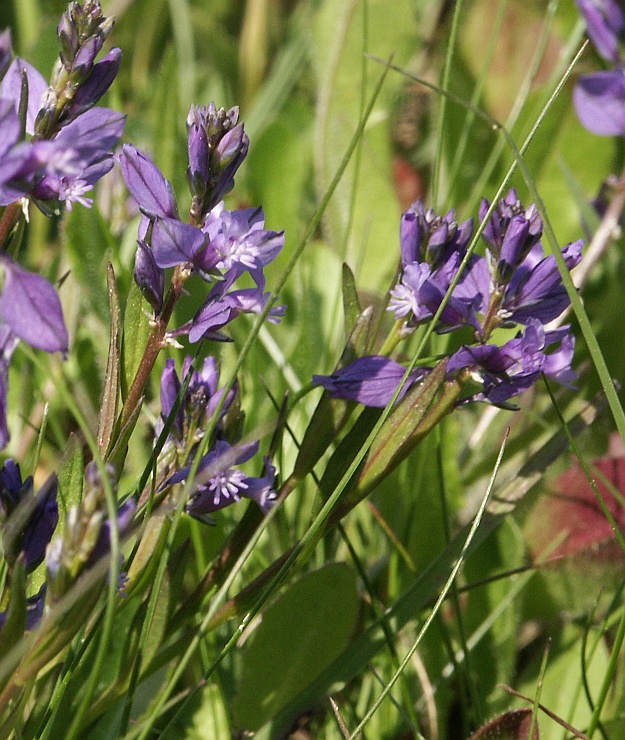
Polygala is the type genus of the milkwort family, Polygalaceae, and one of the most species-rich genera within the order Fabales. Linnaeus formally established the genus in Species Plantarum (1753), retaining a pre-Linnaean concept from Tournefort, and authorities still cite it as "Tourn. ex L." Modern checklists place the worldwide total at around 420 to 500 accepted species, with Plants of the World Online recognizing 422 species and GBIF indexing more than a thousand descendant names once synonyms and infraspecific taxa are included.
The genus is morphologically diverse, encompassing annual and perennial herbs as well as shrubs, climbers, and small trees. Despite this variation, the flowers are unmistakable. Each bloom has five sepals: the three outer are small and inconspicuous, while the two inner lateral sepals enlarge into petal-like "wings" that flank the corolla. The corolla itself comprises three petals, the lowest fused into a boat- or helmet-shaped keel that often terminates in a fringed or crested appendage. Eight stamens (sometimes six) are typically monadelphous, their filaments fused into a sheath split along the upper side, and the ovary is bilocular. Flowers are borne in racemes that range from open and spike-like to compact, almost head-like clusters. The capsular fruits release small, often hairy black seeds tipped by a conspicuous white aril, and the roots of many species carry a characteristic wintergreen-like scent.
Common names — milkwort, snakeroot — trace back to ancient belief that the plants increased milk yield in nursing animals, the same notion that gave Greek-speaking herbalists the name polýgalon, "much milk." That association underpinned both folk veterinary use and the long medicinal history of the genus in European and Asian herbal traditions.
Polygala is cosmopolitan in distribution, occurring natively across Africa, Asia, Europe, and the Americas, with the greatest concentration of species in tropical and subtropical South America. The genus extends from Greenland and high-latitude Europe through Mediterranean and Saharan latitudes into South and Southeast Asia, and it has been introduced widely beyond its native range, including parts of western North America, Hawaii, New Zealand, Réunion, and several Atlantic islands. In temperate Europe alone, Switzerland's national flora records 16 Polygala taxa, illustrating how richly the genus radiates even within a single mountainous country.
Etymology
The genus name Polygala comes from ancient Greek and means "much milk." Classical and early modern herbalists believed that the plants increased milk production in nursing livestock, a folk association that also gave rise to the English common names milkwort and milkweed-like vernaculars across European languages. Linnaeus retained the Tournefortian name when he formally described the genus in 1753.
Distribution
Polygala has a near-cosmopolitan range, occurring natively across Africa, Asia, Europe, and the Americas. Plants of the World Online lists native presence from Greenland and Mediterranean Europe through extensive African territories and across Asia from the Middle East to Southeast Asia, with Mexico marking the genus's northward extent in the New World. South America holds the greatest species diversity, followed by Africa and Asia. The genus has also been introduced well beyond its native range, with records from British Columbia, California, Oregon, Washington, Michigan, Vermont, Hawaii, Madeira, Réunion, St. Helena, New Zealand's North Island, and Norfolk Island. Regional floras illustrate the genus's reach into temperate uplands: the Swiss national flora alone records 16 Polygala taxa, while SEINet documents representatives in southwestern North America.
Taxonomy
Polygala is the type genus of family Polygalaceae in the order Fabales. The accepted authority is "Tourn. ex L.", reflecting Linnaeus's 1753 retention of an earlier Tournefort concept in Species Plantarum. Plants of the World Online currently recognizes 422 accepted species; Wikipedia summarizes published estimates ranging from roughly 350 to 730 with a current consensus near 420, and SEINet cites approximately 500. GBIF indexes more than 1,000 descendant taxa under the genus once subspecies, varieties, and synonyms are counted.
History
The link between Polygala and dairying is encoded in the name itself: classical and medieval herbalists used the plants as a galactagogue, believing them to increase milk yield in cows and nursing mothers. That tradition carried through to the early modern period, when Tournefort circumscribed the genus and Linnaeus adopted it into the binomial system in 1753. Common names such as milkwort and snakeroot still reflect this herbal heritage.










