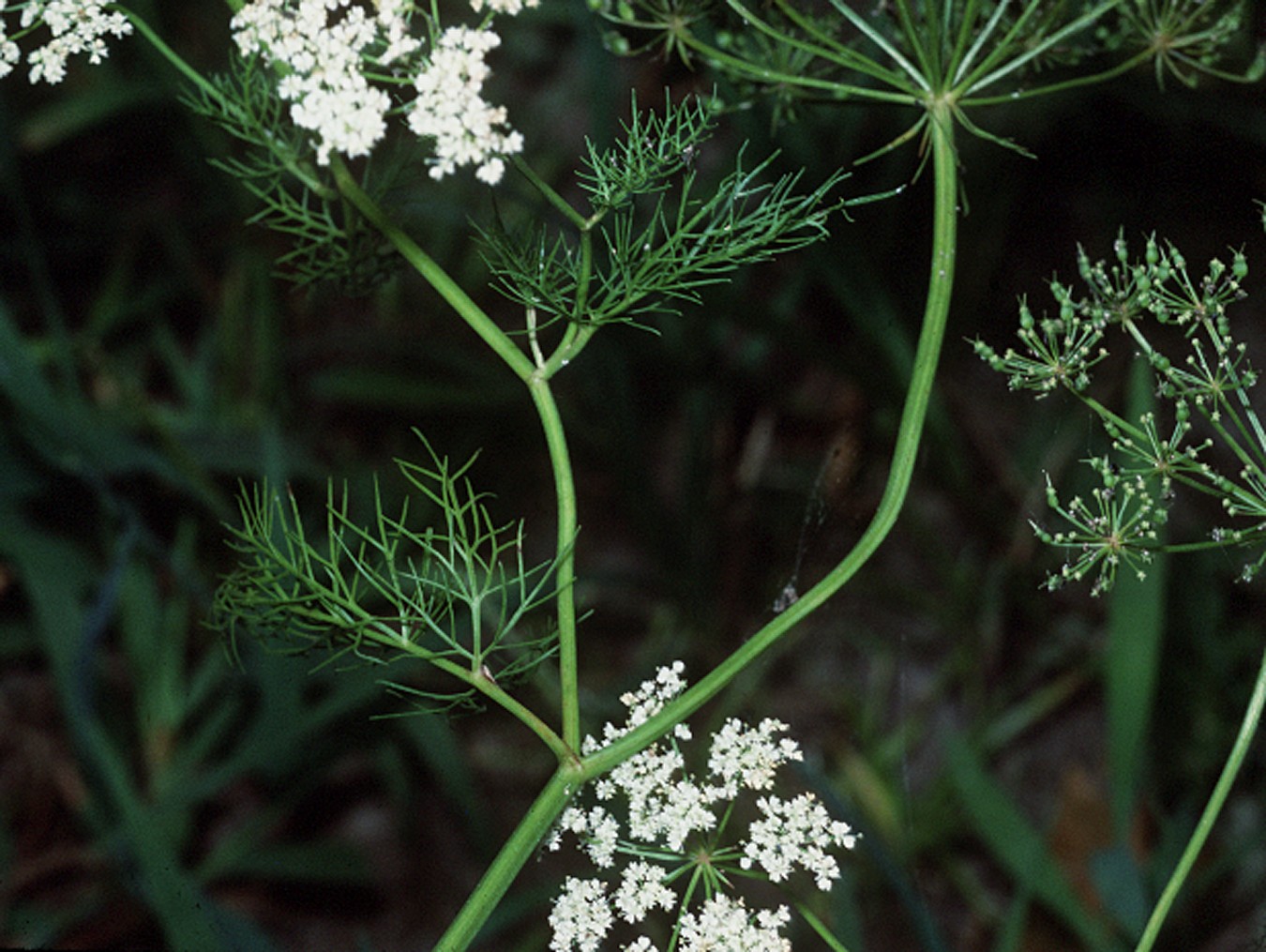
Ptilimnium, commonly called mock bishopweed or mock bishop's weed, is a small genus of flowering plants in the carrot family (Apiaceae), placed in the order Apiales. The genus was formally described in 1819 and is endemic to the United States, with its greatest diversity in the Southeast, the Lower Mississippi Valley, and the Lower Great Plains.
Members of the genus are delicate annual or perennial herbs typical of the Apiaceae, bearing finely divided, hair-like (capillaceous) leaves and small white flowers arranged in compound umbels — the characteristic inflorescence of the carrot family. The name "mock bishopweed" reflects a resemblance to the unrelated bishopweed (Aegopodium).
Plants of the World Online (as of December 2022) accepts five species: Ptilimnium ahlesii, P. capillaceum, P. costatum, P. nuttallii, and P. texense. A sixth species, P. nodosum, is treated by POWO as Harperella nodosa in a separate genus. The most widespread species, P. capillaceum, ranges across the southeastern and northeastern United States; P. costatum and P. nuttallii are restricted to the south-central region; P. texense is known from Texas, Louisiana, and Florida.
Distribution
Ptilimnium is endemic to the United States, with its range centered on the Southeast, the Lower Mississippi Valley, and the Lower Great Plains. Individual species vary in extent: P. capillaceum is the most widespread, occurring in southeastern, south-central, and parts of northeastern states, while P. costatum and P. nuttallii are confined to the south-central United States, and P. texense is known from Texas, Louisiana, and Florida.
Taxonomy Notes
The genus was described in 1819 and belongs to the family Apiaceae (order Apiales). Ptilimnium nodosum, formerly placed here, is now treated as Harperella nodosa by Plants of the World Online. GBIF records the genus as accepted with family Apiaceae, order Apiales.










