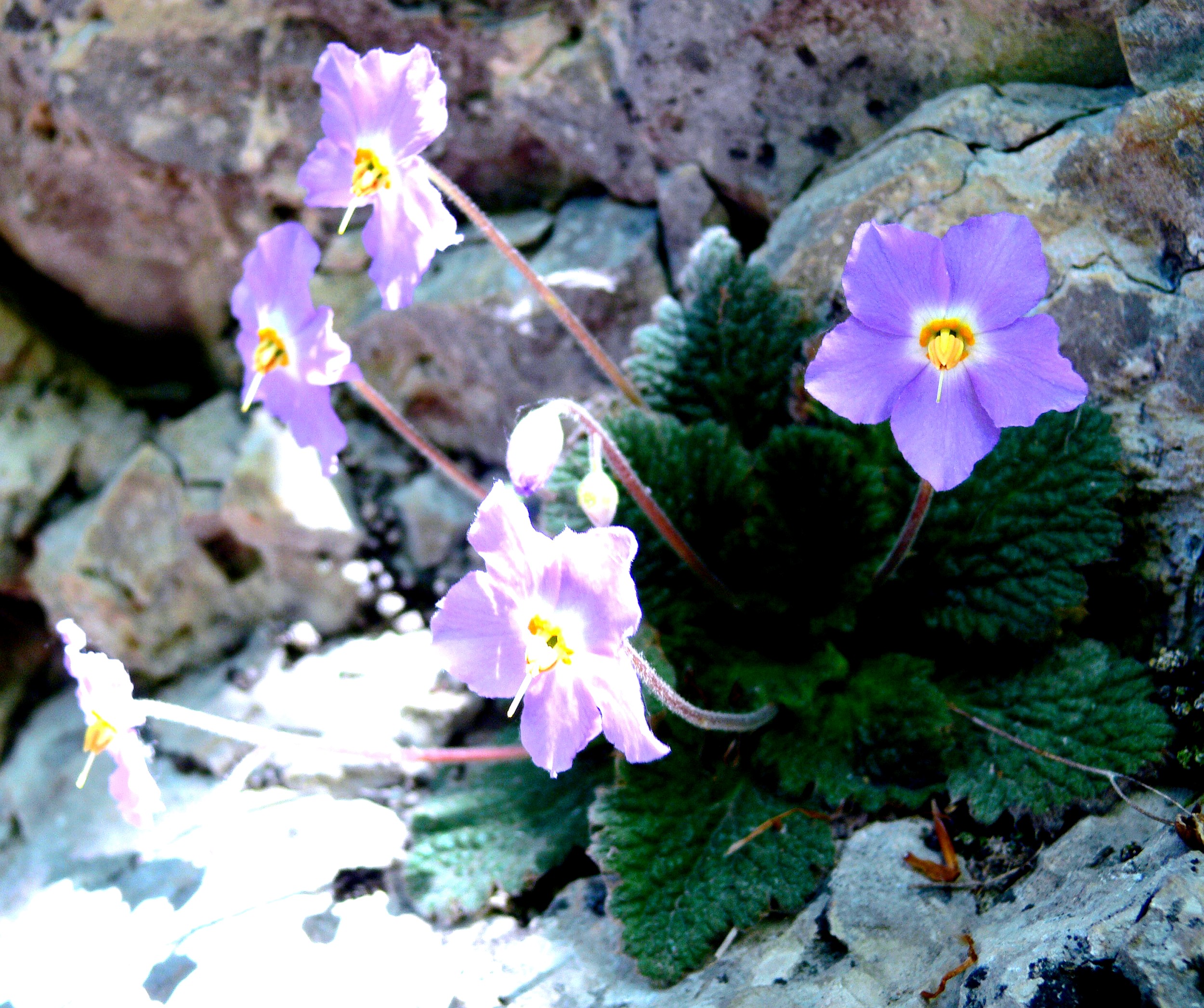
Ramonda is a small genus of four species of evergreen flowering plants belonging to the family Gesneriaceae, within the order Lamiales. The genus is native to shady, rocky habitats in north-eastern Spain, the Pyrenees, and the mountains of south-eastern Europe, where its members grow in crevices and on cliff faces that receive little direct sun.
Plants in the genus form low rosettes of distinctively crinkly, wrinkled leaves and produce nearly actinomorphic (radially symmetrical) flowers on slender, leafless stems in spring. One of their most remarkable biological traits is poikilohydry — the ability to survive almost complete desiccation and recover fully upon rehydration, a rare adaptation among higher plants more commonly associated with mosses and lichens.
The genus contains four accepted species: Ramonda myconi, native to the Pyrenees and north-eastern Spain; Ramonda serbica and Ramonda nathaliae, both from the Balkans; and Ramonda heldreichii, formerly placed in the monotypic genus Jankaea and native to Mount Olympus in Greece. All four are considered relict species — survivors of a flora that was far more widespread before the Pleistocene ice ages.
Etymology
The genus Ramonda is named after Louis Ramond de Carbonnières (1755–1827), a French botanist and explorer who was among the first scientists to undertake systematic exploration of the high Pyrenees and document its flora.
Distribution
Ramonda species are native to two disjunct regions of southern Europe: the Pyrenees and north-eastern Spain (R. myconi), and the mountains of the western Balkans and northern Greece (R. serbica, R. nathaliae, R. heldreichii). All species favour shaded, rocky habitats such as cliff faces, gorges, and boulder fields, typically on calcareous or siliceous substrates.
Ecology
Ramonda plants are poikilohydric — they can lose nearly all cellular water during drought and revive fully upon rehydration, an extreme stress-tolerance adaptation. This trait, exceptional among flowering plants, allows them to persist on exposed rock faces that experience severe summer desiccation. They are considered glacial relict species, their current fragmented distribution reflecting the contraction of a once broader European mountain flora during and after the Pleistocene glaciations.
Cultivation
Ramonda species are cultivated as rock garden and alpine house plants, prized for their tolerance of deep shade and their spring flowers. They perform best in vertical or near-vertical crevices that allow water to drain freely from the rosettes, mimicking their natural cliff-face habitat. They are hardy in temperate climates but susceptible to crown rot if water sits on the leaves.
Conservation
Ramonda species are narrow endemics with restricted ranges confined to specific mountain massifs. R. heldreichii is the rarest, known only from Mount Olympus, and was until recently placed in its own monotypic genus Jankaea. Their relict status and specialised habitat requirements make them vulnerable to climate change, particularly warming and drying of montane habitats.










