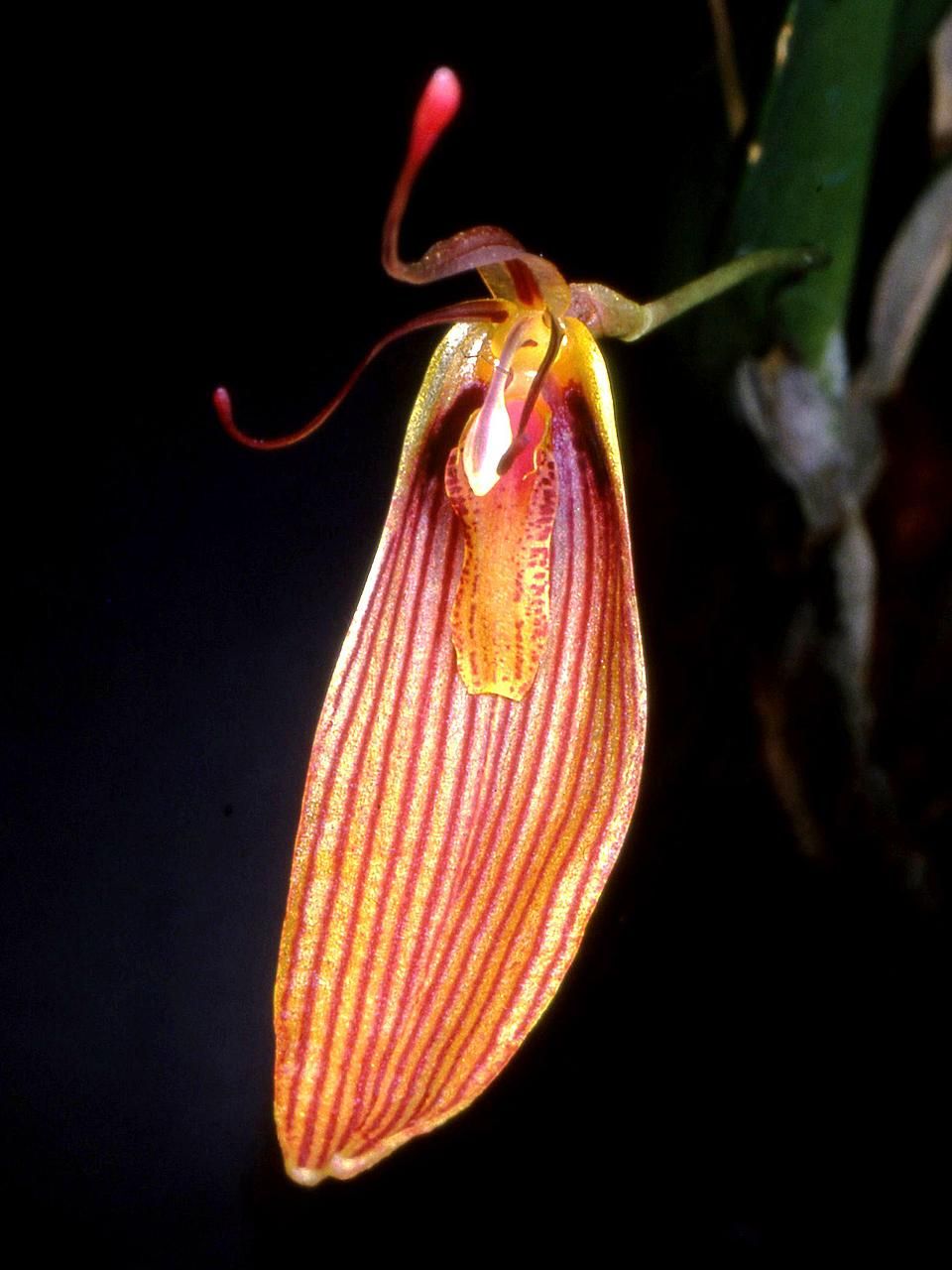
Restrepia (abbreviated Rstp in the horticultural trade) is a small genus of approximately 69 epiphytic orchid species in the family Orchidaceae, order Asparagales. It is closely allied to Pleurothallis and belongs to the diverse tribe Epidendreae of the pleurothallid alliance. The genus was described by Carl Sigismund Kunth in 1816.
Plants are tiny to small epiphytes, rarely lithophytes, and conspicuously lack pseudobulbs. Each plant bears a single erect, thick, leathery leaf that is elliptic-ovate in outline, with aerial roots that appear as fine hairs. Growth is tufted, with white-sheathed stems and fine papery bracts.
Flowers are produced one at a time on a slender peduncle arising from the base of the back of the leaf. The long dorsal sepal is erect and terminates in a thickened, club-shaped tip; the lateral sepals are fused into a synsepal and are often the showiest part of the flower, ranging from white, yellow, rose, purple, and orange to tan, frequently overlaid with contrasting reddish-purple spots or stripes. The lateral petals are long and similarly club-tipped. The lip is long, ovoid, and widest at its apex, matching the color and marking variation of the sepals. Under good growing conditions plants can remain in bloom year-round. New plants arise naturally as keikis — small plantlets — from the base of mature leaves.
Several species show exceptional variability; Restrepia muscifera, for example, varies so markedly in size, shape, and color that no two wild populations look alike. The genus is distributed primarily in the cool, moist montane forests of the Andes and Venezuela, at higher elevations, with outlying populations extending into Central America as far north as southern Mexico.
Etymology
The genus Restrepia was named by Carl Sigismund Kunth in honor of Don Jose Restrepo, a Colombian botanist and naturalist who contributed to the early documentation of South American flora.
Distribution
Restrepia species are found primarily in cool, damp montane forests at higher elevations in the Andes and Venezuela. The range extends into Central America, with some species reaching as far north as southern Mexico.
Ecology
Members of Restrepia grow as epiphytes (rarely lithophytes) in cool, humid montane forest habitats, typically at higher altitudes where cloud forest conditions prevail. Their fine hair-like aerial roots are well adapted to moisture capture in these misty environments.
Cultivation
Restrepia orchids are popular in cultivation due to their compact size and the potential to flower throughout the year. They prefer cool to intermediate temperatures, high humidity, and good air movement, reflecting their high-altitude montane forest origins. Plants propagate readily by keikis that form at the base of mature leaves, making division straightforward. The genus is considered more showy than many other pleurothallid orchids.










