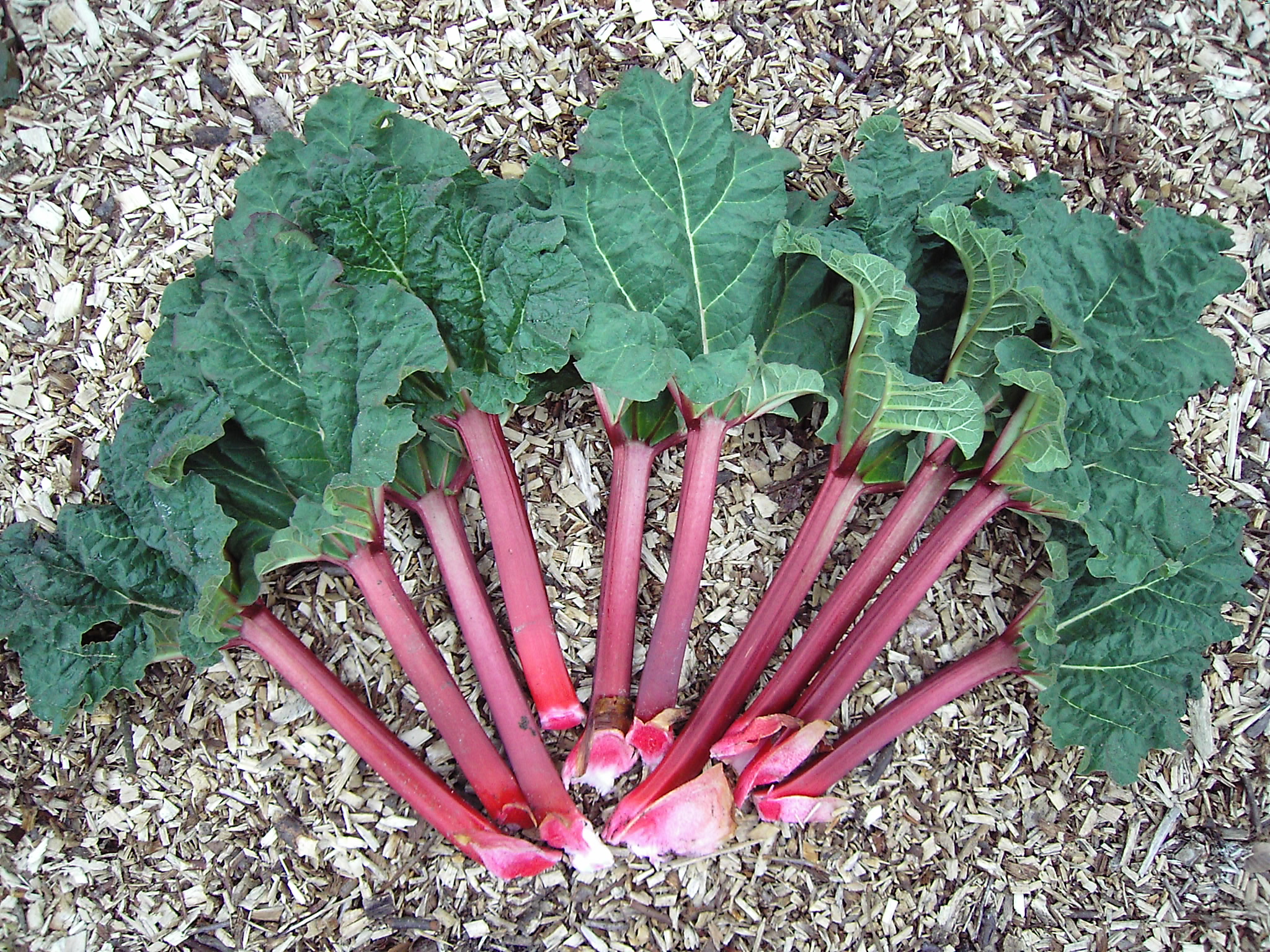
Rheum is a genus of roughly 60 herbaceous perennial plants in the family Polygonaceae, order Caryophyllales. Plants are typically robust perennials with large, somewhat triangular to palmately lobed leaves borne on long, fleshy petioles — the petioles of several species being the familiar edible rhubarb stalks. Flowers are small, greenish-white to rose-red, and arranged in compound leafy inflorescences. The tart flavour associated with culinary rhubarb comes from nontoxic malic acid in the stalks; oxalic acid is present throughout the plant and renders the leaf blades toxic in large quantities.
The genus was formally described by Carl Linnaeus in 1753, initially with three species. Modern circumscriptions range from around 12 to 56 accepted species depending on authority; Plants of the World Online currently recognises 56. Species are native primarily to eastern Europe, Central Asia, and temperate to subtropical Asia, with Central Asia representing the centre of diversity. The genus has been introduced into cultivation across North America and Europe. Within Polygonaceae, Rheum sits in tribe Rumiceae alongside Rumex and Oxyria, with Rumex as its closest relative.
Beyond the kitchen, the genus has deep roots in traditional medicine, particularly in Asia where rhubarb root preparations have been used for over two millennia. Several species — notably Rheum officinale and R. palmatum — remain important in herbal pharmacopeias today. Ecologically, Rheum species support numerous Lepidoptera larvae and play a documented role in the early-spring nutrition of Himalayan brown bears.
Etymology
The genus name Rheum derives from the Greek rheon, a term used by the first-century Greek physician Dioscorides as an alternative name for medicinal rhubarb. The Greek word itself is thought to trace back to old Persian rewend. An ancient alternative theory links the Greek word rha — another early name for rhubarb — to the Scythian name for the Volga River, along whose banks rhubarb was said to grow in antiquity.
Distribution
Rheum species are native to a broad belt running from eastern Europe (Bulgaria) eastward through temperate and montane Asia to northern Indo-China. The core native range encompasses Afghanistan, Iran, the Himalayas, Mongolia, and central and southwestern China, with Central Asia representing the region of greatest species diversity. A few species extend into northern tropical Asia. The genus has been introduced into cultivation widely across Europe and North America, where several species and cultivars are naturalised or locally persistent outside gardens.
Ecology
Rheum species occupy a variety of temperate and montane habitats, from open steppes and rocky slopes to alpine meadows at high elevations in the Himalayas and Central Asia. Several Lepidoptera species use Rheum as larval food plants, including the buff ermine moth (Spilarctia luteum), the garden tiger moth (Arctia caja), and Xestia baja. In Central Asia, the Middle East, and Turkey, Rheum serves as a host for myrmecophilous Callophrys butterfly caterpillars that associate with ant colonies.
The large, fleshy leaves of early-emerging species are ecologically significant food sources. In Kyrgyzstan's Taldy-Bulak valley, the emerging leaves of R. maximowiczii provide critical early-season nutrition for Himalayan brown bears coming out of hibernation. Specialist herbivorous beetles have also been recorded on R. ribes in eastern Turkey.
Cultivation
Many Rheum species and cultivars have been brought into cultivation for food, medicine, and ornament. Culinary rhubarb (principally R. rhabarbarum and its hybrids) is grown as a hardy perennial vegetable in cool temperate climates, valued for its early-spring harvest and tolerance of hard frosts. Ornamental species cultivated for garden use include R. acuminatum, R. alexandrae, R. australe, R. kialense, R. palmatum, and R. ribes, grown for their bold foliage and architectural form.
All parts of the plant contain some oxalic acid; leaf blades should not be eaten and can be harmful to livestock in quantity. Gardeners and growers are advised to dispose of leaf blades rather than composting them in large amounts.
Cultural uses
Rhubarb's use as a medicine dates back over 2,000 years in Asia. The roots and rhizomes of R. officinale and R. palmatum are the principal sources of traditional rhubarb drugs used in Chinese, Tibetan, and other Asian medical systems, with applications ranging from laxative and digestive treatments to anti-inflammatory preparations. Rhubarb was among the most prized and expensive herbal commodities reaching medieval Europe via overland trade routes.
In the culinary domain, the tart petioles of domesticated R. rhabarbarum and hybrid cultivars (R. × hybridum) are used in pies, crumbles, jams, and compotes across Europe and North America. The edible portions owe their sourness to malic acid, not to oxalic acid (which accumulates in the leaf blades and is toxic in large doses). Beyond food and medicine, R. macrocarpum roots are used as a yellow-orange dye in the Tian-Shan region of Central Asia.
Taxonomy
Rheum was first formally described by Carl Linnaeus in his 1753 Sp. Pl. (p. 371) with three species: R. rhaponticum, R. rhabarbarum, and R. ribes. The genus belongs to family Polygonaceae, order Caryophyllales, within the subfamily Polygonoideae and tribe Rumiceae. Molecular and morphological work places Rheum as most closely related to Rumex, with Oxyria as a more distant ally.
Infrageneric classification remains unsettled. A.R. Li's widely cited treatment divides the genus into five sections: sect. Rheum (mid-sized species with entire leaves), sect. Deserticola (small desert-adapted species), sect. Nobilia (large monocarpic alpine species), sect. Palmata (the largest rhubarbs, to 2 m, with lobed leaves), and sect. Spiciforma (stemless high-altitude species). Accepted species counts across authoritative sources range from around 12 to 56, with POWO currently recognising 56. The sole generic synonym is Rhabarbarum Fabr. (1759).










