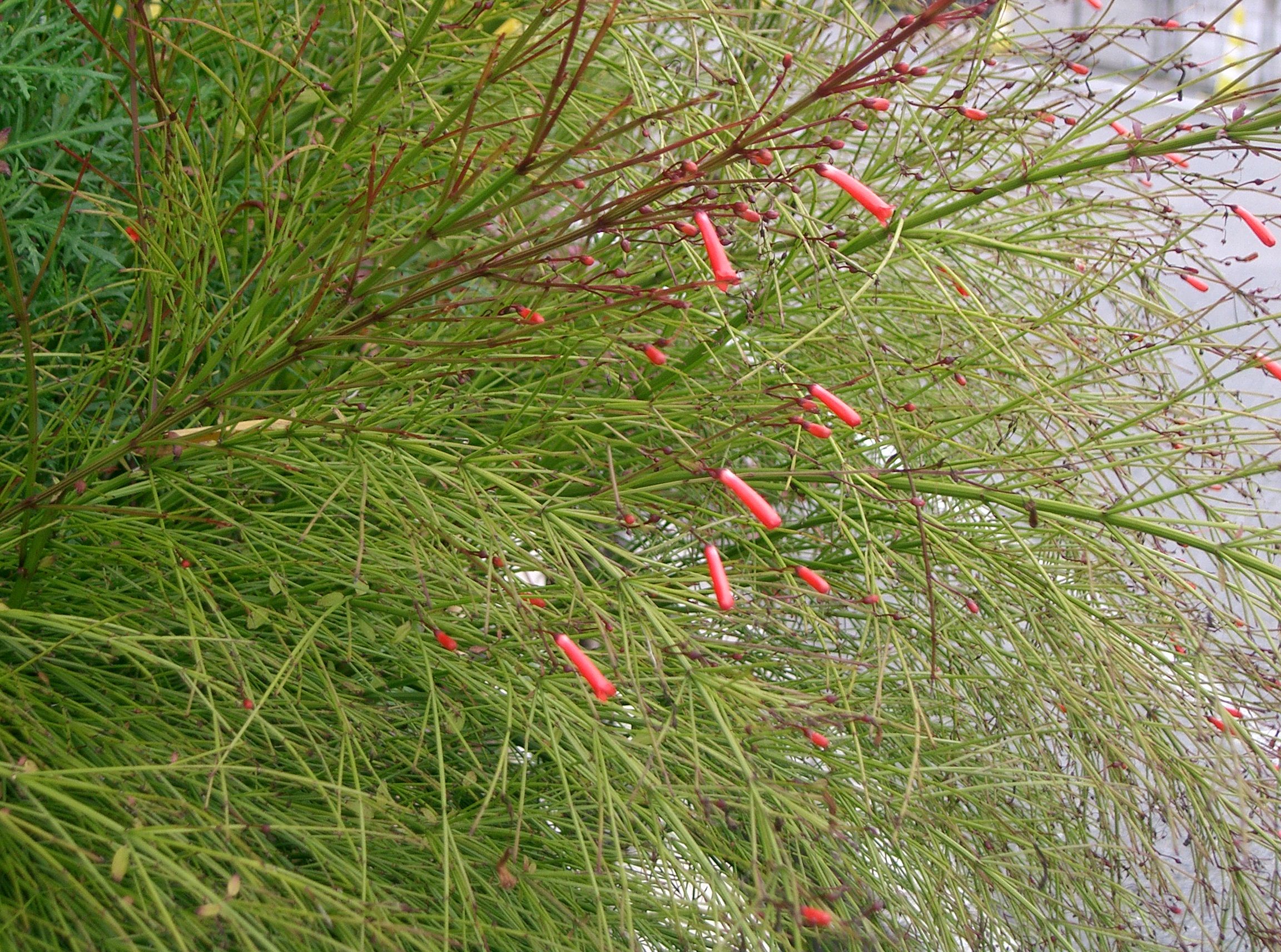
Russelia is a genus of evergreen flowering shrubs in the plantain family Plantaginaceae (order Lamiales), occasionally classified under the older families Scrophulariaceae or Veronicaceae. The genus is best known by its common names firecracker plant and coralblow, reflecting the vivid tubular red to orange flowers that cascade from arching, rush-like stems.
Plants in the genus typically grow to around 1.8 m (6 ft) tall, with slender, jointed, largely leafless stems that give them a distinctive wispy, fountain-like silhouette. They are evergreen and bloom throughout most of the year in suitable climates. Species are noted for being mildly drought resistant and tolerant of a range of light conditions from full sun to partial shade, which makes them popular in warm-climate gardens worldwide.
The most widely cultivated species, Russelia equisetiformis (firecracker plant), together with Russelia sarmentosa, are frequently used as ornamental ground covers to conceal retaining walls, fences, and embankments, forming dense, fast-growing masses of foliage and flowers. Their brightly coloured blossoms attract hummingbirds, butterflies, and bees, making them valuable for wildlife gardening.
The genus was named in honour of Alexander Russell (1715–1768), a Scottish naturalist and physician. It belongs to a diverse and largely tropical and subtropical group, with its native range centred in Mexico and Mesoamerica, though species have become naturalised or are cultivated across many parts of the world.
Etymology
The genus name Russelia honours Alexander Russell (1715–1768), a Scottish physician and naturalist. Members are popularly known as firecracker plants or coralblows, names that allude to the vivid, tubular red and orange flowers that erupt along the arching stems.
Distribution
Russelia is native to Mexico and Mesoamerica, with the centre of diversity in Mexico. Species have been widely introduced through cultivation and are now grown throughout tropical, subtropical, and warm-temperate regions worldwide, particularly in gardens across Asia, the Pacific, Africa, and the Americas.
Cultivation
Russelia species thrive in full sun to partial shade and are notably drought tolerant once established, requiring only moderate water. They perform best in well-drained soils in frost-free climates (USDA zones 9–11) but can be grown as container plants in cooler regions. Fast-growing and evergreen, they are commonly planted as informal hedges or cascading ground covers to mask walls and fences, and are especially effective in wildlife gardens for attracting hummingbirds and pollinating insects. Little pruning is required; cutting stems back after a flush of blooming encourages fresh growth.










